Targeting Life Skills in 4-H
Life Skills
A skill is a learned ability. Life Skills are those competencies that assist people in functioning well in the environments in which they live. Youth development professionals are concerned with helping youth become competent in the life skills that will prepare them for transition to adulthood. Helping youth meet their basic needs and develop the competencies important to their immediate and future success is the role of the youth development professional. 4-H focuses on developing skills that are healthy and productive for both youth and their communities.
Positive youth development programs identify the skills within the five targeted competency areas that are appropriate to the age of the youth in the program and offer experiences to teach these skills. Because skills are best learned through practice, many experiences that teach or reinforce skills must be provided. Mastery of any skill requires opportunities to try, make mistakes, and try again.
Skills are learned in sequential steps related to the age and stage of development of the young person. Consequently, it is important to understand the developmental tasks and characteristics common to the ages of the youth with whom you work.
Youth development professionals are expected to have and apply this knowledge.
The 4-H Framework
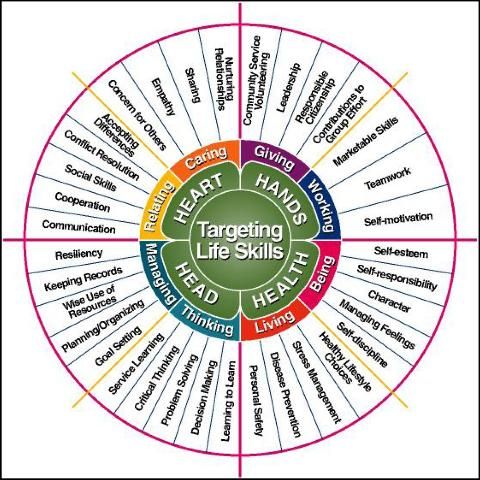
4-H uses a framework based upon the 4-H Pledge to organize the delivery of experiences that support the growth and development of youth. 4- H refers to this framework as a "Targeting Life Skills Model" (Hendricks, 1998). This model addresses the skills within the five competency areas that youth development traditionally addresses. These are noted in the following description of the model.
In this framework, two of the competencies have been combined in order to fit the four-category structure of the pledge. The important point, however, is that the skills needed for positive growth and development are addressed through 4-H delivery format. Because these skills are inter-related, the categories in which they are placed could vary with organizational structures.
4-H Focus of Youth Competencies
HEAD: Knowledge, Reasoning, and Creativity Competencies
Thinking: using one's mind to form ideas and make decisions; to imagine, to examine carefully in the mind, to consider. Managing: using resources to accomplish a purpose.
HEART: Personal/Social Competencies
Relating: establishing a mutual or reciprocal connection between two people that is wholesome and meaningful to both. Caring: showing understanding, kindness, concern and affection for others.
HAND: Vocational/Citizenship Competencies
Giving: Providing, supplying, or causing to happen (social responsibility). Working: Accoplishing something or earning pay to support oneself through physical or mental effort.
HEALTH: Health/Physical Competencies
Living: Acting or behaving; the manner or style of daily life. Being: living one's life; pursuing one's basic nature; involved in personal development.
Life Skills Developed through 4-H
The following chart lists the specific skills that lead to mastery in the four categories and eight subcategories of the 4-H Targeting Life Skills Model.
The following graphic represents a system for targeting skills that lead to mastery of targeted competencies. These are life skills and it is these skills that 4-H addresses. It is important to know this 4-H framework as well as the structure a youth program uses to organize the competencies it targets. By understanding both structures, professionals, volunteers and parents will know the expectations each organization has for staff and participants and will be able to partner more effectively.