


Liner Production of Florida Native Wildflowers by Seed1
Demand for native wildflowers and grasses has increased since the late 1980s to early 1990s as a result of the surge in interest in use of native species, especially native plants that are adapted to Florida conditions. Growers of native plants are trying to keep up with demand but frequently have to work out production protocols because such information is limited.
In this publication we describe in detail the methods that we have successfully used to produce liners of Florida native wildflowers (Table 1) under greenhouse conditions. Information is based on production of "2-inch" liners that could be sold or used as transplants in 4-inch, 1-qt. or 1-gal. containers (Figure 1), or they could be transplanted to the field.
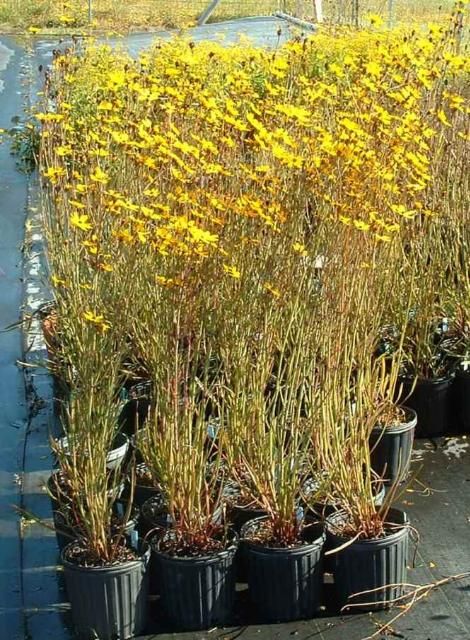
While this information is based on our experience with non-varietal germplasm, the methods would be suitable for use with many types of wildflower seeds.
Seeds
Seeds in bulk or packets are available from the Florida Wildflower Seed and Plant Growers Association, also known as the Florida wildflower seed coop. Seeds that are not sown soon after purchase should be stored in a cool, dry environment where the sum of the temperature (°F) and relative humidity do not exceed 100. For long-term storage, place seeds in an airtight container with a tight fitting lid, or a freezer bag, and store them in a refrigerator. When it's time to sow the seeds, let the cold container sit at room temperature for a few hours so that any seeds that are not used will not get moist. Water will condense on the surface of cold seeds; moist seeds have very short shelf life.
Liner Production
General Sowing Protocol
Sow seeds about 2 months before finished liners are needed. For spring-flowering species to be ready in March in north Florida, sow seeds the first or second week of January. For fall-flowering species, sow seeds in mid-spring to mid-summer.
Special Sowing Protocols
Swamp or Pink Coreopsis (Coreopsis nudata)—Harvest seed heads soon after the petals drop off and while the seed heads are green or reddish green. Break up the seed heads by hand and sow the green, immature seeds the same day of harvest.
The later that seeds are sown, the smaller the liners will be when ready for sale, repotting, or transplanting (Figure 2). Delayed seeding is used to ensure that liners of tall species like Florida coreopsis (Coreopsis floridana) do not outgrow containers and to minimize the likelihood of the plants falling over because they are top heavy.
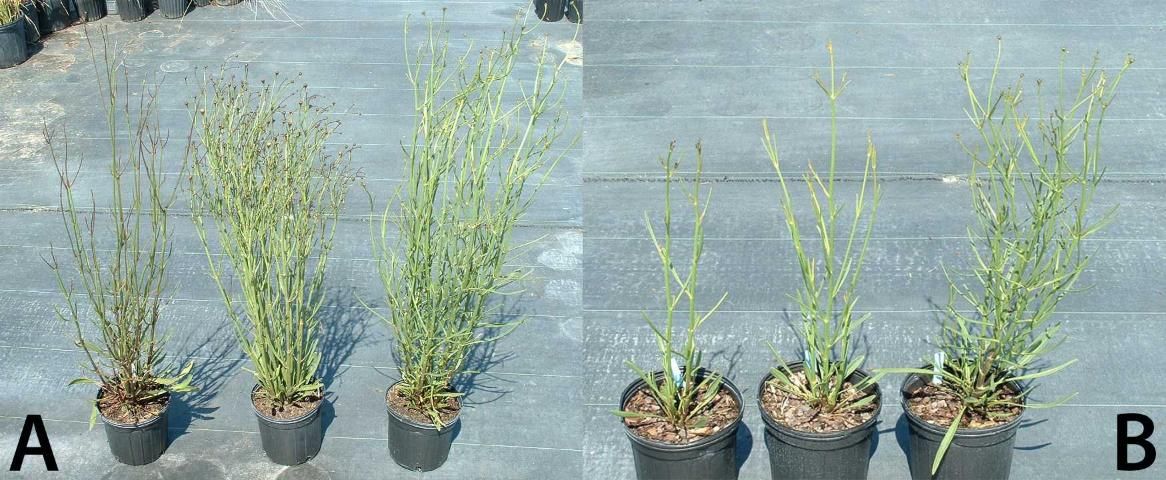
Fill seedling flats with fine-textured, soilless substrate designed for germinating seed, such as Metro Mix 200®. Substrates such as Metro Mix 200® are fine textured enough to ensure contact with the seeds and retain moisture for germination yet drain freely. Spread seeds as uniformly as possible over the surface of the substrate, and then lightly spread some dry substrate over the seeds. This light covering of substrate enhances seed uptake of moisture but still allows seeds to be exposed to light. Many wildflowers have small seeds that require light for germination. Small-seeded species may germinate, but not emerge if planted too deeply.
Place flats in greenhouse with thermostats set at 50°F and 90°F for heating and cooling (fan and pad), respectively. Irrigate flats so that the substrate remains moist. An automated, overhead mist system will ensure that substrate remains moist without disturbing the seeds or seedlings.
Weekly fertigation is started when most seedlings have emerged, which is about 10 to 14 days after seeds were sown. To minimize seedling disturbance, seedlings are fertigated from the bottom by placing flats in 11-inch x 21-inch x 4-inch (or larger) tubs containing a 100-ppm-N solution of a 15-30-15 water-soluble fertilizer. Once the surface of the substrate glistens with a film of water, flats are removed and drained. Slow release fertilizers can also be used in place of the weekly fertigation with good results.
About 1 month after seeds are sown, transplant seedlings into cell packs that are composed of 48 "2-inch" cells (actual dimensions are 2 1/4 inches x 1 5/8 inches x 2 1/4 inches) and are filled with the same substrate used for germinating the seedlings (Figure 3).
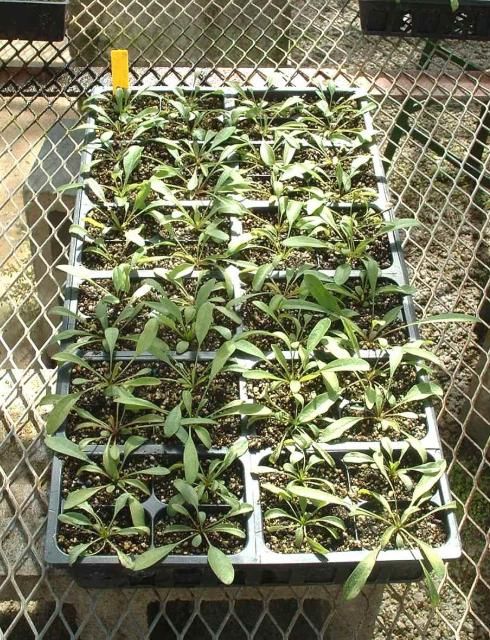
These cell packs fit within a 11-inch x 21-inch flat. Fertigate seedlings weekly as described before.
After 1 month, seedlings in cell packs (Figure 4) are ready for sale or transplanting to 4-inch, 1-qt. or 1-gal. containers, or they can be transplanted to a field production site. Seeds can also often be planted right into quart or gallon containers to avoid the 2-step method.
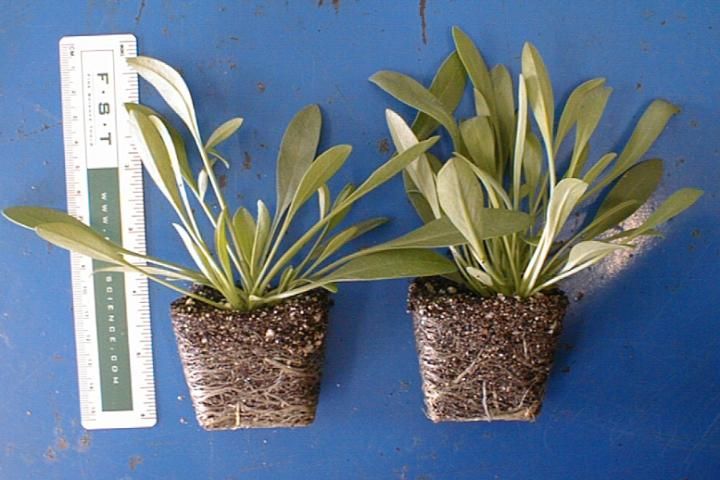
NOTE: In central and south Florida, liner production times might be compressed by a week or two due to warmer temperatures.
Reference
Ingram, D.L. and T.H. Yeager. 1991. Propagation of landscape plants. Gainesville: University of Florida Institute of Food and Agricultural Sciences. http://ufdc.ufl.edu/IR00003393/00001