


Passiflora incarnata Wild Passion Flower, Maypop
Introduction
Maypop is undoubtedly the showiest of the native Passiflora species. It is an evergreen, flowering vine that climbs by tendrils. Its height and spread varies depending on the structure it climbs on. The flower is a spectacular pink and purple and generally reaches a width of 3 to 5 inches. Each unique flower lasts about one day, appearing in the summer and early fall. The flowers fill the plant, making maypop a fine flowering plant for most of Florida. The leaves have three lobes and smooth margins. Ovoid, green fruits are abundantly produced and can be found on the vine along with the flowers. Fruits are light weight and the flesh is spongy and white. They are attractive and edible (but not very tasty) and attain a diameter of 2 ½ to 3 inches.
General Information
Scientific name: Passiflora incarnata
Pronunciation: pass-siff-FLOR-ruh in-kar-NAY-tuh
Common name(s): wild passion flower, maypop
Family: Passifloraceae
Plant type: vine
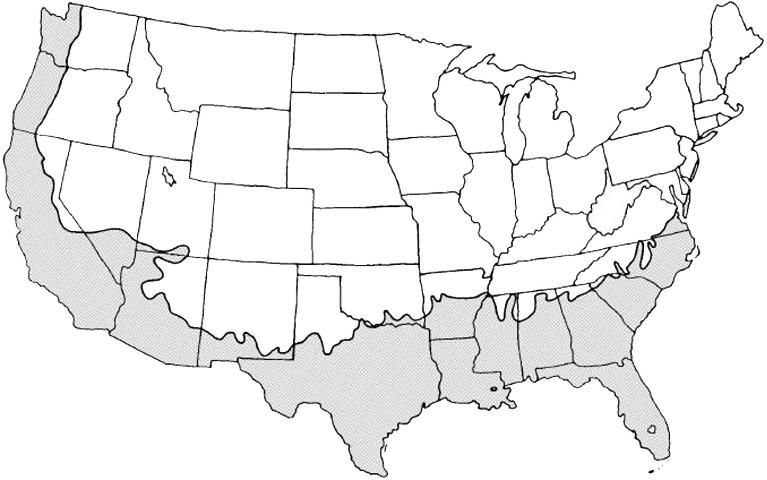
USDA hardiness zones: 7B through 11 (Fig. 1)
Planting month for zone 7: year round
Planting month for zone 8: year round
Planting month for zone 9: year round
Planting month for zone 10 and 11: year round
Origin: native to Florida
Uses: attracts butterflies; attracts hummingbirds; cascading down a wall
Availability: somewhat available, may have to go out of the region to find the plant
Description
Height: depends upon supporting structure
Spread: depends upon supporting structure
Plant habit: spreading
Plant density: dense
Growth rate: fast
Texture: medium
Foliage
Leaf arrangement: alternate
Leaf type: odd-pinnately compound
Leaf margin: serrate
Leaf shape: ovate
Leaf venation: parallel; pinnate
Leaf type and persistence: evergreen
Leaf blade length: 4 to 8 inches
Leaf color: green
Fall color: no fall color change
Fall characteristic: not showy
Flower
Flower color: pink; purple
Flower characteristic: summer flowering; fall flowering
Fruit
Fruit shape: oval
Fruit length: 1 to 3 inches
Fruit cover: fleshy
Fruit color: green
Fruit characteristic: suited for human consumption
Trunk and Branches
Trunk/bark/branches: not applicable
Current year stem/twig color: green
Current year stem/twig thickness: medium
Culture
Light requirement: plant grows in full sun
Soil tolerances: occasionally wet; acidic; slightly alkaline; sand; loam; clay
Drought tolerance: high
Soil salt tolerances: moderate
Plant spacing: 36 to 60 inches
Other
Roots: not applicable
Winter interest: no special winter interest
Outstanding plant: plant has outstanding ornamental features and could be planted more
Invasive potential: aggressive, spreading plant
Pest resistance: long-term health usually not affected by pests
Use and Management
Maypop can be supported on a fence, trellis, or arbor. Members of this genus are often grown for their attraction to butterflies. Try this one for a nice addition to your native landscape. Fertilize two or three times each year to maintain vigorous growth.
Passion flowers are drought tolerant and can be grown in different soils. They can be found growing close to the beach on other shrubs and small trees in north and central Florida. This plant does require a position in the landscape that receives full sun for best flowering.
There are at least five other native species of Passiflora in Florida: lutea, multiflora, pallens, sexflora, and suberosa. Passiflora incarnata is by far the most showy with pink and purple 4-inch-wide flowers appearing in the warm months. Although its natural range extends only slightly into south Florida, it can probably be grown in most of south Florida with little trouble. In most cases, this plant would be preferable over introduced species such as Passiflora foetida which has become invasive in Palm Beach County and is spreading.
The wild passion flower is propagated by seeds or cuttings.
Pests and Diseases
Nematodes can be a serious problem.
Caterpillars slow growth by eating foliage.

