


Introducing Ecotourism to Florida's Counties and Landowners: An Ecotourism/Nature Based Tourism Fact Sheet1
Ever since the origins of tourism, travelers have been moved by, and drawn to, nature and protected areas. While the global tourism industry has grown immensely over the last several decades, tourism to natural areas has become an even greater component of that large industry and is has continued to grow throughout the 2020s (MarketWatch, 2020).
In the United States, natural areas became tourism destinations in the late 19th century when the federal government designated Yellowstone, Yosemite, and Grand Canyon national parks due, in part, to intense lobbying from the railroad industry, whose interest was in catering to tourists. Internationally, nature-based tourism gained popularity with the environmental movement in the 1970s and tourists' desires to learn about ecosystems and cultures other than their own.
Nature-based tourism is not ecotourism. Throughout the world, and particularly in Florida, tourism can dramatically affect cultures, environments, and economies—and not always for the better. As defined in this paper, ecotourism is a concept of managing and planning the nature-based tourism industry so it provides for desired benefits. Many people see ecotourism as an alternative to mass tourism and the many negative social and cultural problems that have been associated with it, including loss of community culture, destruction of sensitive ecosystems, and the leakage of profits estimated as high as 50–90%. However, when nature-based tourism is planned and well managed, it can provide income to a diversity of local residents; conserve rural and natural areas; educate people about little known natural, cultural, and historical wonders; and numerous other benefits.
Ecotourism and Nature-Based Tourism Defined
As defined below, nature-based tourism simply describes a type of tourism where nature is the attraction. Ecotourism is more of a concept or philosophy that can guide the planning and management of nature-based tourism (Stein 2004).
Nature-Based Tourism
"Nature tourism involves travel to unspoiled places to experience and enjoy nature" (Martha Honey 2008)
Ecotourism
Researchers and practitioners most commonly use two definitions of ecotourism:
"Responsible travel to natural areas that conserves the environment and improves the well-being of local people, and involves interpretation and education." (The International Ecotourism Society 2015)
"Environmentally responsible travel and visitation to relatively undisturbed natural areas in order to enjoy and appreciate nature (and any accompanying cultural features—both past and present) that promotes conservation, has low visitor impact, and provides for beneficially active socio-economic involvement of local populations." (Héctor Ceballos-Lascurain and The World Conservation Union (IUCN) 1996)
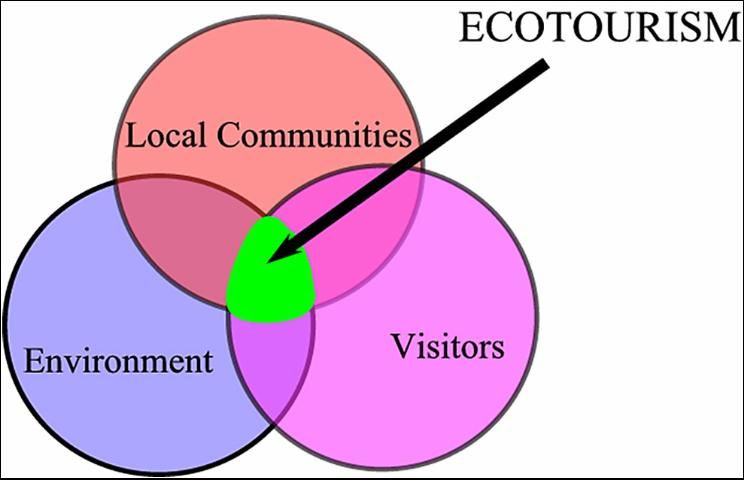
The concept of ecotourism argues that tourism should work to conserve the environment, enhance the quality of life of the resident community, and improve the tourism product and services (Figure 1). In addition, tourism can provide many opportunities for on-site educational and interpretive programs, which play an important role in conserving natural and rural landscapes and connecting visitors with nature (Kimmel 1999).
Credit: UF/IFAS (2006)
Nature-Based Tourism Statistics
A 2011 survey found that 6.4 million Florida residents and nonresidents, 16 years-old and older participated in some sort of wildlife-recreation activity (i.e., fishing, hunting or wildlife watching)and spent $9.0 billion (US Fish and Wildlife Service 2012).
Nearly half of Americans participated in at least one outdoor recreation activity in 2015, which equates to 142.4 million participants, who went on almost 12 billion outdoor outings (The Outdoor Foundation 2016).
Americans spend $887 billion annually participating in outdoor recreation supporting 7.6 million American jobs (Outdoor Industry Association 2017).
About 20% of total international travel focuses nature as the attraction (UNWTO 2014).
Nature-Based Tourism: Positive and Negative Aspects
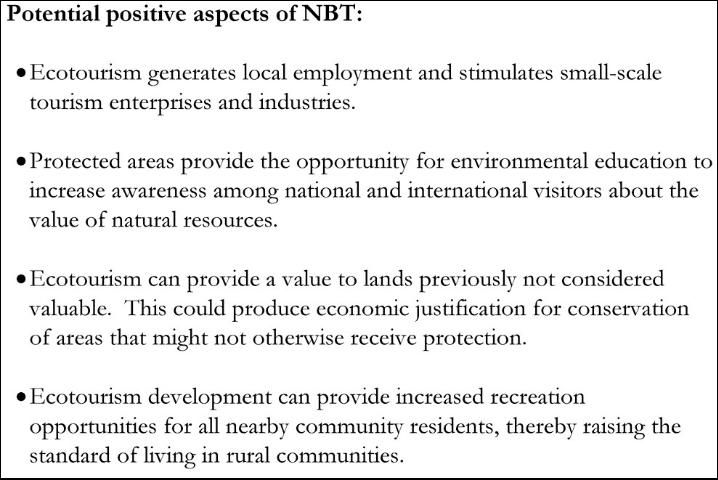
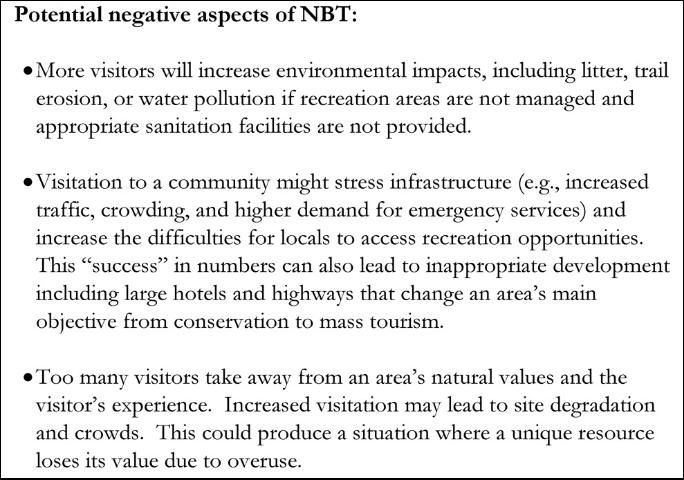
Nature-based tourism can have both positive and negative impacts on an area (Figures 2 and 3). On the positive side, nature-based tourism generates local employment and stimulates small-scale tourism enterprises and industries including lodging, restaurants, transportation, souvenirs and handicrafts, and guide services. In areas that might not otherwise receive any protection, nature-based tourism can sometimes be the economic justification for conservation. In some situations, nature-based tourism can also represent a viable economic alternative to unprofitable, and sometimes unsustainable, forestry and agriculture practices (Boo 1990).
Credit: UF/IFAS (2006)
Credit: UF/IFAS (2006)
Community-Based Ecotourism
Actually planning and managing for ecotourism at the community level in Florida is a complicated practice. It requires knowledge of ecological systems, community planning, tourism development, and recreation resource management. The model often practiced in Florida, and the rest of the United States, consists of local businesses identifying ways to cater to people who visit publicly managed natural areas (Stein 2004). Little collaboration may exist between the public land management agency and the surrounding communities that could potentially benefit from tourism. This disjointed approach leads to a hodgepodge of tourism efforts that may not meet the needs of the visitor or the natural area. Throughout the world, research shows that successful collaboration between multiple stakeholders is one of the best ways to realize the ecotourism concept. Several approaches to tourism collaboration are described below.
Family or group initiatives within communities (Wesche and Drumm 1999). This model involves voluntary participation among community members. It is a flexible model and arrangements between individuals can be adjusted or changed. Labor and services are contracted within the community and members of the community can join the group to sell handicrafts or provide other services. This high involvement of community members helps to sustain benefits for the entire area by keeping decision-making and economic activities locally based. Often, family members lead tours and provide tourism services. They also work with their neighbors to build upon the services they offer.
There are few examples of this model in Florida. However, small communities like High Springs and Apalachicola have succeeded in catering to tourists while maintaining local control over the tourism enterprise. The Florida Scenic Highway Program is another example of a collaboration effort that works to involve local residents in developing a large-scale tourism initiative (Florida Department of Transportation 2020).
Joint ventures between a family or community and an outside partner (Wesche and Drumm 1999). This model involves two distinct kinds of joint venture agreements:
In the first type of joint venture agreement, someone from outside the community supplies the tourists and transportation to the community or location. The local resident(s), in turn, takes care of logistics (the program and arrangements within the community, such as arranging local lodging, activities, and dining). For example, Holbrook Travel, based in Gainesville, Florida, has conducted several tours in Florida where it pays a guide who serves as a naturalist and takes tourists throughout the state. The company makes arrangements with lodging, restaurants, and parks to host the residents.
In the second type of joint venture agreement, the outside partner signs a contract or lease with the community and is responsible for managing (and sometimes building) tourism facilities and services at a particular recreation site. In return, employment and other specified benefits for the community are established and guaranteed. Several public land management agencies in Florida contract with local businesses to provide recreation and tourism services on public lands. For example, the US Forest Service contracts with a recreation management company to manage most of its recreation sites in the Ocala National Forest. Although the company is national, it hires local residents to manage and maintain the facilities. In addition, Florida state parks often contract with concessionaires to offer a variety of services to tourists, which the agency would not normally provide. For example, Little and Big Talbot Islands State Park contracts with a locally owned kayak outfitter company to work in the park and provide tours for its visitors.
Making Ecotourism Happen in Florida
Every situation will not always fit the above models. However, there are numerous examples of successful nature-based tourism development in Florida, which can likely assist the development of new nature-based tourism initiatives throughout Florida. The following section briefly describes these examples and provides websites to access more information.
Suwannee River Wilderness Trail https://www.floridastateparks.org/parks-and-trails/suwannee-river-wilderness-state-trail [27 June 2020]
This cooperative effort between the Suwannee River Water Management District (SRWMD), the Florida Department of Environmental Protection (FDEP), and the Suwannee River Basin communities (businesses and citizens) is an example of a public/private partnership in Florida. The 207 miles of Suwannee River trail creates connections between the existing eight state parks along the river, the six riverfront communities, and the many recreational and ecotourism businesses. Amenities include existing and planned sleeping platforms, cabins, information sites, and other public and private facilities.
Florida Keys Overseas Heritage Trail https://www.floridastateparks.org/trail/Florida-Keys [27 June 2020]
This project was developed in partnership between Clean Florida Keys (CFK), the Florida Department of Transportation (FDOT), Florida Department of Environmental Protection (FDEP), Monroe County, the Rails-to-Trails Conservancy, and the National Park Service.
The trail spans from Key West to Key Largo for 110 miles connecting 10 state parks and provides educational opportunities to learn not only about sustainable development but also about the history of the Florida Keys. In addition, this project provides access to local businesses and promotes recreational opportunities, as well as offers an alternative form of transportation and decreases highway congestion.
Great Florida Birding and Wildlife Trail http://floridabirdingtrail.com/ [27 June 2020]
The Florida Fish and Wildlife Conservation Commission (FWC) established the Great Florida Birding Trail in the early 2000 in eastern Florida, and it has evolved throughout the state to encompass birding and wildlife viewing. Working with the Fish and Wildlife Foundation of Florida, the FWC provides a comprehensive website, trail guides, and electronic guides, which allows birding and wildlife viewers a wealth of information to plan a nature tour throughout Florida. Tourism businesses can work with the FWC to be listed on the Trail or partner with existing birding and wildlife sites currently listed.
Conclusion
The concept of ecotourism is important to keep in mind as Floridians develop nature-based tourism that creates employment and socio-economic opportunities for local communities while striving to protect and preserve Florida's many unique natural and cultural areas. Nature-based tourists need protected areas, protected areas need the revenue that nature-based tourism generates and the exposure tourists bring, but both must be carefully managed. These potential benefits are not ensured and will only be achieved with careful planning, local education and training, and local involvement. Bringing visitors, the environment, and local communities together in a planned, cohesive manner can produce benefits for all three of these cornerstones of ecotourism.
References
Boo, E. 1990. Ecotourism: The Potentials and Pitfalls. Vol I and II. World Wildlife Fund: Washington, D.C.
Ceballos-Lascurain, Héctor. 1996. Tourism, Ecotourism, and Protected Areas: The State of Nature-based Tourism Around the World and Guidelines for Its Development. IUCN: Cambridge. [The World Conservation Union].
Florida Department of Transportation. 2020. "Florida Scenic Highway." Available at https://www.fdot.gov/designsupport/highwaybeautification/scenichighways (accessed June 27, 2020).
Honey, M. 2008. Ecotourism and Sustainable Development: Who Owns Paradise. Island Press, Washington DC, Covelo CA.
International Ecotourism Society. 2015. "What is ecotourism?" Available at http://www.ecotourism.org/what-is-ecotourism (accessed June 13, 2017).
MarketWatch 2020. "Ecotourism Market Size Rising at More than 14% CAGR During 2019-2026: Analysis of Key Players, Trends and Drivers" Available at https://www.marketwatch.com/press-release/ecotourism-market-size-rising-at-more-than-14-cagr-during-2019-2026-analysis-of-key-players-trends-and-drivers-2020-04-20 (accessed June 27, 2020)
The Outdoor Foundation. 2016. Outdoor Recreation Participation: Topline Report 2016. The Outdoor Foundation: Washington, D.C.
Outdoor Industry Association. 2017. The Outdoor Recreation Economy. Outdoor Industry Association: Boulder, CO.
Stein, T.V. 2004. "Things to know about offering nature-based tourism on private forestlands in Florida." Florida Forests. 8(1): 6–10.
UNWTO. 2014. Global Report on Adventure Tourism. World Tourism Organization: Madrid, Spain.
US Fish and Wildlife Service. 2014. 2011 National Survey of Fishing, Hunting, and Wildlife-associated Recreation – Florida. U.S. Fish and Wildlife Service: Washington, D.C.
Wesche, R. and A. Drumm. 1999. Defending our rainforest: A guide to community based ecotourism in the Ecuadorian Amazon. Acción Amazonia.