
Potato Physiological Disorders—Growth Cracks
Growth cracking is an external noninfectious physiological disorder of the potato tuber in which the tuber splits while growing. The split heals but leaves a fissure in the tuber. Growth cracks generally start at the bud or apical end of the potato and can extend lengthwise. They vary in severity from a surface abrasion to a split through the tuber, depending on the stage of growth during which the initial cracking occurred (Figure 1).
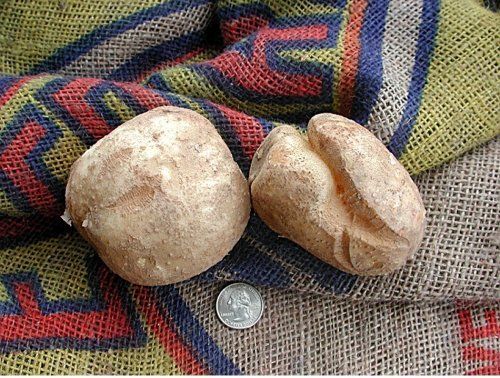
Credit: C. Hutchinson, UF/IFAS
Even though cracking does not usually predispose the tuber to rotting, growth cracks can negatively impact potato tuber quality. Growth cracks make fresh-market tubers unattractive. Severe growth cracks can even impact the quality of chip potatoes and affect processing (Figure 2).
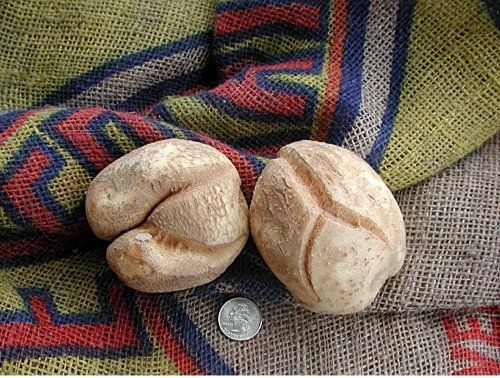
Credit: C. Hutchinson, UF/IFAS
Growth cracks form due to fluctuating environmental conditions, such as uneven soil moisture, soil and air temperature, and rapid water uptake and tuber growth (Hiller and Thornton 2008; Jefferies and MacKerron 1987). Growth cracks increase when relatively poor growing conditions are rapidly followed by relatively good growing conditions, such as prolonged moisture stress or high temperatures followed by excessive irrigation or rainfall (Selman et al. 2008). The severity of growth cracks is increased in plants that are widely spaced or planted at unusually low densities, and it is also made worse if fertilizer is applied unevenly. This is especially true when nitrogen fertilizer is applied in excess or when the application of nitrogen fertilizer is not properly timed. There is also a link between low boron levels in the soil and increased intensity of growth cracks (Hiller, Koller, and Thornton 1985). There is evidence that potato plants infected with viruses that exhibit mosaic symptoms (mottling coloration on the leaves) have increased incidence of growth cracks (Carnegie and McCreath 2010). There are differences in the susceptibility of potato varieties to growth cracks. 'Atlantic', the most widely grown potato for chip processing in Florida, and 'Red Lasoda', a common variety for table-stock, are relatively susceptible to the disorder. The Florida Potato Variety Trials have shown that most of the standard varieties grown in Florida (e.g., 'La Chipper', 'Harley Blackwell', etc.) are not susceptible in most years, but weather has influenced the incidence, especially in hot and wet years (Figure 3).
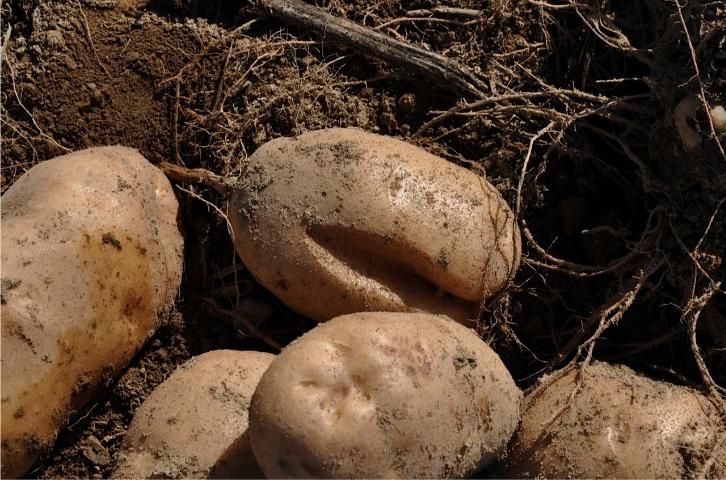
Credit: L. Zotarelli, UF/IFAS
To reduce the incidence of growth cracks, maintain proper soil moisture during the season. This is especially important during the bulking stage when the plants are large and tubers are rapidly expanding. In Florida, this stage occurs late in the season when air and soil temperatures increase quickly. Large plants and expanding tubers require more water to maintain good growth. Other recommendations to reduce the incidence of growth cracking include spacing plants uniformly, applying irrigation evenly to keep soil moisture levels consistent, and ensuring accurate application amounts and fertilizer placement.
The only recourse when the incidence of severe growth cracks is high is to select out tubers with severe growth cracks prior to packing and/or shipping.
Further Information
Bohl, W. H., and S. B. Johnson, eds. 2010. "Commercial Potato Production in North America: The Potato Association of America Handbook." The Potato Association of America. https://vric.ucdavis.edu/pdf/POTATOES/Commercial%20Potato%20Production%20in%20North%20America%202010.pdf
Zotarelli, L., P. D. Roberts, P. J. Dittmar, S. E. Webb, S. A. Smith, B. M. Santos, and S. M. Olson. 2012. Potato Production in Florida. HS733. Gainesville: University of Florida Institute of Food and Agricultural Sciences. https://edis.ifas.ufl.edu/publication/cv131
References
Carnegie, S. F., and M. McCreath. 2010. "Mosaic Virus Symptoms in Potato Crops and the Occurrence of Growth Cracking in Tubers." Potato Research 53(1): 17–24.
Hiller, L. K., D. C. Koller, and R. E. Thornton. 1985. "Physiological Disorders of Potatoes." In Potato Physiology, edited by P.H. Li, 389–455. New York: Academic Press.
Hiller, L.K., and R. E. Thornton. 2008. "Managing Physiological Disorders." In Potato Health Management: Plant Health Management Series, edited by D. A. Johnson, 235–245. St. Paul, MN: The American Phytopathological Society.
Jefferies, R. A., and D. K. L. MacKerron. 1987. "Observations on the Incidence of Tuber Growth Cracking in Relation to Weather Patterns." Potato Research 30(4): 613–623.
Selman, L., N. Andrews, A. Stone, and A. Mosley. 2008. "What's Wrong with My Potato Tubers? Diagnosing Tuber Abnormalities in Western Oregon and Washington." Oregon State University Extension Service and Western Region Sustainable Agriculture Research and Education. https://catalog.extension.oregonstate.edu/sites/catalog/files/project/pdf/em8948.pdf (July 2022)