


Potato Physiological Disorders—Brown Center and Hollow Heart
Brown center and hollow heart are internal noninfectious physiological disorders of the potato tuber. Brown center (also called incipient hollow heart, brown heart, or sugar center) is characterized by a region of cell death in the pith of the tuber that results in brown tissue. Hollow heart is characterized by a star- or lens-shaped hollow in the center of the tuber (Figure 1) (Hiller, Koller, and Thornton1985). Although brown center frequently precedes the development of hollow heart, both disorders often occur separately. Hollow heart may occur without being preceded by brown center (Hiller and Thornton 2008). The probability of brown center incidence that results in hollow heart is based on the rate of tuber growth following a period of stress (Hiller, Koller, and Thornton1985). The larger the tuber and the faster it grows, the greater the susceptibility of the tuber to incidence of hollow heart (Hiller, Koller, and Thornton1985). Neither disorder is initiated by a disease organism.
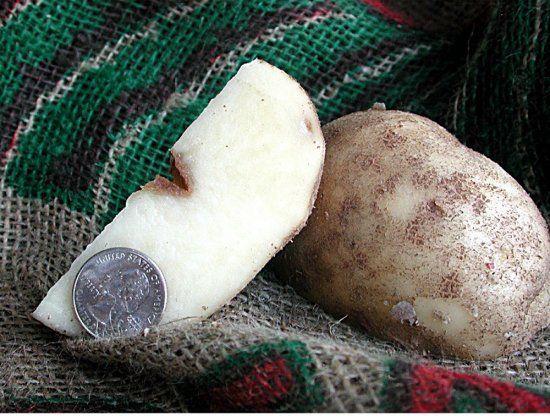
Credit: C. Hutchinson, UF/IFAS
Hollow heart and brown center negatively impact tuber quality. The disorders make cut fresh-market tubers unattractive and can reduce repeat sales. Severe hollow heart negatively impacts the quality of chip-processing potatoes and can result in shipments not making grade. However, neither disorder is reported as harmful and neither affects the tuber's taste or nutrition.
Brown center and hollow heart arise at a higher incidence when growing conditions abruptly change during the season, such as when potato plants recover too quickly after a period of environmental or nutritional stress. When the tubers begin to grow rapidly, the tuber pith can die and/or pull apart, leaving a void in the center. Brown center and hollow heart effects likely form during tuber initiation but could also form during tuber bulking (Christ 1998). If the disorder occurs during the early part of the season, then it is most often preceded by brown center and forms in the stem-end of the tuber, while late-forming hollow heart usually occurs near the bud-end with no brown center symptoms occurring (Christ 1998).
Damage to cells signaling the onset of brown center can occur under conditions such as when soil temperatures are less than 56°F for 5–8 straight days, or when available soil moisture is greater than 80% (Bussan 2008; Christ 1998; Van Denburgh, Hiller, and Koller 1986). Incidence of brown center and hollow heart also increases with periods of stress because of high or low moisture levels (Selman et al. 2008), especially if heavy water applications follow a period of stress because of low moisture levels (Christ 1998). Since large tubers are more prone to develop the disorder, and wide interplant spacing produces larger tubers, this situation can result in higher incidence of brown center and hollow heart (Christ 1998).
There are differences in the susceptibility of potato varieties to hollow heart and brown center. 'Atlantic', the most widely grown potato for chip processing in Florida, is relatively susceptible to both disorders. In 'Atlantic', hollow heart is often seen in conjunction with internal heat necrosis because both disorders are stress related. In 'Russet Burbank', susceptibility to both brown center and hollow heart is highest soon after tuber initiation when the tubers are small (McCann and Stark 1989). Results from the Florida Potato Variety Trials indicated very low incidence of brown center in Northeast Florida for most of the potatoes cultivated under seepage irrigation.
Grower decisions and management practices can be utilized to reduce the incidence of these disorders. Selecting potato varieties that are known to be less susceptible and delaying planting until soil temperature reaches adequate levels can lessen the occurrence of brown center and hollow heart (Christ 1998). Planting with larger seed pieces that are less aged can also reduce brown center and hollow heart risk because of increased stem number per seed piece (Hiller and Thornton 2008; Rex and Mazza 1989). Achieving recommended stand establishment, avoiding planting skips, and applying multiple small or split fertilizer applications (especially nitrogen) are practices that can reduce incidence of brown center and hollow heart (Hiller and Thornton 2008). Maintaining consistent soil moisture through uniform irrigation applications is also critical for avoiding the disorders (Hiller and Thornton 2008).
Rapid swings in air temperature and rainfall amounts cannot be avoided in Florida production areas. Therefore, it is necessary to properly manage seepage irrigation, nutrient balance, and seed spacing to reduce plant stress and the incidence of brown center and hollow heart.
Further Information
Bohl, W. H., and S. B. Johnson, eds. 2010. "Commercial Potato Production in North America: The Potato Association of America Handbook." The Potato Association of America. https://vric.ucdavis.edu/pdf/POTATOES/Commercial%20Potato%20Production%20in%20North%20America%202010.pdf
Zotarelli, L., P. D. Roberts, P. J. Dittmar, S. E. Webb, S. A. Smith, B. M. Santos, and S. M. Olson. 2012. Potato Production in Florida. HS733. Gainesville: University of Florida Institute of Food and Agricultural Sciences. https://edis.ifas.ufl.edu/publication/cv131
References
Bussan, A. J. 2008. "The Canon of Potato Science: 45. Brown Centre and Hollow Heart." Potato Research 50(3–4): 395–398.
Christ, B. J. 1998. "Identifying Potato Diseases in Pennsylvania." Penn State College of Agricultural Sciences. https://extension.psu.edu/identifying-potato-diseases-in-pennsylvania (July 2022)
Hiller, L. K., D. C. Koller, and R. E. Thornton. 1985. "Physiological Disorders of Potatoes." In Potato Physiology, edited by P.H. Li, 389–455. New York: Academic Press.
Hiller, L.K., and R. E. Thornton. 2008. "Managing Physiological Disorders." In Potato Health Management: Plant Health Management Series, edited by D. A. Johnson, 235–245. St. Paul, MN: The American Phytopathological Society.
McCann, I. R., and J. C. Stark. 1989. "Irrigation and Nitrogen Management Effects on Potato Brown Center and Hollow Heart." HortScience 24(6): 950–952.
Rex, B. L., and G. Mazza. 1989. "Cause, Control and Detection of Hollow Heart in Potatoes: A Review." American Potato Journal 66(3): 165–183.
Selman, L., N. Andrews, A. Stone, and A. Mosley. 2008. "What's Wrong with My Potato Tubers? Diagnosing Tuber Abnormalities in Western Oregon and Washington." Oregon State University Extension Service and Western Region Sustainable Agriculture Research and Education. Accessed January 8, 2012. https://catalog.extension.oregonstate.edu/sites/catalog/files/project/pdf/em8948.pdf (July 2022)
Van Denburgh, R. W., L. K. Hiller, and D. C. Koller. 1986. "Ultrastructural Changes in Potato Tuber Pith Cells During Brown Center Development." Plant Physiology 81(1): 167–170.