


Illustrated Key to the Genera of Free-Living Marine Nematodes in the Superfamily Chromadoroides—Exclusive of the Chromadoridae
The Featured Creatures collection provides in-depth profiles of insects, nematodes, arachnids and other organisms relevant to Florida. These profiles are intended for the use of interested laypersons with some knowledge of biology as well as academic audiences.
Introduction
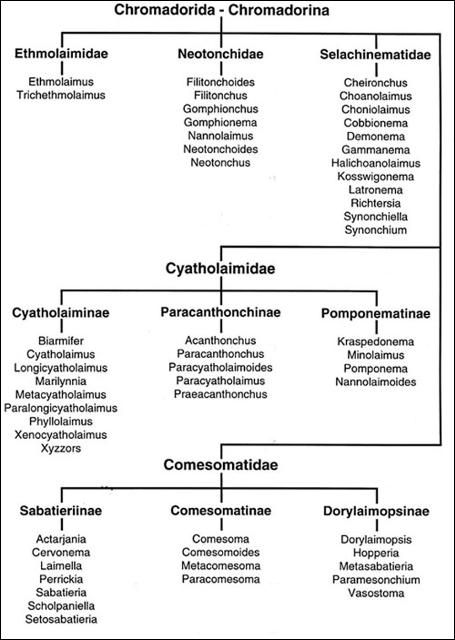
This is an illustrated key to 55 genera of free-living marine nematodes of the superfamily Chromadoroidea, exclusive of the Chromadoridae (Nematoda: Chromadorida: Chromadorina). Illustrations are almost all limited to the heads and caudal regions of the included genera. Specific anatomical features are designated to facilitate use of the key.
This is the fourth in a series of keys by the authors to the groups of the free-living marine nematodes. The purpose of these keys is to provide students and other interested persons with a tool to begin the identification of free-living marine nematodes. These keys, along with those provided by Tarjan (1980) and Platt and Warwick (1983), should provide a basis for the identification of the genera of free-living marine nematodes.
Hope and Murphy (1972), Gerlach and Riemann (1974), Andrassy (1976), Lorenzen (1981), and Inglis (1983) have published classifications of free-living marine nematodes. Platt and Warwick (1988) provided descriptions and figures for the species of chromadorids reported from Britain.
The key presented herein is not intended to reflect phylogenetic relationships. It includes 55 genera of free-living marine nematodes in the suborder Chromadorina, superfamily Chromadoroidea, exclusive of the family Chromadoridae.
Although the key follows the classification of Lorenzen (1981), Jensen (1979) and Platt (1982) should be consulted regarding the Comesomatidae and Ethmolaimidae. Jensen (1979) revised the Comesomatidae and provided keys to the subfamilies, genera, and species. Lorenzen (1981) recognized the family Neotonchidae. Platt (1982) revised the family Ethmolaimidae and included the neotonchids in the Ethmolaimidae as the subfamily Neotonchinae Wieser & Hopper, 1966. Platt (1982) provided keys to the subfamilies, genera, and species of the Ethmolaimidae. Platt and Warwick (1988) also included the neotonchids in the Ethmolaimidae but did not segregate taxa at the subfamily level.
Use of the Key
Couplet numbers and lowercase letters refer to the location of related lower-ranked taxa. When one arrives at a family or subfamily name, rather than another couplet, the genera within that taxon immediately follow in couplets designated by lower-case letters. The parenthetical part of each couplet designation indicates the referent couplet, allowing one to work backward, as well as forward, through the key.
Illustrations in the key were obtained from published references. In some cases, portions of the anatomy shown on the drawings are labeled or emphasized with ink; in other cases pertinent anatomical details have been deleted to better portray the structures of interest. Credit is given for each illustration used.
Taxa included in the key.
Abbreviations Used in the Key
a—amphid
bc—buccal cavity
cs—cephalic sensilla
eb—esophageal bulb
g—gubernaculum
ga—gubernacular apophysis
lp—longitudinal punctations
ls—labial sensilla
m—mandible
ps—precloacal supplement
r—rugae
rs—cervical sensilla
s—spicule
sp—small spines
ss—somatic sensilla
t—teeth
Key to the Genera (exclusive of the Chromadoridae)
Chromadoroidea. Cuticle with punctations; transverse striations present or absent. Head without helmet. Amphid variable in shape, difficult to discern in some species. Only those species with a spiral or circular amphid included in the key.
[Note: When two consecutive numbers are shown, they refer to the anterior and posterior ends of the nematode.]
1. Amphid a distinct spiral (Figs. 53a, 81a) . . . . . 2 1'. Amphid not a distinct spiral . . . . . Chromadoridae (not included)
2 (1). Anterior part of buccal cavity with 12 rugae (Fig. 13r); females with reflexed ovaries . . . . . 5 2'. Anterior part of buccal cavity without 12 rugae; females with outstretched ovaries . . . . . Comesomatidae . . . . . 3
3 (2). Posterior part of buccal cavity weakly cuticularized; spicules short (2 anal body diameters or less) (Fig. 6s); gubernaculum with dorso-caudally directed apophyses (Fig. 4ga) . . . . . Sabatieriinae
-
a. Sublateral longitudinally orientated rows of long cervical sensillae present (Figs. 102, 103) . . . . . Setosabatieria Platt, 1985
-
a'. Sublateral longitudinally orientated rows of long cervical sensillae absent. . . . . b
-
b(a). Amphids situated about 2.0 head diameters posterior to the anterior end (Fig. 7a) outer labial and cephalic sensillae equal in length (Figs. 7cs, 8) . . . . . Cervonema Wieser, 1954
-
b'. Amphids situated about 1.0 head diameter posterior to anterior end; outer labial and cephalic sensillae equal or unequal in length . . . . . c
-
c(b). Outer labial and cephalic sensillae equal in length; amphid with more than 4 spirals (Figs. 89a, 90) . . . . . Pierrickia Vitiello, 1970
-
c'. Outer labial and cephalic sensillae unequal in length; amphid with less than 4 spirals . . . . . d
-
d(c). Outer labial sensillae shorter than cephalic sensillae; cuticle with lateral differentiation (Figs. 3cs, 4) . . . . . Actarjania Hopper, 1967
-
d'. Outer labial sensillae longer than cephalic sensillae; cuticle without lateral differentiation . . . . . e
-
e(d). Outer labial and cephalic sensillae close together; cuticle without distinct punctations (Figs. 49, 50) . . . . . Laimella Cobb, 1920
-
e'. Outer labial and cephalic sensillae well separated; cuticle with distinct punctations . . . . . f
-
f(e). Gubernacular apophyses long, directed caudally or dorso-caudally (Figs. 98, 99ga) . . . . . Sabatieria De Rouville, 1903
-
f'. Gubernacular apophyses short, directed dorsally (Figs. 100, 101ga) . . . . . Scholpaniella Sergeeva, 1979
3'. Posterior part of buccal cavity heavily or moderately cuticularized; spicules elongate (more than 2.0 anal diameters long) (Fig. 18s); gubernacular apophyses directed caudally, parallel to spicules (Fig. 18ga), or absent . . . . . 4
4 (3). Posterior part of buccal cavity collapsed, weakly cuticularized (Fig. 19bc); teeth present or absent . . . . . Comesomatinae
-
a. Teeth present at anterior end of buccal cavity; cuticle with or without distinct punctations (Figs. 77, 78). . . . . Paracomesoma Hope & Murphy, 1972
-
a'. Teeth absent at anterior end of buccal cavity; cuticle with distinct punctations . . . . b
-
b(a). Cuticle with lateral differentiation; gubernaculum with caudally directed apophyses (Figs. 19, 20) . . . . . Comesomoides Gourbault, 1980
-
b'. Cuticle without lateral differentiation; gubernacular apophyses parallel to spicules (Fig. 18ga) . . . . . c
-
c(b). Outer labial and cephalic sensillae in single circle of 10 (Figs. 57cs, 58) . . . . . Metacomesoma Wieser, 1954
-
c'. Outer labial and cephalic sensillae in two separate circles (Figs. 17cs, 18) . . . . . Comesoma Bastian, 1865
4'. Posterior part of buccal cavity expanded, heavily cuticularized (Fig. 42bc), teeth present or absent . . . . . Dorylaimopsinae
-
a. Teeth absent (Figs. 61bc, 62) . . . . . Metasabatieria Timm, 1961
-
a'. Teeth present . . . . . b
-
b(a). Lateral differentiation present . . . . . c
-
b'. Lateral differentiation absent (Figs. 110, 111) . . . . . Vasostoma Wieser, 1954
-
c(b). Lateral differentiation of longitudinal rows of coarse punctuations (Figs. 26lp, 27) . . . . . Dorylaimopsis Ditlevsen, 1918
-
c'. Lateral differentiation of transverse rows of coarse punctations. . . . . d
-
d(c). Posterior part of buccal cavity cylindrical (Figs. 42bc, 43) . . . . . Hopperia Vitiello, 1969
-
d'. Posterior part of buccal cavity conical (Figs. 85bc, 86) . . . . . Paramesonchium Hopper, 1967
5 (2). Amphid unispiral (Fig. 28a); buccal cavity elongate, not funnel-shaped (Fig. 108bc) . . . . . Ethmolaimidae
-
a. Extremely long somatic sensillae present; teeth equal (Figs. 108, 109) . . . . . Trichethmolaimus Platt, 1982
-
a'. Extremely long somatic sensillae absent; teeth unequal, dorsal tooth largest (Figs. 28, 29) . . . . . Ethmolaimus De Man, 1880
5'. Amphid multispiral; buccal cavity elongate, sometimes funnel-shaped . . . . . 6
6 (5). Teeth mostly absent, mandibles present (Fig. 106m) or absent; if both teeth and mandibles absent, then cuticle with numerous longitudinal rows of small spines (Fig. 96sp) . . . . . Selachinematidae
-
a. Buccal cavity in two parts (Fig. 38); anterior part cup-shaped, posterior part cylindrical, both parts supported by cuticularized rods; mandibles absent . . . . . b
-
a'. Buccal cavity not divided into two parts; mandibles present (Fig. 104m) or absent . . . . . g
-
b(a). Esophagus with distinct posterior bulb (Figs. 13, 14). . . . . Choniolaimus Ditlevsen, 1918
-
b'. Esophagus without distinct posterior bulb . . . . . c
-
c(b). Cephalic sensillae short, papilliform . . . . . d
-
c'. Cephalic sensillae longer, setiform . . . . . e
-
d(c). Tail short, conical; tip blunt (Figs. 11, 12) . . . . . Choanolaimus De Man, 1880
-
d'. Tail long, cylindrical then conical, sometimes flagellate (Figs. 40, 41) . . . . . Halichoanolaimus De Man, 1886
-
e(c). Cuticle with 12-50 longitudinal rows of punctations (Figs. 51, 52ld) . . . . . Latronema Wieser, 1954
-
e'. Cuticle without longitudinal rows of punctations . . . . . f
-
f(e). Tail short, conical (Figs. 38, 39) . . . . . Gammanema Cobb, 1920
-
f'. Tail long, flagellate (Figs. 15,16) . . . . . Cobbionema Filipjev, 1922
-
g(a). Mandibles present . . . . . h
-
g'. Mandibles absent; cuticle with numerous longitudinal rows of small spines (Figs. 96sp, 97) . . . . . Richtersia Steiner, 1916
-
h(g). Mandibles equal in length (Fig. 104m) . . . . . i
-
h'. Mandibles unequal in length, dorsally reduced (Fig. 24m) . . . . . j
-
i(h). Mandibles single distally (Fig. 106m); cephalic sensillae papilliform; lateral differentiation absent; gubernaculum absent (Figs. 106, 107) . . . . . Synonchium Cobb, 1920
-
i'. Mandibles doubled distally (Fig. 104m); cephalic sensillae setiform; lateral differentiation present; gubernaculum present (Figs. 104, 105) . . . . . Synonchiella Cobb, 1933
-
j(h). Esophagus with distinct peribuccal bulb (9eb, 10) . . . . . Cheironchus Cobb, 1917
-
j'. Esophagus without distinct peribuccal bulb, tail variable . . . . . k
-
k(j). Tail conical then filiform (Figs. 23-25) . . . . . Demonema Cobb, 1894
-
k'. Tail short, conical (Figs. 44, 45) . . . . . Kosswigonema Gerlach, 1964
6'. Teeth, if present, appear as a single dorsal tooth and two subventral teeth (Fig. 71t) or a single dorsal tooth (Fig. 36t). If teeth absent then buccal cavity not divided into cup-shaped and cylindrical parts; mandibles absent . . . . . 7
7 (6). Esophagus with posterior bulb; spicules typically bent about 2/3 distance from proximal end (Fig. 70s); male precloacal supplements well developed, cup-shaped . . . . . Neotonchidae
-
a. Buccal cavity small, not heavily cuticularized (Fig. 67bc) . . . . . b
-
a'. Buccal cavity large, heavily cuticularized (Fig. 36bc) . . . . . d
-
b(a). Labial sensillae setiform (Figs. 67, 68) . . . . . Nannolaimus Cobb, 1920
-
b'. Labial sensillae papilliform (Fig. 30ls) . . . . . c
-
c(b). Spicules broad (Figs. 32, 33) Filitonchus Platt, 1982
-
c'. Spicules slender (Figs. 30, 31) Filitonchoides Jensen, 1986
-
d(a). Dorsal tooth massive (Fig. 36t); subventral teeth absent; spicules with lateral pieces (Figs. 36, 37) . . . . . Gomphionema Wieser & Hopper, 1966
-
d'. Dorsal tooth not as massive; subventral teeth present or absent; spicules without lateral pieces . . . . . e
-
e(d). Dorsal tooth extending anteriorly into vestibule; subventral teeth present, small (Figs. 34, 35). . . . . Gomphionchus Platt, 1982
-
e'. Dorsal tooth not extending anteriorly into vestibule (Fig. 71t); subventral teeth present or absent . . . . . f
-
f(e). Dorsal and two small subventral teeth present (Figs. 71t, 72) . . . . . Neotonchus Cobb, 1933
-
f'. Dorsal tooth present; subventral teeth reduced to ventral ridges (Figs. 69, 70) . . . . . Neotonchoides Platt, 1982
7'. Esophagus with or without a posterior bulb; spicules not characteristically bent about 2/3 distance from proximal end; precloacal supplements cup-shaped, tubular or absent . . . . . Cyatholaimidae . . . . . 8
8 (7). Ten longitudinal alae present; cuticular punctations absent (Figs. 112, 113) . . . . . Xenocyatholaimus Gerlach, 1953
8'. Longitudinal alae absent; cuticular punctations present . . . . . 9
9 (8). Precloacal supplements present in male . . . . . 10
9'. Precloacal supplements absent in male . . . . . Cyatholaiminae (in part)
-
a. Esophagus with posterior bulb; teeth absent (Figs. 83, 84) . . . . . Paralongicyatholaimus Stekhoven, 1950
-
a'. Esophagus without a posterior bulb; teeth present or absent . . . . . b
-
b(a). Dorsal tooth reduced or absent; lateral differentiation present (Figs. 59, 60) . . . . . Metacyatholaimus Stekhoven, 1942
-
b'. Dorsal tooth prominent (Fig. 22t); lateral differentiation absent . . . . c
-
c(b). Lips leaf-like, bent backward (Figs. 87, 88) . . . . . Phyllolaimus Murphy, 1963
-
c'. Lips not leaf-like, not bent backward (Figs. 21, 22) . . . . . Cyatholaimus Bastian, 1865
10 (9). Male precloacal supplements weakly cuticularized, simple cup-shaped (Fig. 6ps) or narrow tubes; lateral differentiation present . . . . . Cyatholaiminae (in part)
-
a. Male precloacal supplements simple tubes (Figs. 93-95) . . . . . Praeacanthonchus Micoletzky, 1924
-
a'. Male precloacal supplements small, cup-shaped (Fig. 6ps) . . . . . b
-
b(a). Buccal cavity with single dorsal tooth; subventral teeth as two pairs . . . . . c
-
b'. Buccal cavity with single dorsal tooth (Fig. 53t); subventral teeth absent or as a single pair . . . . . d
-
c(b). Hypodermal pore complexes present in eight longitudinal rows (Figs. 114-115) . . . . . Xyzzors Inglis, 1963
-
c'. Pores arranged in 12 longitudinal rows, reduced in area between nerve ring and preanal region (Figs. 55-56) . . . . . Marilynnia Hopper, 1972
-
d(b). Lateral differentiation present (Figs. 53, 54) . . . . . Longicyatholaimus Micoletzky, 1924
-
d'. Lateral differentiation absent (Figs. 5-6) . . . . . Biarmifer Wieser, 1954
10'. Male precloacal supplements strongly cuticularized, complex cup-shaped (Fig. 64ps), tubular (Fig. 2ps) or setose; lateral differentiation present or absent . . . . . 11
11 (10). Male precloacal supplements protrusible tubes (Fig. 2ps) or setose (Fig. 80ps) . . . . . Paracanthonchinae
-
a. Male precloacal supplements protrusible tubes . .b
-
a'. Male precloacal supplements setose . . . . . . c
-
b(a). Gubernaculum dentate (Fig. 75g) (Figs. 73-76) . . . . . Paracanthonchus Micoletzky, 1924
-
b'. Gubernaculum not dentate (Figs. 1, 2) . . . . . Acanthonchus Cobb, 1920
-
c(a). Amphids of both sexes dissimilar in size (Figs. 81, 82) . . . . . Paracyatholaimoides Gerlach, 1953
-
c'. Amphids of both sexes similar in size (Figs. 79, 80) . . . . . Paracyatholaimus Micoletzky, 1922
11'. Male precloacal supplements complex, consisting of a number of elements (Fig. 64ps) . . . . . Pomponematinae
-
a. Buccal cavity large with teeth (Fig. 46t). . . . . b
-
a'. Buccal cavity small without teeth (Figs. 63, 64) . . . . . Minolaimus Vitiello, 1970
-
b(a). Cuticle with eight longitudinal rows of punctations (Figs. 46-48) . . . . . Kraspedonema Gerlach, 1954
-
b'. Cuticle without eight longitudinal rows of punctations . . . . . c
-
c(b). Buccal cavity with large dorsal tooth and two subventral teeth; denticles may also be present; esophageal bulb absent (Figs. 91, 92) . . . . . Pomponema Cobb, 1917
-
c'. Buccal cavity with dorsal and subventral teeth reduced; denticles absent; esophageal bulb present (Figs. 65-66) . . . . . Nannolaimoides Ott, 1972
Acknowledgments
We express our sincere appreciation to Drs. K. B. Nguyen, R. P. Esser, and especially G. C. Smart, Jr., for their review of this manuscript and suggestions for its improvement.
Selected References
Andrassy I. 1976. Evolution as the Basis for the Systematization of Nematodes. Pitman Publishing, London. Akademiai Kaido, Budapest, 288 pp.
Gerlach SA, Riemann F. 1973. The Bremerhaven Checklist of Aquatic Nematodes. Veröff. Inst. Meeresforsch. Bremerhaven, Supplement 4, pp. 1–734.
Hope WD, Murphy DG. 1972. A taxonomic hierarchy and checklist of the genera and higher taxa of marine nematodes. Smithson. Contrib. Zool. 137, pp. 1–101.
Inglis WG. 1983. An outline classification of the phylum Nematoda. Australian Journal of Zoology 31: 243–255.
Jensen P. 1979. Revision of the Comesomatidae (Nematoda). Zool. Scripta 8: 81–105.
Lorenzen S. 1981. Entwurf eines phylogenetischen Systems der freilebenden Nematoden. Veröff. Inst. Meeresforsch. Bremerhaven, Supplement 7, pp. 1–472.
Platt HM. 1982. Revision of the Ethmolaimidae (Nematoda: Chromadorida). Bulletin of the British Museum (Natural History) Zool. 43: 185–252.
Platt HM, Warwick RM. 1983. Free-living Marine Nematodes. Part I. British Enoplids. Cambridge Univ. Press, Cambridge, 307 pp.
Platt HM, Warwick RM. 1988. Free-living Marine Nematodes. Part III. British Chromadorids. E. J. Brill/Dr. W. Backhuys, New York, 502 pp.
Tarjan AC. 1980. An Illustrated Key to the Marine Nematodes. UF/IFAS, Gainesville, 135 pp.
References for Illustrations
Boucher G. 1976. Nématodes dessables fins infralittoraux de la Pierre Noire (Manche accidentale) II. Chromadorida. Bul. Mus. Nat. d'Hist. Nat. Paris, 3e ser, no. 352 Zool. 245: 25–61.
Furstenberg JP, Heyns J. 1987. Cobbionema capense n. sp. from Swartkops estuary, Port Elizabeth (Nematoda: Selachinematidae). Canadian Journal of Zoology 65: 80–82.
Gerlach SA. 1953a. Die Nematodenbesiedlung des Sandstrandes und des Kustengrundwassers an der italienischen Kuste. I. Systematischer Teil. Arch. Zool. Italiano 37: 517–640.
Gerlach SA. 1953b. Recherches sur la fauna des eaux interstitielles de Madagascar. III. Mem. Instit. Scient. Madagascar Ser. A. 8: 73–86.
Gerlach SA. 1954. Nouveaux nématodes libres des eaux souterraines littorales Francaises. Vie et Milieu 4: 94–110.
Gerlach SA. 1956. Diagnosen neuer Nematoden aus der Kieler Bucht. Kieler Meeresforsch. 12: 85–109.
Gerlach SA. 1958. Freilebende Nematoden von den Korallenriffen des Roten Meeres. Kieler Meeresforsch. 14: 241–246.
Gerlach SA. 1964a. Revision der Choniolaiminae und Selachinematinae (freilebende Meeres Nematoden). Mitt. Hamburg. Zool. Mus. Inst. Kosswig-Festschrift, pp. 23–50.
Gerlach SA. 1964c. Neue Cyatholaimidae (Nematoda, Chromadorida) von den Malediven. Veröff. Inst. Meeresforsch. Bremerhaven 9: 70–78.
Gourbault N. 1980. Nématodes abyssaux (Campagne Walda du N/O << J. Charcot>>). II. Espèces et genre nouveaux de Comesomatidae. Bull. Mus. natn. hist. nat., Paris 4 ser. 2: 737–749.
Hopper BE. 1967. Free-living marine nematodes from Biscayne Bay, Florida. I. Comesomatidae: the male of Laimella longicauda Cobb, 1920, and a description of Actarjania new genus. Mar. Biol., International Journal of Life Oceans Coastal Waters 1: 140–144.
Hopper BE. 1972. Free-living marine nematodes from Biscayne Bay, Florida. IV. Cyatholaimidae: On the occurrence of Marilynia n. gen. and Longicyatholaimus Micoletzky, 1924 in Biscayne Bay, with a description of L. longicaudatus (de Man, 1876) from the type locality. Zool. Anz., Leipzig 189: 64–88.
Inglis WG. 1963. New marine nematodes from off the coast of South Africa. Bulletin of the British Museum (Natural History) Zool. 10: 529–552.
Inglis WG. 1970. Cyatholaimidae (Nematoda) from the coast of Western Australia. Rec. S. Aust. Mus. 16: 1–13.
Jensen P. 1976. Free-living marine nematodes from a sublittoral station in the North Sea off the Belgian coast. Biol. Jb. Dodonaea 44: 231–255.
Jensen P. 1979. Nematodes from the brackish waters of the southern archipelago of Finland. Benthic species, Ann. Zool. Fennici 16: 151–168.
Jensen P. 1986. The nematode fauna in the sulphide-rich brine seep and adjacent bottoms of the East Flower Garden, NW Gulf of Mexico. I. Chromadorida. Zool. Scripta 14: 247–263.
Jensen P, Gerlach SA. 1977. Three new Nematoda - Comesomatidae from Bermuda. Ophelia 16: 59–76.
Murphy DG. 1963. A new genus and two new species of nematodes from Newport, Oregon. Proceedings of the Helm. Society of Washington 30: 73–78.
Murphy DG. 1964. Free-living marine nematodes, I. Southerniella youngi, Dagda phinneyi, and Gammanema smithi, new species. Proceedings of the Helm. Society of Washington 31: 190–198.
Ott JA. 1972. Twelve new species of nematodes from an intertidal sandflat in North Carolina. Int. Revue ges. Hydrobiol. 57: 463–496.
Pastor de Ward CT. 1979. Free-living marine nematodes (subclass Adenophorea) of the Ria Deseado (Santa Cruz, Argentina). Ann. Soc. Roy. Zool. Belg. 108: 29–45.
Platt HM. 1982. Revision of the Ethmolaimidae (Nematoda: Chromadorida). Bulletin of the British Museum (Natural History) Zool. Ser. 43: 185–252.
Platt HM. 1985. The freeliving marine nematode genus Sabatieria (Nematoda: Comesomatidae). Taxonomic revision and pictorial keys. Zool. Journal of the Linnean Society 83: 27–78.
Riemann F. 1966. Die interstitielle Fauna im Elbe-Aestuar Verbreitung und Systematik. Arch. Hydrobiol. Suppl. XXXI: pp. 1–279.
Schuurmans Stekhoven JH. 1950. The free-living marine nemas of the Mediterranean. I. The bay of Villefranche. Mem. Inst. Roy. Sci. Nat. Belg. 37: 1–220.
Sergeeva NG. 1973. New species of free-living marine nematodes from the order Chromadorida in the Black Sea. Zool. Zh. 52: 1238–1241.
Soetaert K, Vincx M. 1987. Six new Richtersia species (Nematoda, Selachinematidae) from the Mediterranean Sea. Zool. Scripta 16: 125–142.
Timm RW. 1961. The marine nematodes of the Bay of Bengal. Proceedings of the Pakistan Academy of Science 1: 1–88.
Vitiello P. 1969. Hopperia, nouveau genre de nématode libre marin (Comesomatidae). Tethys 1: 485–491.
Vitiello P. 1970. Nématodes libres marins des vases profondes du Golfe du Lion. II. Chromadorida. Tethys 2: 449–500.
Warwick RM. 1971. The Cyatholaimidae (Nematoda, Chromadoroidea) off the coast of Northumberland. Cah. Biol. Marine 12: 95–110.
Wieser W. 1954. Free-living marine nematodes. II. Chromadoroidea. Acta Univ. Lund Sect. II Med. Math. Sci. Rerum Nat. 50: 1–148.
Wieser W. 1955. A collection of marine nematodes from Japan. Publ. Seto. Mar. Biol. 4: 159–181.
Wieser W. 1959. Free-living nematodes and other small invertebrates of Puget Sound beaches. University of Washington Publ. Biol. 19: 1–179.
Wieser W, Hopper BE. 1966. The Neotonchiinae, new subfamily (Cyatholaimidae: Nematoda), with an analysis of its genera, Neotonchus Cobb, 1933 and Gomphionema new genus. Canadian Journal of Zoology 44: 519–532.
Wieser W, Hopper BE. 1967. Marine nematodes of the East coast of North America. I. Florida. Bulletin of the Museum of Comparative Zoology 135: 239–344.