


Guava Fruit Fly, Anastrepha striata Schiner (Insecta: Diptera: Tephritidae)
The Featured Creatures collection provides in-depth profiles of insects, nematodes, arachnids and other organisms relevant to Florida. These profiles are intended for the use of interested laypersons with some knowledge of biology as well as academic audiences.
Introduction
The guava fruit fly, Anastrepha striata Schiner, is one of the most common species of fruit flies throughout most of its range. However, it has not acquired a well-established common name as have others such as the Mexican, Caribbean, and Mediterranean fruit flies. This probably is because it is not considered to be of primary economic importance, although it often is abundant and may be highly destructive to dooryard plantings of some tropical fruits.
However, Anastrepha striata is an important pest in the American tropics and subtropics, especially of guavas and other myrtaceous fruits, although it has also been reported to attack mango, mombins, orange, and peach. It is considered a pest of quarantine significance by USDA-APHIS-PPQ and many other regulatory agencies. The main damage is caused by the larvae, which feed inside the fruit (Norrbum 2001).
Synonymy
Dictya cancellaria Fabricius 1805
(From Norrbum 2001)
Distribution
This species is found in Mexico (north to southern Sinaloa, Aguascalientes and northern Veracruz) and south to Peru, Bolivia, and Brazil. In the West Indies, it is found in Trinidad (White and Elson-Harris 1994). A few specimens have been collected in the United States (southern Texas and California), but Anastrepha striata is not currently established there (Norrbum 2001).
Description
Adult
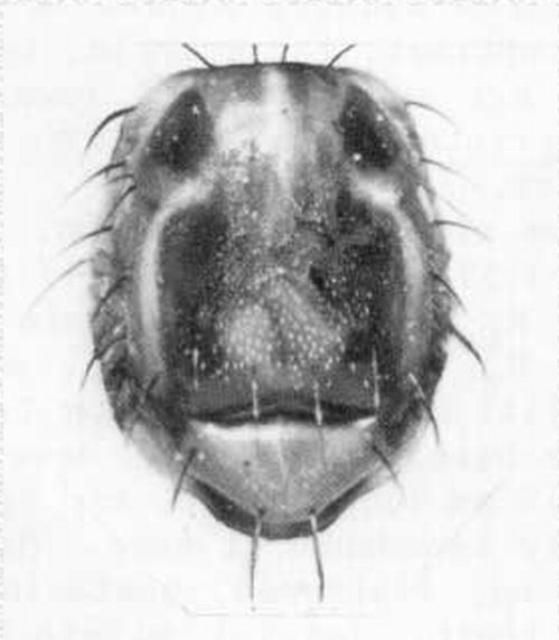
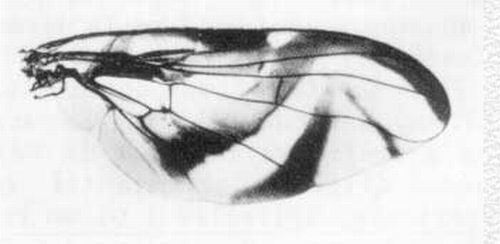
The adult fruit fly is rather small to medium sized; yellow brown, thorax patterned with black. The length of mesonotum is 2.45–3.57 mm. Wings are 5.9–7.7 mm long, with yellow brown bands; costal and S bands touching on vein R4+5 and usually again just anterior to vein R2=3, leaving a small hyaline spot in cell R3; V band complete, separated from S band, outer arm narrow.
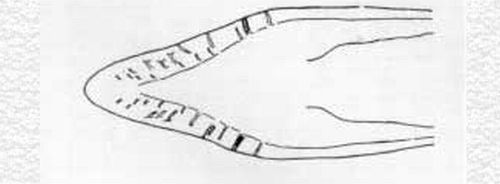
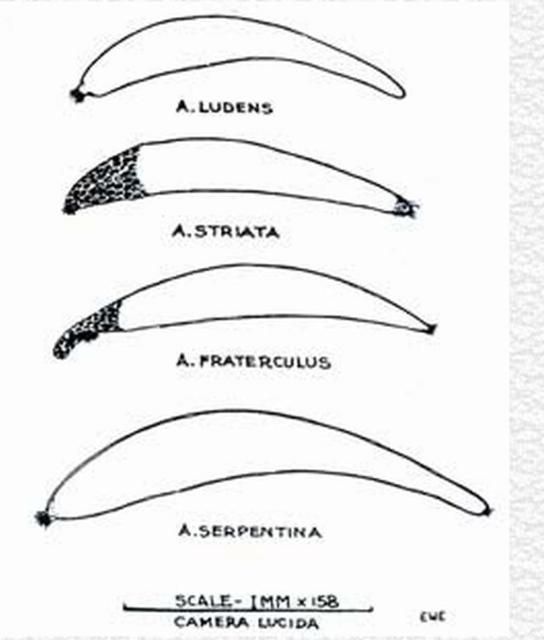
Female terminalia: ovipositor sheath 2.6-2.9 mm long, stout, tapering posteriorly, spiracles 1.05 mm from base. The rasper is well developed, hooks elongate, slender, in four or five rows. The ovipositor is 2.0-2.15 mm long, stout, tip broad and blunt without distinct serrations; and the shaft is slightly broadened at base.
Male terminalia: tergal ratio about 1.19; claspers about 0.44 mm long, flattened, posterior surface with a distinct carina from near base to apex of teeth; lateral margin beyond teeth convex, carinate; extreme apex narrow, abruptly turned posteriorly; teeth about at middle. The only species with thoracic pattern and wing pattern closely resembling this species is Anastrepha bistrigata Bezzi. Lateral half of brown stripe on mesoscutum from transverse suture to scutellum denuded in Anastrepha striata; brown stripe wholly setose in Anastrepha bistrigata.
White and Elson-Harris (1994) state that Anastrepha striata is separated from the other species with a complete Anastrepha type wing pattern by the short (under 2.0 mm) aculeus with a non-serrate apex and U-shaped pattern on the scutum.
Anastrepha striata is the only species of Anastrepha in which the mating behavior is known to include trophallaxis (passing of a substance from the male to the female via the mouthparts) (Norrbum 2001).
Egg
Credit: Division of Plant Industry
Larva
The larva is a typical, pale yellowish-white fruit fly maggot, cylindrical in shape, with inconspicuous head and 11 body segments, which are not clearly separable into thoracic and abdominal regions.
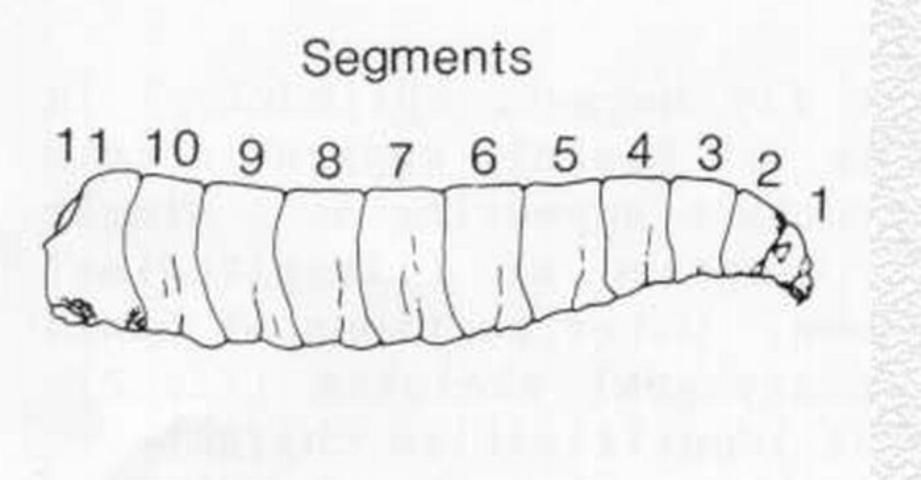
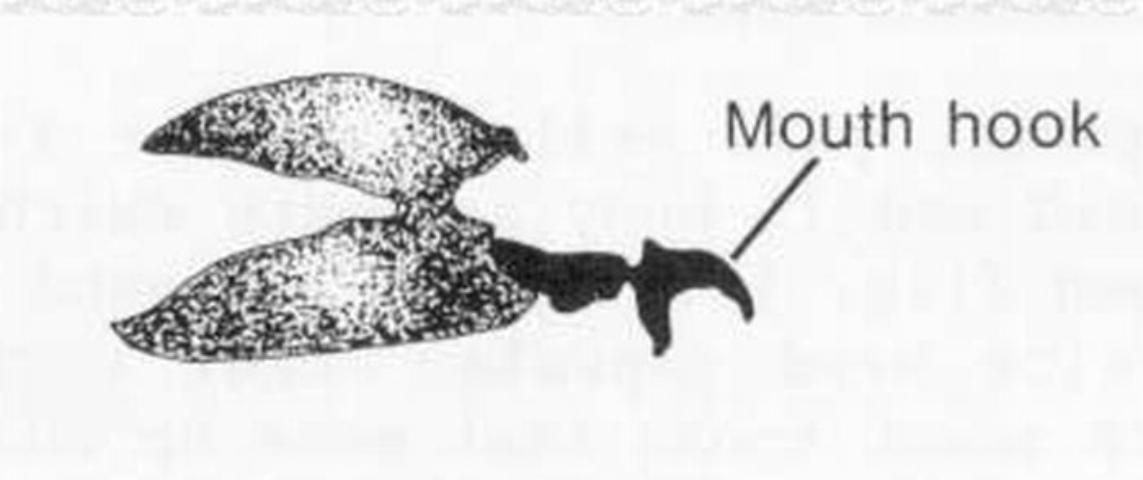
The larval head is a compound structure appearing as a single small segment with no definite head capsule. The oral cavity is composed of a longitudinal cavity which contains two black mouth hooks that move up and down. Outer portions of hooks protrude from preoral cavity, and bases articulate with pharyngeal skeleton. Shape of hooks and form of pharyngeal skeleton provide useful identification characters, as do buccal carinae. Anastrepha striata has eight to nine buccal carinae.
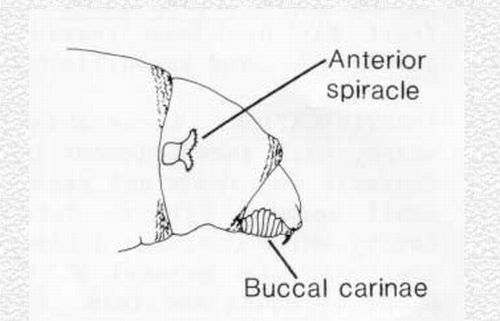
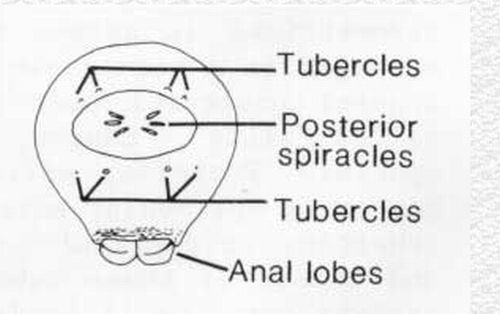
The two anterior spiracles, located laterally at base of first body segment behind the head, are modified ends of tracheae divided into small tubules or digits. Anterior spiracles are small and asymmetrical in shape, anterior margin of each, in Anastrepha striata, bearing 13 to 17 tubules arranged in a transverse row with median indentation as seen in profile. Caudal segment possesses a pair of posterior spiracles, each with three long spiracular openings called slits. Length, width, and position of these are useful characters in separating species. Posterior spiracular entrances of Anastrepha striata are about five times longer than wide; posterior spiracular hairs numerous and slender.
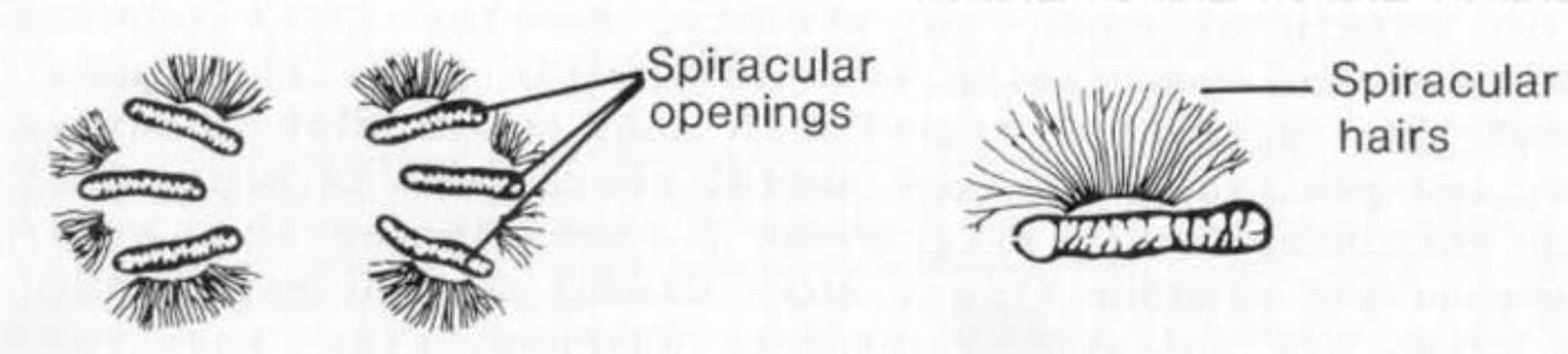
The caudal segment may contain tubercles or papillules, which often are indistinct. Presence, absence, size, position, and number of these tubercles may be useful in identification of fruit fly larvae. Anastrepha striata has four small caudal papillules above and below posterior spiracles. Caudal papillules of Anastrepha striata below posterior spiracles usually minute or apparently absent or arranged in a transverse row, in contrast, for example, to those of the Mexican fruit fly, Anastrepha ludens (Loew), which are arranged in two rows.
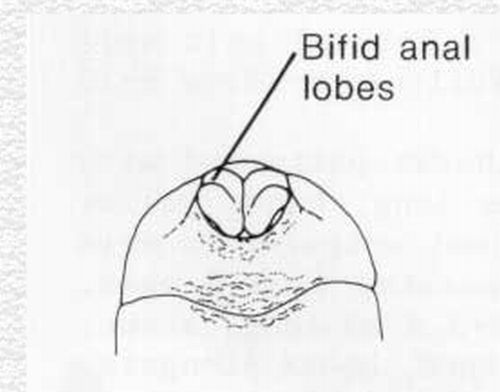
The anal lobes of Anastrepha striata are bifid. The full-grown larva can grow to 10 mm in length and approximately 2 mm in diameter.
Hosts
Guava, Psidium guajava L., is the preferred food host.
Other hosts include:
- avocado, Persea americana
- black sapote, Diospyros digyna
- Brazilian guava, Psidium guineense
- cassava, Manihot esculenta
- green sapote, Pouteria viridis
- mango, Mangifera indica
- peach, Prunus persica
- rose-apple, Syzgium jambos
- spicewood, Psidium sartorianum
- star-apple, Chrysophyllum cainito
- strawberry guava, Psidium littorale
- sweet orange, Citrus sinensis
- tropical almond, Terminalia catappa
- wild guava, Psidium friedrichsthalianum
This fruit fly has been reared in the laboratory from Surinam cherry, Eugenia uniflora; and sapodilla, Manilkara zapota (White and Elson-Harris 1994).
Survey and Detection
Larvae can be collected from infested fruit, but are very difficult to identify except when raised to adults. They tend to flex and jump up to 25 mm when mature. For larval preservation, kill in boiling water, place in 50% alcohol for 2 days, then to 75% isopropyl alcohol. Adults usually are collected by sticky board and baited traps.
Selected References
Berg GH. 1979. Clave ilustrada de larvas de moscas de la fruta de la familia Tephritidae. Organismo Internacional Regional de Sanidad Agropecuaria (OIRSA), San Salvador, Republica de El Salvador. 36 pp.
de Costa LA. 1934. Moscas de frutas do genero Anastrepha Schiner, 1868 (Diptera: Trypetidae). Memorias do Instituto Oswaldo Cruz 28: 487–575.
Norrbom AL. (2003). Anastrepha striata Schiner. The Diptera site.
Pruitt JH. 1953. Identification of Fruit Fly Larvae Frequently Intercepted at Ports of Entry of the United States. Unpublished M.S. thesis, University of Florida, Gainesville. 69 pp.
Stone A. 1942. The Fruit Flies of the Genus Anastrepha. USDA Miscellaneous Publication No. 439, Washington, D.C. 112 pp.
White IM, Elson-Harris MM. 1994. Fruit Flies of Economic Significance: Their Identification and Bionomics. CAB International. Oxon, UK. 601 pp.