
Achoccha -- Cyclanthera pedata L. Achoccha -- Cyclanthera pedata L.
Achoccha -- Cyclanthera pedata L.1
James M. Stephens2Achoccha is also called wild cucumber, caihua, and korila. However, it is unlike the viny plant known as wild cucumber in Florida, a weed pest in lawns and around the home with miniature cucumber-like leaves and fruits.
![]()
Achoccha. DESCRIPTION AND USE
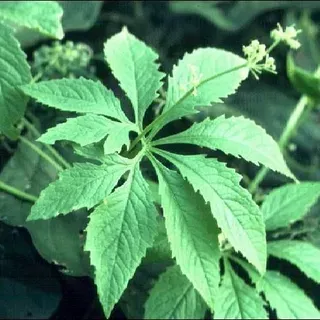
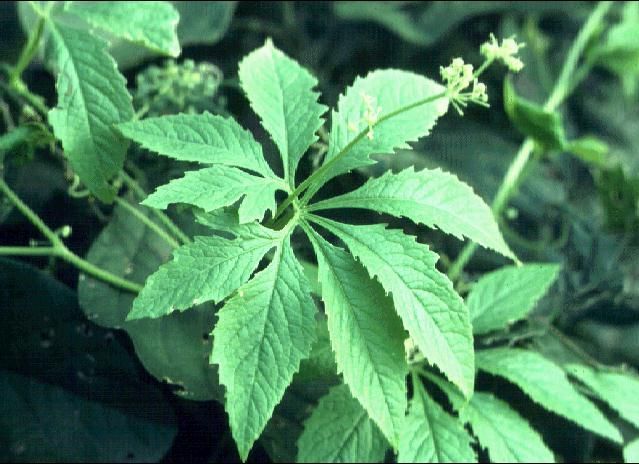
Achoccha, which is rarely grown in Florida, does produce a trailing vine, but the leaves are segmented, usually with five further segmented lobes. The vine is stringy, quite long (up to 40 feet), and equipped with tendrils for climbing. The leaves are 4-5 inches wide and divided into several lobes, some of which are further divided into "mini-lobes." Fruits produced in Mexico and the Caribbean resemble hollow cucumbers. They are elongated, 4-6 inches long, 2-3 inches wide, and hollow. The spongy pulp contains black seeds attached to the placenta in a manner similar to pepper. In fact, the fruits are eaten much like pepper pods, often stuffed and cooked but also eaten raw.CULTURE
Propagation is by seeds, and the vines are often trellised. Similar soil preparation and fertilization practices as for cucurbits should be used.This author has not observed it to produce fruit in Florida, when seeded in September and maturing in short days of a warm fall.

Footnotes
1. This document is HS538, one of a series of the Horticultural Sciences Department, Florida Cooperative Extension Service, Institute of Food and Agricultural Sciences, University of Florida. Original publication date April 1994. Reviewed May 2003. Visit the EDIS Web Site at http://edis.ifas.ufl.edu.2. James M. Stephens, professor, Horticultural Sciences Department, Cooperative Extension Service, Institute of Food and Agricultural Sciences, University of Florida, Gainesville FL 32611.
The Institute of Food and Agricultural Sciences (IFAS) is an Equal Opportunity Institution authorized to provide research, educational information and other services only to individuals and institutions that function with non-discrimination with respect to race, creed, color, religion, age, disability, sex, sexual orientation, marital status, national origin, political opinions or affiliations. For more information on obtaining other extension publications, contact your county Cooperative Extension service.
U.S. Department of Agriculture, Cooperative Extension Service, University of Florida, IFAS, Florida A. & M. University Cooperative Extension Program, and Boards of County Commissioners Cooperating. Larry Arrington, Dean.
Copyright Information
This document is copyrighted by the University of Florida, Institute of Food and Agricultural Sciences (UF/IFAS) for the people of the State of Florida. UF/IFAS retains all rights under all conventions, but permits free reproduction by all agents and offices of the Cooperative Extension Service and the people of the State of Florida. Permission is granted to others to use these materials in part or in full for educational purposes, provided that full credit is given to the UF/IFAS, citing the publication, its source, and date of publication.