


Bamboo—Phyllostachys spp.1
Bamboo is useful in many ways, and its value as a vegetable should be discussed. Bamboos are woody stemmed perennial grasses, usually evergreen where adapted. There are 700 or more species of bamboo, ranging in height from 1 to 100 feet or more. In the U.S., only two species occur naturally (Arundinaria gigantea and A. tecta). Neither of these are used for human food.
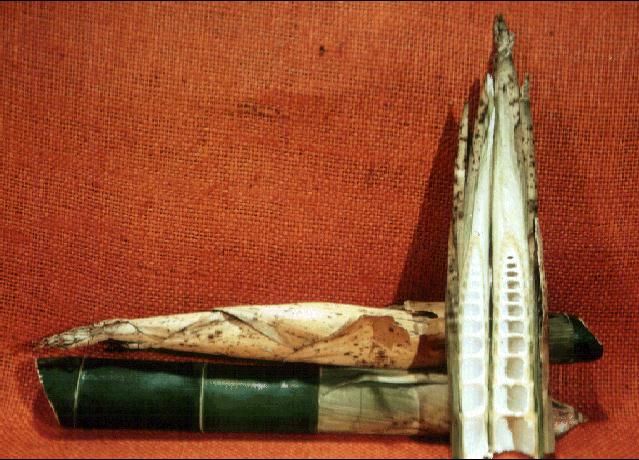
Credit: Blue Goose, Inc.
Description
A bamboo plant consists of two parts: the aboveground jointed stem called a culm and the underground jointed rhizome that bears true roots.
Culture
Propagation is almost entirely by vegetative means, which uses cuttings made from the underground rhizomes. Make cuttings 12 inches long, and then plant them end-to-end 6 inches deep from January to March. Do not let the rhizomes dry out. Caution: some species grown as ornamentals may spread by rhizomes to become a pervasive weed pest.
Use
The young sprouts, or undeveloped stem shoots, of the hardy Chinese and Japanese bamboos are practically all edible. Sprouts are crisp in texture and without pronounced flavor. Some kinds taste bitter, but bitterness is usually removed by boiling twice in water. To get good edible bamboo shoots, try mounding soil over the base of the clumps to exclude sunlight from the sprouts. The sprouting season is usually short (3 to 4 weeks).
A typical food sprout properly dug is somewhat cylindrical in shape, resembling an ear of sweet corn in configuration. It has a small, rooted, woody, basal part, increasing in diameter upward for a short distance to a point, and is covered with an enveloping sheath.
Shoots should be dug when the tips are just emerging from the surface of the soil or very soon thereafter. Tissues at the base become increasingly woody as the shoots elongate after emergence.
To prepare the shoots for cooking: 1) remove the sheath covering; 2) cut off and discard the tough basal part; and 3) cut the tender middle and upper parts into thin slices or according to a recipe.
Bamboo sprouts are used with good results as an ingredient in many ordinary dishes of various vegetables and meats. Sometimes they are served alone after boiling for about 20 minutes. Also, the most tender parts of nonbitter shoots can be used raw in mixed salads.