

Boniato—Ipomoea batatas (L.) Poir1
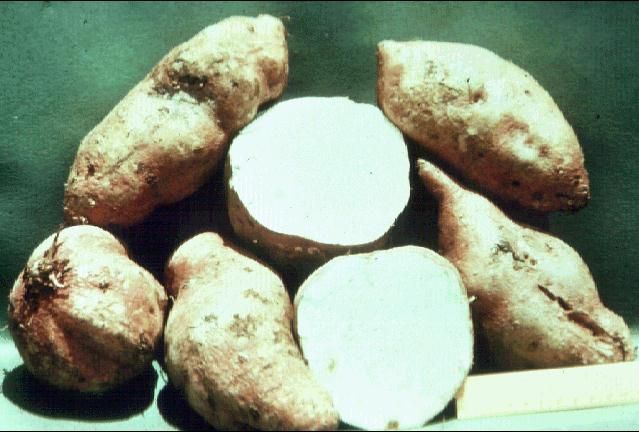
Bonatios are also commonly called Cuban sweet potatoes. While the generic name is the same as for the ordinary sweet potato widely grown in gardens and farms around the state, boniatos differ primarily by having a distinctive white interior rather than the characteristic yellow or orange flesh of other varieties. Boniatos have been grown throughout the subtropical world for centuries, but became an important commercial crop in Florida in recent years. Popularity rose with the increasing population of Cubans in the Dade County area. Since there was always a small Cuban-Latin sector in South Florida, boniatos were grown for home use and limited sales for many years before that.
Credit: James M. Stephens
Commercially, over 5,000 acres of boniatos were planted yearly in Dade County. At one time in the 1980s, some fields were 50 to 100 acres in size, while the average was close to 10 acres. The value of the boniato industry in Dade County in 1983 was estimated to be 10 million dollars. Boniatos are grown in numerous backyard gardens within the Latin sector and other areas of the county. While boniatos will grow in other sweet potato-producing areas of the U.S., interest in them outside Dade County is limited.
Description
Boniatos resemble ordinary sweet potatoes, having roundish, oblong roots with fleshy taproots. They are not always smooth and uniform in shape and size. Underneath the reddish brown skin is a bright white, very dry interior. Two varieties in commercial production in South Florida are 'Picadita' and 'Campeon.' 'Picadita' is a dark, purple-red-skinned variety, usually grown in the fall and winter. 'Campeon' has a lighter red skin and is grown in the summer and fall.
Culture
Boniatos are grown in a manner similar to that for regular sweet potatoes. They are started by using plants called draws, slips, or transplants or by using vine cuttings. Transplants are grown from roots that have been bedded, with each root expected to produce from 8 to 12 plants. Vine cuttings may be taken from vigorously growing vines at the terminal or middle portions. These 8- to 10-inch long sections are planted at 12-inch intervals in rows spaced 3 to 4 feet apart.
Boniatos are planted year-round in South Florida, with harvests occurring 120 to 180 days after plants. The average growing season is 150 days. There is great variability in yields and performance from one plant to another. The average yields reported in Dade County were 5 to 6 tons per acre, in contrast to much higher yields reported for regular sweet potatoes in other areas of the state.
Gardeners wishing to try boniatos in their home plots will find it difficult to obtain roots or plants for starts. Sweet potato weevils and nematodes are serious pest problems with boniatos. Root decay caused by Rhizopus, Diplodia, and Fusarium prevents long-time storage of the roots.