
Chrysanthemum, Edible -- Chrysanthemum coronarium L.
Click here to view a PDF version of this document.
Home Search What's New Products Survey Help
Chrysanthemum, Edible -- Chrysanthemum coronarium L.


Chrysanthemum, Edible -- Chrysanthemum coronarium L.1

James M. Stephens2

The vegetable chrysanthemum, also called garland chrysanthemum , looks very much like the leafy portion of the ornamental version. It is commonly eaten in the Orient where it is known as shungikee in Japan and kor tongho in China. The leaves have that whitish green color and notched leaf appearance of the flowering sort. Some varieties have smaller leaves than others and are said to be more cold tolerant than the broad leaf type.
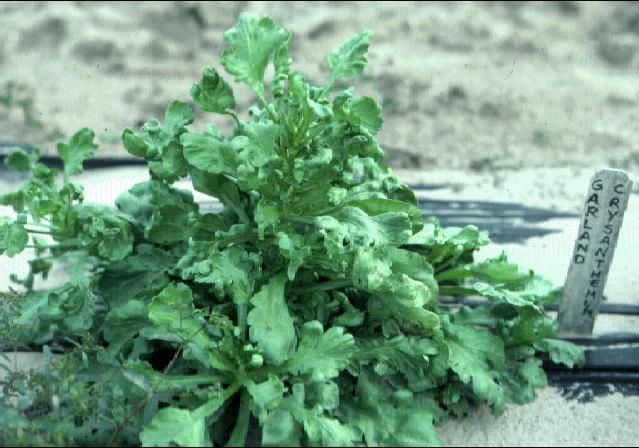
garland chrysanthemum.

CULTURE

In Florida gardens it grows fairly well when the seeds are sown in the fall (September through November), and in the spring. Winter production in South Florida is also possible. Ordinary vegetable garden practices of fertilizing, mulching, and soil preparation are suggested. The young tender leaves are ready for harvest about a month after the seeds are sown. The flowers are bright yellow and daisy-like in appearance.


Footnotes

1. This document is HS582, one of a series of the Horticultural Sciences Department, Florida Cooperative Extension Service, Institute of Food and Agricultural Sciences, University of Florida. Original publication date May 1994. Reviewed May 2003. Visit the EDIS Web Site at http://edis.ifas.ufl.edu.

2. James M. Stephens, Professor, Horticultural Sciences Department, Cooperative Extension Service, Institute of Food and Agricultural Sciences, University of Florida, Gainesville FL 32611.


The Institute of Food and Agricultural Sciences (IFAS) is an Equal Opportunity Institution authorized to provide research, educational information and other services only to individuals and institutions that function with non-discrimination with respect to race, creed, color, religion, age, disability, sex, sexual orientation, marital status, national origin, political opinions or affiliations. For more information on obtaining other extension publications, contact your county Cooperative Extension service.

U.S. Department of Agriculture, Cooperative Extension Service, University of Florida, IFAS, Florida A. & M. University Cooperative Extension Program, and Boards of County Commissioners Cooperating. Larry Arrington, Dean.


Copyright Information

This document is copyrighted by the University of Florida, Institute of Food and Agricultural Sciences (UF/IFAS) for the people of the State of Florida. UF/IFAS retains all rights under all conventions, but permits free reproduction by all agents and offices of the Cooperative Extension Service and the people of the State of Florida. Permission is granted to others to use these materials in part or in full for educational purposes, provided that full credit is given to the UF/IFAS, citing the publication, its source, and date of publication.