
Chufa -- Cyperus esculentus L. var. sativus Boeck
Click here to view a PDF version of this document.
Home Search What's New Products Survey Help
Chufa -- Cyperus esculentus L. var. sativus Boeck


Chufa -- Cyperus esculentus L. var. sativus Boeck1

James M. Stephens2

Chufa has other names such as tiger nut, zulu nut, yellow nutgrass, ground almond, edible rush, and rush nut. It is one of two major species of the nutsedge genus Cyperus found throughout Florida on all types of soil from rockland to muck. Its close relative, C. rotundus, is purple nutgrass, a severe problem weed. Both are weed pests, but rotundus is much more of a problem than the chufa, which has been cultivated as a livestock food. On occasion, it is cultivated for human consumption of the tubers, which are eaten raw or baked.

DESCRIPTION

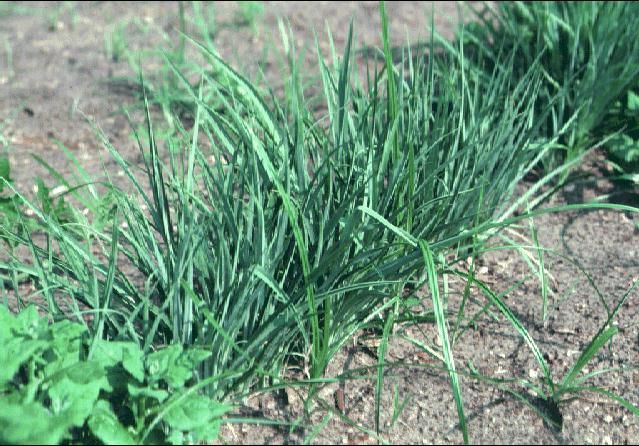
Chufa is a perennial sedge that produces small tubers (½ - ¾ inch or less in diameter) underground in a chain-like fashion. The top of the plant is grass-like from 6-36 inches tall.

Chufa.

CULTURE

Chufa is planted in late spring to midsummer by dropping the dried tubers 6-12 inches apart in rows spaced 2-3 feet apart. Planting rate is 15-40 pounds per acre. The tuber develops into a plant with several tubers bunched together directly beneath the plant and a few stragglers some distance away. Although bunched together, each nut is attached to a thin underground stem (rhizome) that connects the single tuber to the growing shoot.

USE

While seldom grown as a food item in home gardens, chufas were grown on about 2,000 farms mostly in Florida in the United States in 1944. In 1941, 7,000 acres were planted for hog pasture in Florida and over 3,000 bushels were dug from 170 additional acres. The nuts weigh about 44 pounds per bushel. In the 1980s, chufas are still grown for livestock feed on a few farms in the Florida Panhandle.


Footnotes

1. This document is HS583, one of a series of the Horticultural Sciences Department, Florida Cooperative Extension Service, Institute of Food and Agricultural Sciences, University of Florida. Original publication date May 1994. Reviewed May 2003. Visit the EDIS Web Site at http://edis.ifas.ufl.edu.

2. James M. Stephens, Professor, Horticultural Sciences Department, Cooperative Extension Service, Institute of Food and Agricultural Sciences, University of Florida, Gainesville FL 32611.


The Institute of Food and Agricultural Sciences (IFAS) is an Equal Opportunity Institution authorized to provide research, educational information and other services only to individuals and institutions that function with non-discrimination with respect to race, creed, color, religion, age, disability, sex, sexual orientation, marital status, national origin, political opinions or affiliations. For more information on obtaining other extension publications, contact your county Cooperative Extension service.

U.S. Department of Agriculture, Cooperative Extension Service, University of Florida, IFAS, Florida A. & M. University Cooperative Extension Program, and Boards of County Commissioners Cooperating. Larry Arrington, Dean.


Copyright Information

This document is copyrighted by the University of Florida, Institute of Food and Agricultural Sciences (UF/IFAS) for the people of the State of Florida. UF/IFAS retains all rights under all conventions, but permits free reproduction by all agents and offices of the Cooperative Extension Service and the people of the State of Florida. Permission is granted to others to use these materials in part or in full for educational purposes, provided that full credit is given to the UF/IFAS, citing the publication, its source, and date of publication.