

Horseradish -- Armoracia rusticana Gaertn., Mey., Scherb. Horseradish -- Armoracia rusticana Gaertn., Mey., Scherb.
Horseradish -- Armoracia rusticana Gaertn., Mey., Scherb.1
James M. Stephens2Horseradish is a hardy perennial usually grown as an annual for the pungent roots. These roots contain an oil that gives the roots a hot, biting, pungent taste. This sharp taste makes horseradish valuable as a condiment. Horseradish does not grow well in Florida although gardeners do attempt to grow it. The best horseradish is grown in the northern section of this country and at higher elevations of the tropics.
![]()
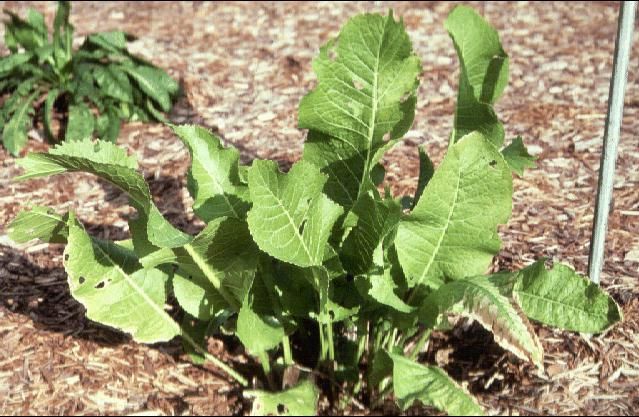
Horseradish. DESCRIPTION
Where horseradish is grown, two types are usually found: the "common" and the "Bohemian." The common type has broad, crinkled leaves and high quality roots. The Bohemian type has narrow, smooth leaves, with root quality somewhat less than that for the common type.CULTURE
Propagation is by vegetative means, utilizing side root cuttings called "sets." Seeds are not used. The side roots (sets) are removed from the main central root when it is harvested. All small, slender root sets between 8 and 14 inches long and about the thickness of a pencil are removed, trimmed, and stored in a moist, cool place until time for planting in early spring.Rows are spaced 30 inches apart and plants are spaced 2 feet apart in the row. A furrow 3-5 inches deep is dug in each bed. The sets are placed horizontally in the bottom of the furrow and a little soil is placed on the bottom end of the root, leaving the top portion uncovered.
A special practice is utilized by horseradish growers to obtain top quality roots. When the largest leaves reach 8 inches long, the soil is dug away from the top end of the main root. While the lower end is left undisturbed, the top and middle portions are stripped of any small roots. Then the soil is replaced. A few weeks later, the practice of stripping is repeated. The result is a smooth root with few, if any, side roots to mar the appearance.

Footnotes
1. This document is HS611, one of a series of the Horticultural Sciences Department, Florida Cooperative Extension Service, Institute of Food and Agricultural Sciences, University of Florida. Original publication date May 1994. Reviewed May 2003. Visit the EDIS Web Site at http://edis.ifas.ufl.edu.2. James M. Stephens, Professor, Horticultural Sciences Department, Cooperative Extension Service, Institute of Food and Agricultural Sciences, University of Florida, Gainesville FL 32611.
The Institute of Food and Agricultural Sciences (IFAS) is an Equal Opportunity Institution authorized to provide research, educational information and other services only to individuals and institutions that function with non-discrimination with respect to race, creed, color, religion, age, disability, sex, sexual orientation, marital status, national origin, political opinions or affiliations. For more information on obtaining other extension publications, contact your county Cooperative Extension service.
U.S. Department of Agriculture, Cooperative Extension Service, University of Florida, IFAS, Florida A. & M. University Cooperative Extension Program, and Boards of County Commissioners Cooperating. Larry Arrington, Dean.
Copyright Information
This document is copyrighted by the University of Florida, Institute of Food and Agricultural Sciences (UF/IFAS) for the people of the State of Florida. UF/IFAS retains all rights under all conventions, but permits free reproduction by all agents and offices of the Cooperative Extension Service and the people of the State of Florida. Permission is granted to others to use these materials in part or in full for educational purposes, provided that full credit is given to the UF/IFAS, citing the publication, its source, and date of publication.
