
Malanga—Xanthosoma spp.1
In Florida, malanga is the most popular form of cocoyam, which is a general name applied to several species of Xanthosoma. Many of the common names are confusing because of the interchangeable usage within the various forms and varieties. Malanga, yautia, tannia, and tanier appear most often in common usage, especially in trade circles. Leafy types not grown for tubers are called belembe and calalous.
Credit: UF/IFAS
Description
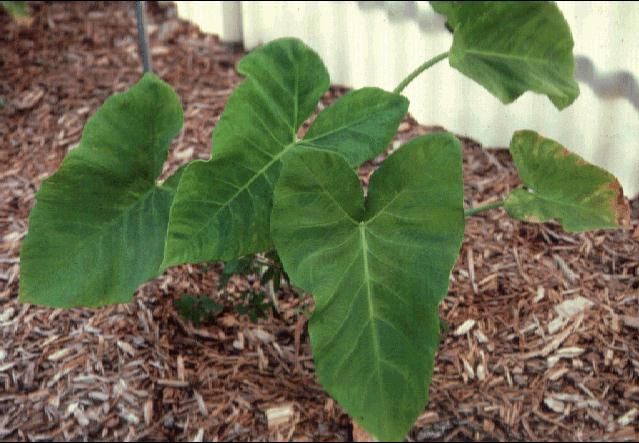
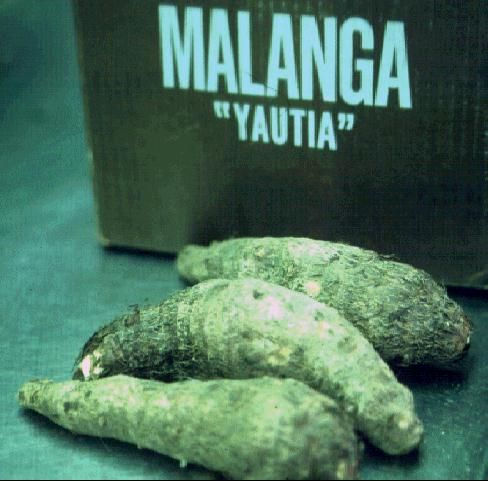
Generally, malanga resembles dasheen (taro) and the elephant-ear plant, with large green leaves about 2 feet wide by 2½ feet long. The upper leaf surface is rather smooth and sometimes waxy, and the lower surface is ribbed. The main difference in leaf shape between dasheen and malanga is that the dasheen's petiole (leaf stem) joins the leaf blade away from the edge of the leaf, whereas the malanga's petiole attaches at the notched edge of the leaf. The malanga plant may attain a height of 5 feet or more. Edible tubers (cormels) are formed in the soil at the base of the plant. A central large tuber (corm) is formed, with a cluster of cormels, grayish brown to black lateral tubers, around it.
Malanga is widely grown and used in the tropics. In South Florida, it has been grown in small patches for many years, and on a limited commercial sale since 1963 to meet the demands of Latin Americans living here. There were about 2,500 acres of malanga grown in Dade County, Florida, in 1985. Malanga, along with calabaza and boniato, made up most of the 14,000 acres of tropical vegetables grown in Dade County in 1991.
Culture
In Florida, malanga should be started in the spring since the crop requires 9 to 10 months to mature. It is injured by frosts. It can be propagated by several methods: (1) plant the top (head), (2) plant the whole main tuber, (3) plant pieces of the main tuber, or (4) plant individual secondary tubers. Propagative materials should be set 3 to 5 inches below the surface. In Florida, plantings have been successful on low-lying marl and rockland soils. Other soil types may be utilized as long as adequate moisture and good drainage are provided.
Credit: UF/IFAS
Use
Harvested malanga tubers can be kept in good condition at room temperature (79°F) and humidity (76%) for just a few weeks. They keep longer if refrigerated at 45°F. Tender tubers are washed and peeled before cooking. Some are so hard that cooking is required before peeling. They may be baked, mashed, fried, or otherwise used as potatoes. Leaves are also eaten as greens.