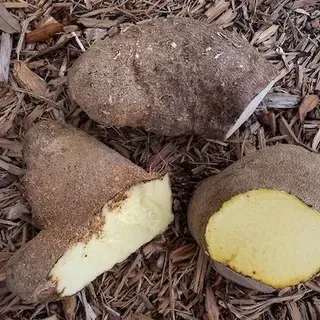


Yams—Dioscorea spp.1
Yam is the common name applied to plants of about 500 species of the genus Dioscorea of the Dioscoreaceae family. Other terms for yam are true yams, greater yam, tropical yam, and name. True yam plants are climbing perennial vines with heart-shaped leaves. Underground tubers vary in size and shape, averaging 3–8 pounds but sometimes reaching 60 pounds or more. Aerial tubers may develop in the axils of the leaves, especially when vines run on the ground. The species occur rather abundantly in tropical and subtropical regions of the world. Several species occur here in Florida and in temperate regions as wild plants.
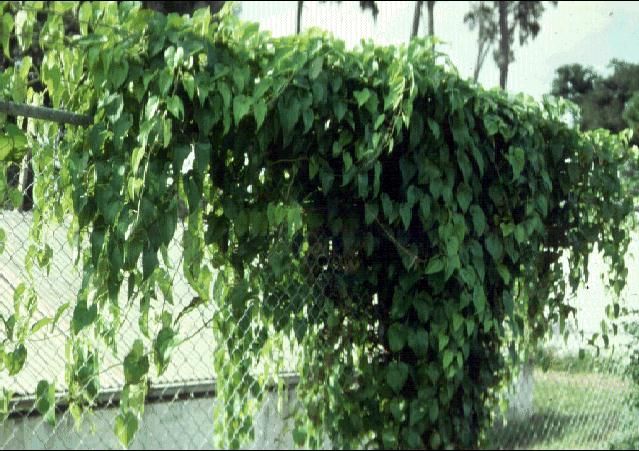
Credit: James M. Stephens, UF/IFAS
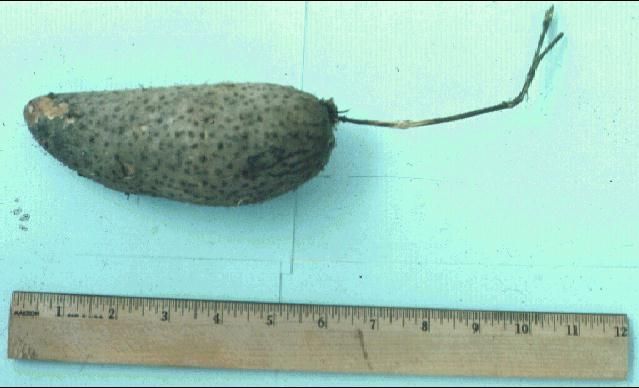
Credit: James M. Stephens, UF/IFAS
Types
-
D. alata L.—Chinese yam, white yam, Lisbon yam, pei tsao, bak chiu, and agua yam. An invasive in Florida.
-
D. batatas Decne—Japanese yam, nago imo, shan yao, and shan yuek.
-
D. cayenensis Lam.—'Guinea,' a popular white-fleshed variety; 'Congo Yellow' and 'Guinea Yellow' are yellow-fleshed varieties; purple-fleshed varieties are 'Purple Ceylon' and 'Mapuey Morado' (also, D. rotunda).
-
D. aculeata L.—Tongo yam.
-
D. rotundata Poir.—Guinea yam.
-
D. trifida L.—cushcush.
Of the sapogenin-bearing Dioscorea species, four are most prominent:
-
D. composita Hensl.—large white tubers (yield best in Florida trials).
-
D. floribunda M & G. Ñ—small, yellow, compact, shallow tubers.
-
D. friedrich-sthalii Knuth.—white. intermediate, compact tubers.
-
D. spiculiflora Hemsl.—small, white, compact, shallow tubers.
Others of less importance are the wild yams, D. bublifera L. or Rajania cordota L.
Culture
Portions of tubers or whole small tubers are used for seed pieces. Each seed piece should weigh 4 to 5 ounces. They can be planted 2 to 3 inches deep in 42-inch rows with plants spaced 18 inches apart, or in hill plantings 3 feet apart. Yams do well when planted in a hill filled with compost. In Florida, tubers should be planted in March-April and harvested 10 to 11 months later. Best results are obtained if the vines are supported with some sort of trellis. Stakes can be used, or yams can be planted along the fence for support.
Use
A few of the cultivated species bear edible starchy tubers that resemble the potato in food value. In some areas, particularly Louisiana, the sweet potato is popularly called yam, which is a misnomer. Although resembling each other in many other respects, the true yam and sweet potato are not related botanically.
Many species of Dioscorea contain sapogenin, a compound having medicinal value. Species have been collected from all parts of the world and evaluated for steroidal sapogenins. It has been reported that many wild species contain the poisonous principle dioscorine, which makes them inedible. For this reason aerial and underground tubers of the wild plants should not be eaten.
In addition to having food and medicinal value, some species have strikingly variegated leaves and are of interest as ornamentals. Some of the edible species and varieties follow.