Pesticide Labeling: First Aid Statements
This document explains first aid statements seen on pesticide labels and discusses the toxicity criteria used in determining the manner in which they are presented on the pesticide label. Examples of typical statements regarding first aid found on pesticide labels are provided.
Introduction
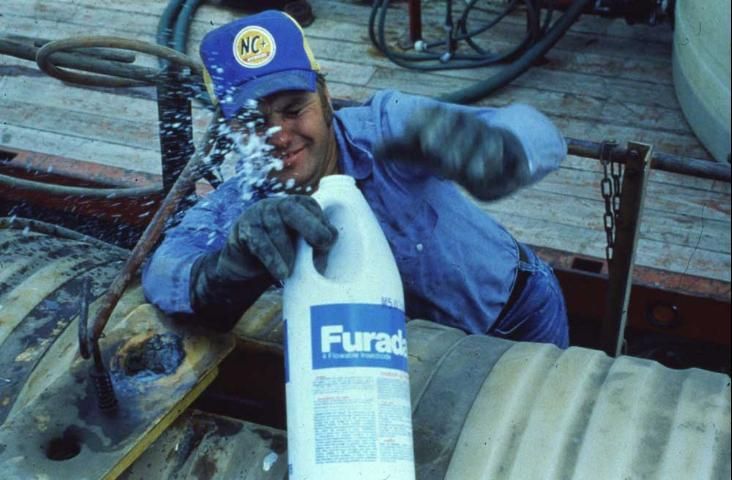
A co-worker has accidentally ingested a small amount of concentrated pesticide from a splash that occurred while pouring the concentrate into the sprayer's tank (Figure 1). Should you give the person water to drink? Maybe it would be more appropriate to help your co-worker induce vomiting; but then again, maybe not.
The pesticide label's first aid statements contain valuable information regarding treatment of victims subjected to pesticide exposure—for all major routes of entry into the body, including ocular, oral, dermal, and inhalation.
Which pesticides labels require first aid statements?
A first aid statement (Figure 2) is required when any acute toxicity study result is classified as Category I, II, or III (Table 1). Although not required, it is acceptable for a pesticide manufacturer to include first aid statements on product labels for which studies have shown to be classified as Category IV. The statements will appear under one of the following headings: "First Aid" or "Statements of Practical Treatment." If the product is classified as toxicity Category I, the statement must appear on the label's front panel.
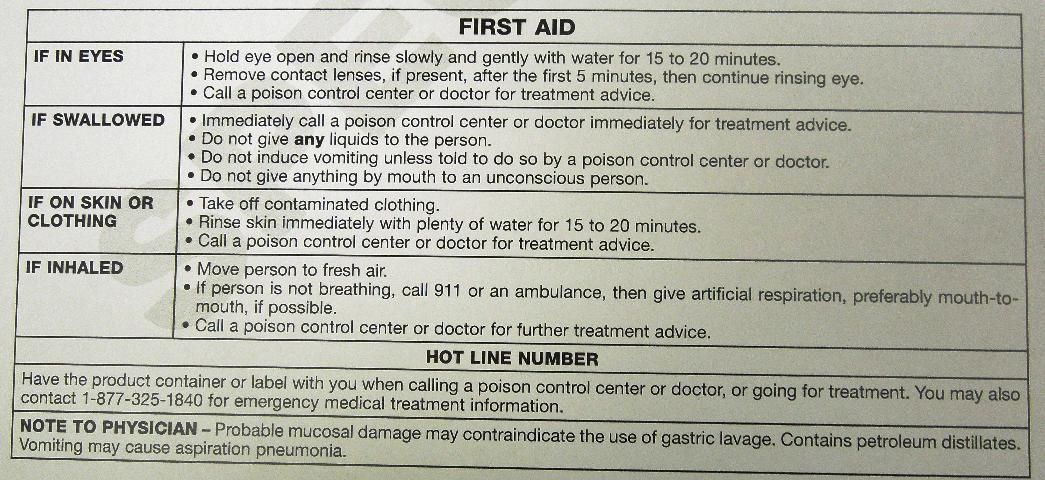
Credit: CDMS
Products classified as toxicity Categories II and III may have their first aid statements on any panel of the product's label. However, if they don't appear on the front panel, a referral statement such as "see side/back panel for first aid" should appear on the front panel in close proximity to the signal word. First aid statements are organized so that the most severe routes of exposure, as shown with the toxicity classification, are listed first. Examples of typical first aid statements are shown in Table 2.
Unique First Aid Statements for Certain Pesticides
If the product contains an organophosphate or carbamate. These pesticides inhibit cholinesterase; therefore, a first aid statement similar to the following will be shown: "Product contains (either carbamate or organophosphate) that inhibits cholinesterase."
If the product contains zinc phosphide. Statements similar to the following may appear: "If swallowed: Immediately call a Poison Control Center or doctor or transport the person to the nearest hospital. DO NOT DRINK WATER. Do not administer anything by mouth or make the person vomit unless advised to do so by a doctor."
If the product contains =10% petroleum distillates. This type of statement is shown: "If swallowed: Immediately call a poison control center or doctor. Do not induce vomiting unless told to do so by a poison control center or doctor. Do not give any liquid to the person. Do not give anything by mouth to an unconscious person."
Note to Physicians
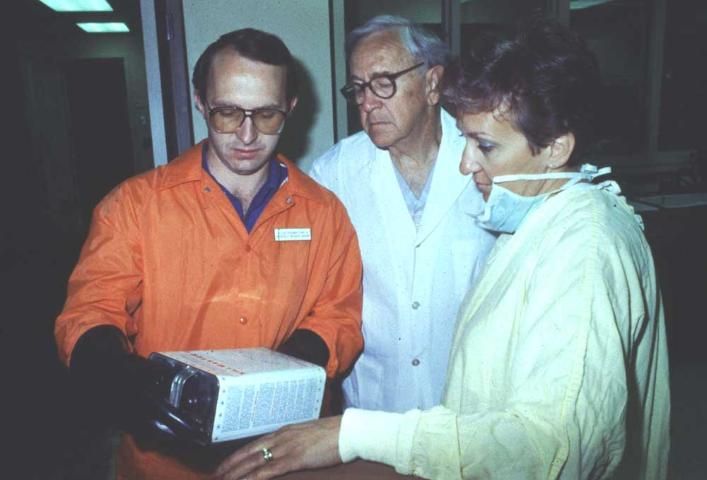
Whenever a person has to be taken to an emergency facility due to a pesticide exposure, the product's label should be taken along. Found on the label, the note to physicians provides detailed instructions for treating an exposure victim (Figure 3). It is found on labels of:
-
All products that are classified as toxicity Category I.
-
Products which are corrosive or classified as toxicity Category I for eye or skin. These products will contain the following note to physicians: "Probable mucosal damage may contraindicate the use of gastric lavage."
-
Products which contain at least 10% petroleum distillate will have a note to physicians such as: "Contains petroleum distillate. Vomiting may cause aspiration pneumonia."
-
Products which produce physiological effects requiring specific antidotal or medical treatment such as: cholinesterase inhibitors, metabolic stimulants, and anticoagulants.
The note to physicians is located in close proximity to the first aid statements, but is clearly distinguished from it. It is not placed within the first aid statements, but appears below the first aid statements.
Additional Information
Fishel, F.M. 2005. Interpreting Pesticide Label Wording. PI-34. Gainesville: University of Florida Institute of Food and Agricultural Sciences. https://edis.ifas.ufl.edu/PI071
Fishel, F.M. 2005. Respirators for Pesticide Applications. PI-77. Gainesville: University of Florida Institute of Food and Agricultural Sciences. https://edis.ifas.ufl.edu/PI114
Fishel, F.M. 2008. EPA Approval of Pesticide Labeling. PI-167. Gainesville: University of Florida Institute of Food and Agricultural Sciences. https://edis.ifas.ufl.edu/PI203
Fishel, F.M. 2009. Personal Protective Equipment for Handling Pesticides. PI-28. Gainesville: University of Florida Institute of Food and Agricultural Sciences. https://edis.ifas.ufl.edu/pi061
Nesheim, O.N., F.M. Fishel and M. Mossler. 2005. Toxicity of Pesticides. PI-13. Gainesville: University of Florida Institute of Food and Agricultural Sciences. https://edis.ifas.ufl.edu/PI008