


Rules and Scorecard Grading Policies for the Annual Florida 4-H/FFA Land Judging Contest
Purpose
The purpose of this publication is to outline the rules of the annual Florida 4-H/FFA Land Judging Contest and to guide participants in correctly completing the Land Judging and Homesite Evaluation scorecards.
What Is the Florida 4-H/FFA Land Judging Contest?
The Florida 4-H/FFA Land Judging Contest provides a forum for youth to first evaluate the quality of land and homesite characteristics and then to identify appropriate land uses. Youth gain knowledge of the land and homesite characteristics that may affect water quality, soil quality, agricultural production, and a range of homesite construction issues. The Florida 4-H/FFA Land Judging Contest is held annually in March and is open to teams of either middle school or high school students. Teams can compete in either 4-H or FFA divisions. Teams in each division compete only against other teams within that division. Teams that win their division contest at the local level become eligible to compete in the state contest. For more information about the Florida 4-H/FFA Land Judging Contest please see the EDIS publication SL362/SS563, Engaging Youth in the Environment through the Florida Land Judging Program, available at https://edis.ifas.ufl.edu/ss563.
General Rules for Land Judging and Homesite Evaluation Contests
Contestants MUST comply with all contest rules. Contestants should pay close attention to guides or leaders and must be prompt in following instructions. The general rules for the land judging and homesite evaluation contests are as follows:
- The use of bulletins, books, notes, levels, drawings, soil samples, or other sources of assistance or information is prohibited during the contest. Contestants may carry a knife and a small bottle of water (to moisten the soil for determining surface texture).
- Contestants may not copy information from other contestants.
- Contestants are prohibited from talking with others during the contest.
- Contestants will be allotted 20 minutes to fill in the answers on their scorecards at each field site (unless otherwise designated).
- The location of the contest fields will be announced only at the start of the contest.
- Paid agricultural workers are ineligible to compete for prizes.
- All decisions made by the judges are final. Appeals are not permitted.
Guidelines for Completing the Land Judging Scorecard
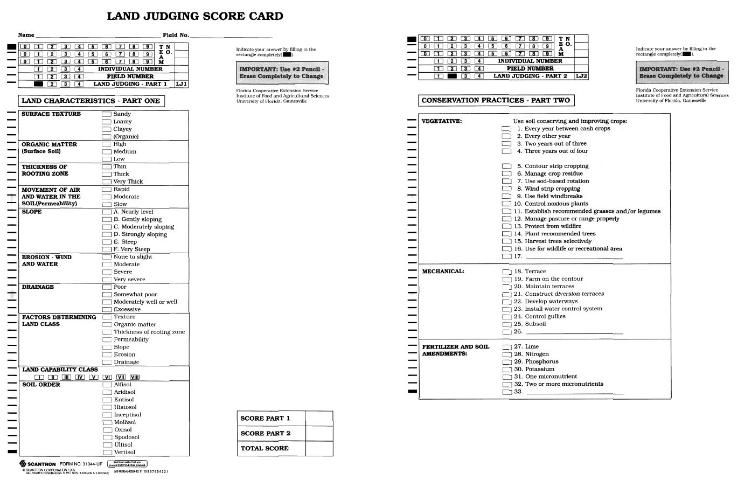
Contestants record their observations and interpretations of the soil and land at the field sites on the provided scorecard. Participants complete three separate land judging scorecards, one for each of the three field sites (Fields 1, 2, and 3). An example of the land judging scorecard is shown in Figure 1. Contestants should follow these guidelines when completing these scorecards:
- When the land is in Class I, contestants should mark no factors. For other classes, contestants should mark the factors that keep the land from being rated as Class I.
- The maximum score for each field is variable, and the score will depend on the number of conservation practices required.
- The blank lines (items 17, 26, and 33) on the land judging scorecard can be used to write in soil-conserving and soil-improving practices not otherwise listed on the scorecard. Officials will make an announcement regarding the additional practice(s) at a particular field site before the contest begins. Given these circumstances, contestants should write the announced practice(s) on the scorecard on the appropriate designated blank lines.
- When selecting conservation practices for Part 2 of the scorecard, contestants should consider the most intensive use that could occur on the land (based on its limitations).
- Contestants should select only the number of conservation practices needed for each site. Officials will give credit for correct practices, but will deduct points for any incorrect practices that have been checked.
Guidelines for Completing the Homesite Evaluation Scorecard
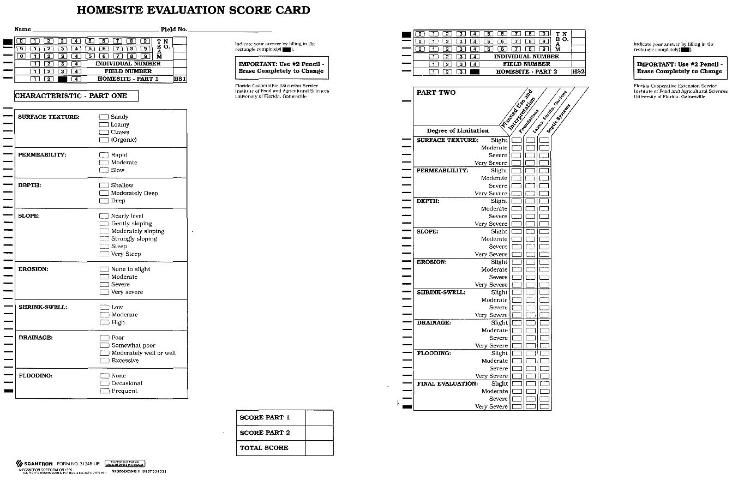
Contestants record their observations and interpretations of the soil and land at the field sites on the provided scorecard. Participants complete one homesite evaluation scorecard for Field 4. An example of the homesite evaluation scorecard is shown in Figure 2. Contestants should follow these guidelines when completing the homesite evaluation scorecard:
- The maximum possible score at the homesite field is 70 points. The maximum score for Part I is 16 points and the maximum score for Part II is 54 points (18 points for each use).
- Contestants should determine the final evaluation of the site based on the most restrictive "degree of limitation" for the particular planned use and interpretation (e.g., foundations; lawns, shrubs, gardens; septic systems).
Scorecard Grading Policies
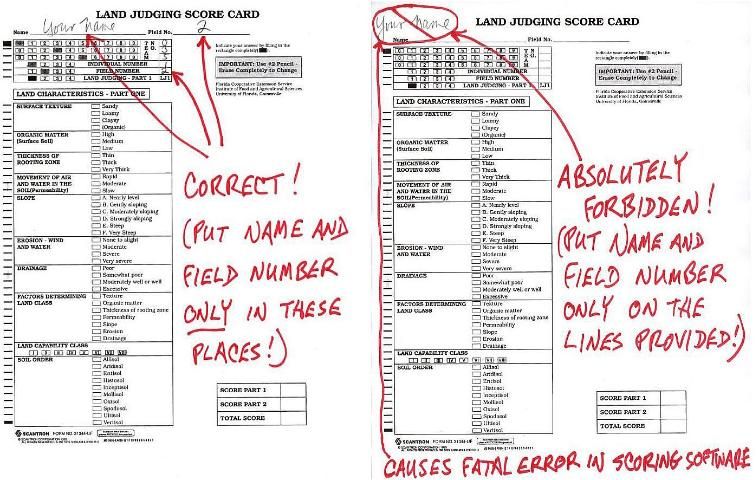
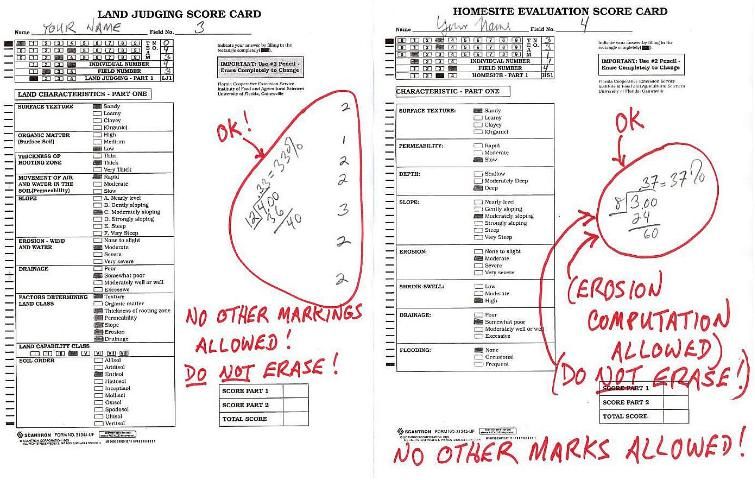
Examples of completed scorecards with acceptable and unacceptable markings are shown in Figures 3 through 8. Contestants MUST follow these rules when completing scorecards to ensure that their scorecard does not receive a zero score:
- Scorecards MUST be completed using a #2 pencil.
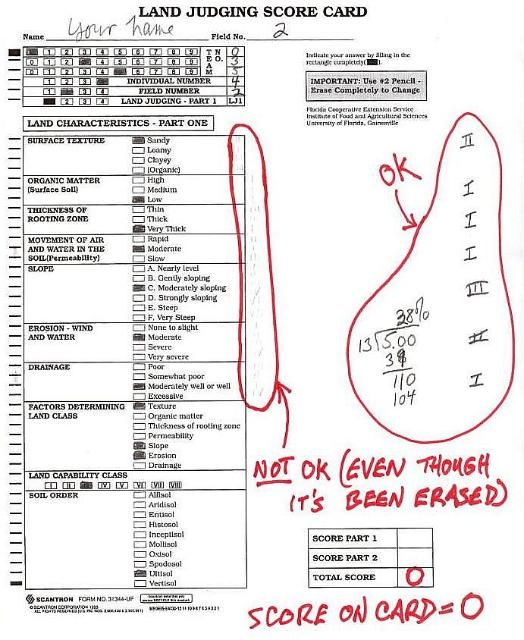
- Land judging or homesite evaluation scorecards must ALWAYS be identified with the field number and the contestant's name (Figure 3). This information should be included on the appropriate lines at the top of the front page of the scorecard.
- In addition to name and field number, the ONLY marks allowed on scorecards are:
a. Filled rectangles provided for team identification and answers.
b. If necessary, some minor arithmetic to compute the change in thickness of the topsoil when determining degree of erosion (Figure 4).
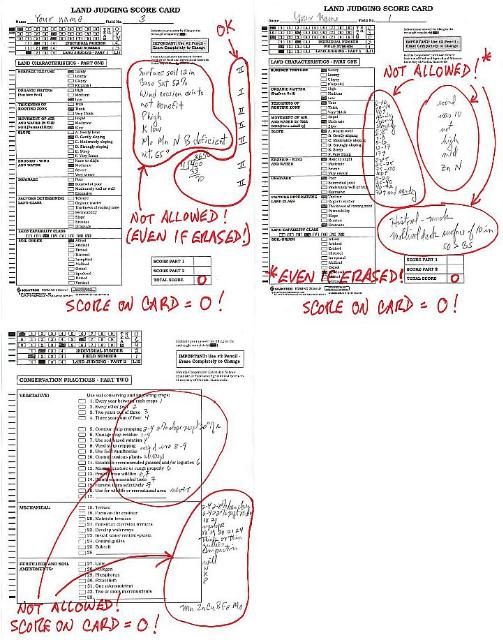
c. A maximum of seven Roman or Arabic numerals corresponding with a contestant's estimate of the best possible land classes associated with the seven appropriate soil characteristics (surface texture, organic matter, rooting zone, permeability, slope, erosion, and drainage) identified at the field site on part one of the land judging scorecard. In other words, one and only one numeral may be written on the card for each appropriate soil characteristic (Figure 5).
4. Any allowed markings (described above) should be:
a. Made lightly in pencil.
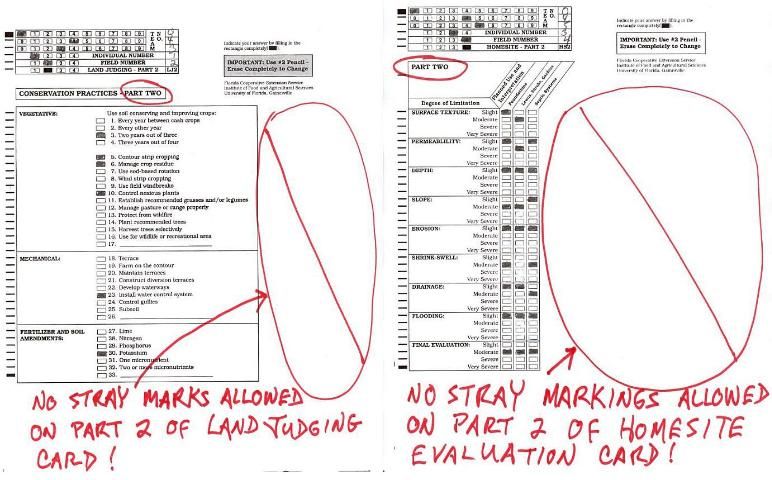
b. Kept clear of the scoring fields (i.e., placed only on the right-hand side of the card, outside and well away from the large boxes where answers are entered) (Figure 6).
c. Left on the card as written and not erased.
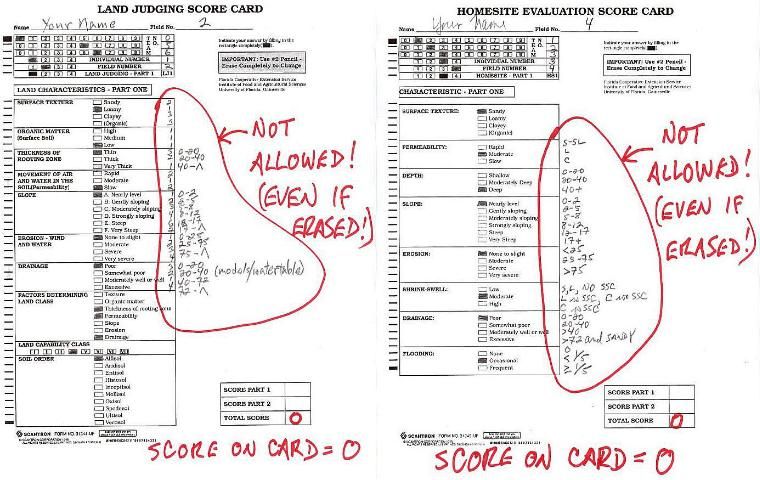
Any scorecard with notes, numbers, and/or marks (from training materials, memory, or other sources) written on the card will be assigned a score of 0 (zero)! Evidence of all other notes/numbers/markings that have been written on a card and then erased will also cause a score of 0 (zero) to be assigned to that card! See Figures 6 through 8 for examples of marks that are NOT allowed on land judging and homesite evaluation scorecards.
Scorecard Grading and Determination of Contest Winners
Contestants submit completed scorecards to a proctor for grading immediately following the judging of each site. Grading will be completed within a few hours if scorecards are filled out correctly and in good condition. The official "answers" will be shared with the participants once each team has completed evaluations of all four field sites. Coaches and participants are free to ask questions during this grading, or they can discuss items after grading is completed.
The contestant with the highest overall scores on the land judging and homesite evaluation scorecards will be declared the winner. In the event of a tie, the individual score for Field 1 will be used as the first tie breaker. If a tie still exists, individual field scoring will continue in this manner for Fields 2, 3, and 4 until the tie is broken. In the event that a tie still exists after comparing scores from all fields, officials will take one of these two actions:
- Hand-graded scorecards: The winner will be determined based on the score of Part 1 of Field 1, Part 1 of Field 2, etc.; or
- Machine-graded scorecards: Declare a tie between individuals (and/or teams) having identical scores, and provide duplicate plaques/rosettes to these individuals (and/or teams) as soon as possible following the contest.
Once scorecards are graded, the contest organizers will review the results, confirm the eligibility of the winners, and hold an awards ceremony. The ceremony is held as soon as possible following the contest, which is typically in early to mid-afternoon. Awards are given to the top individual and top five teams in each category (e.g., 4-H middle school, FFA high school).