


Bauhinia spp.: Orchid Tree1
Introduction
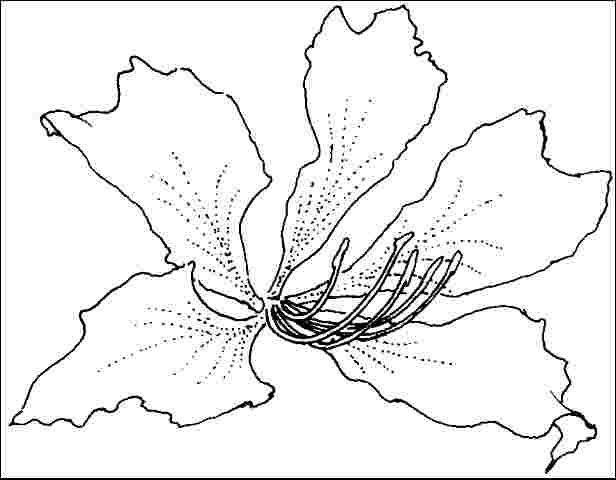
This deciduous to semievergreen tree has a vase-shaped, open canopy with lower branches removed made up of large, bilobed, light green, papery leaves. Unpruned trees form a rounded crown. The orchid-like blooms, in shades of purple, red, pink, white, or yellow, are three to four inches across and produced in abundance at various times of the year, depending upon species. Orchid tree makes a spectacular specimen or shade tree or fits well into mixed shrubbery borders.
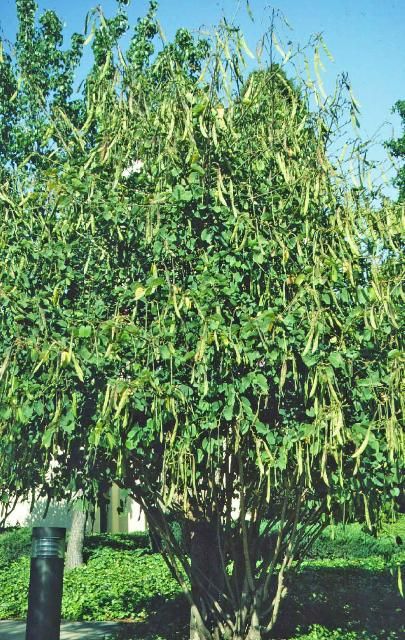
Credit: Ed Gilman
General Information
Scientific name: Bauhinia spp.
Pronunciation: bah-HIN-ee-uh species
Common name(s): Orchid tree
Family: Leguminosae
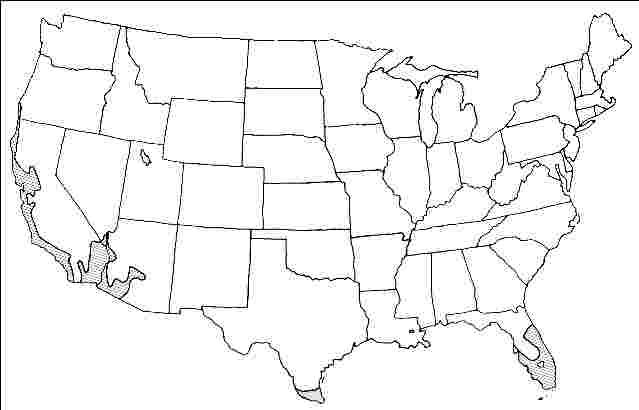
USDA hardiness zones: 9B through 11 (Fig. 2)
Origin: not native to North America
Invasive potential: According to the UF/IFAS Assessment of the Status of Non-Native Plants in Florida's Natural Areas (Fox et al. 2005), Bauhinia spp . (orchid tree) is invasive and not recommended for use in the southern zone of Florida (counties are listed by zone at https://assessment.ifas.ufl.edu/); may be used with caution in central Florida, but should be managed to prevent its escape 1; and it is not considered a problem species and may be used in north Florida.
Uses: deck or patio; shade; specimen; reclamation; street without sidewalk; parking lot island < 100 sq. ft.; parking lot island 100–200 sq. ft.; parking lot island > 200 sq. ft.; tree lawn 3–4 feet wide; tree lawn 4–6 feet wide; tree lawn > 6 ft. wide; highway median
Availability: not native to North America
1Current assessment is incomplete; please check for updated information at https://assessment.ifas.ufl.edu/
Description
Height: 25 to 30 feet
Spread: 25 to 35 feet
Crown uniformity: irregular
Crown shape: vase, round
Crown density: moderate
Growth rate: fast
Texture: coarse
Foliage
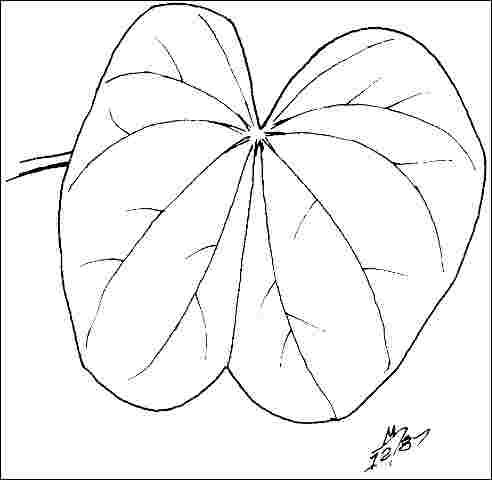
Leaf arrangement: alternate (Fig. 3)
Leaf type: simple
Leaf margin: cleft, lobed
Leaf shape: orbiculate
Leaf venation: palmate
Leaf type and persistence: deciduous, semievergreen, evergreen
Leaf blade length: 2 to 4 inches
Leaf color: green
Fall color: no color change
Fall characteristic: not showy
Flower
Flower color: white/cream/gray, purple, red, pink, yellow
Flower characteristics: very showy
Fruit
Fruit shape: elongated, pod or pod-like
Fruit length: 6 to 12 inches
Fruit covering: dry or hard
Fruit color: brown
Fruit characteristics: does not attract wildlife; showy; fruit/leaves a litter problem
Trunk and Branches
Trunk/bark/branches: branches droop; not showy; typically multi-trunked; thorns
Pruning requirement: needed for strong structure
Breakage: susceptible to breakage
Current year twig color: brown
Current year twig thickness: thin, medium
Wood specific gravity: unknown
Culture
Light requirement: full sun, partial sun or partial shade
Soil tolerances: clay; sand; loam; acidic; slightly alkaline; well-drained
Drought tolerance: high
Aerosol salt tolerance: moderate
Other
Roots: not a problem
Winter interest: yes
Outstanding tree: no
Ozone sensitivity: unknown
Verticillium wilt susceptibility: unknown
Pest resistance: free of serious pests and diseases
Use and Management
Growing best in full sun or high, shifting pine shade, orchid tree thrives in any well-drained soil but in alkaline soils will show interveinal chlorosis (yellowing) on the leaves. The flowers are followed by many brown, woody, 12-inch-long seed pods, which are unattractive on the tree and a nuisance when they drop. The wood tends to be weak and sprouts are often seen growing from the base of the tree, creating an unkempt appearance. Some people consider the fallen leaves messy because they are large and decompose slowly.
In flower, orchid tree makes a beautiful street tree effect with foliage and flowers arching over the road. However, the drooping branches must be removed as they develop, to allow for vehicle clearance beneath. Because sprouts will have to be removed regularly and the tree is bare for a month or two, this is considered by many to be a high-maintenance tree not suited for large-scale street tree planting. But it is a tough tree growing in most soils with pH below 7.5.
Many species, cultivars, and varieties are available. Bauhinia blakeana, the Hong Kong orchid tree, is seedless and would not present such a litter problem. It is also the most spectacular and most wanted Bauhinia spp., bearing six-inch, orchid-like flowers of rich reddish or rose purple during the winter but is very tender to freezing temperatures. Bauhinia variegata, most popular, produces in winter and spring most nearly orchid-like blossoms of purplish casts or pure white in cultivar 'Candida'. Bauhinia purpurea, most variable, produces narrow-petaled, red-purple to blue-purple flowers in late fall and early winter while leaves are on the trees. Bauhinia monandra produces pink, single-stamened flowers all summer. Bauhinia acuminata also blooms all summer but with white flowers. Bauhinia aculeata, with white flowers, is hardy as far north as hardiness USDA hardiness zone 8b but has a tendency to produce many root suckers.
Propagation is by seeds, or cuttings for the rare types.
Pests
Chewing insects and borers may present a problem for orchid tree.
Diseases
No diseases are of major concern. Interveinal chlorosis occurs on high pH soil from micronutrient deficiency.

