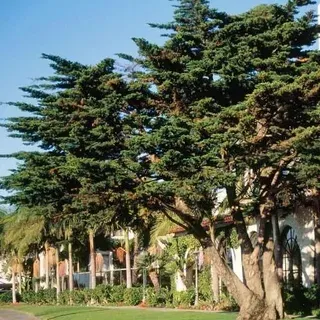
Hesperocyparis macrocarpa: Monterey Cypress
Introduction
Monterey cypress thrive near the sea on the west coast of the United States, where it is native to the Monterey Bay, California, area. It has a high wind tolerance, becoming increasingly more attractive under heavy wind conditions. Narrow and pyramid-shaped when young, monterey cypress spreads with age, and can become 70 to 90 feet in height. It is one of the major trees planted to hold the sands in Golden Gate Park, San Francisco, but unfortunately many are dying. The plant is only grown in the western states.
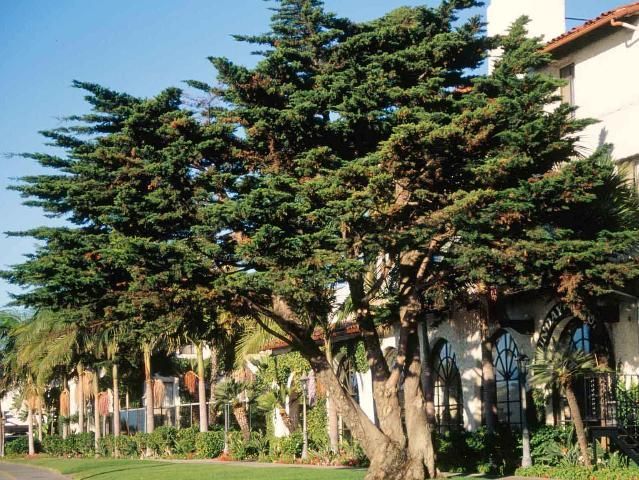
Credit: Ed Gilman, UF/IFAS
General Information
Scientific name: Hesperocyparis macrocarpa
Pronunciation: hes-per-oh-SY-pair-iss mack-roe-KAR-puh
Common name(s): Monterey cypress
Family: Cupressaceae
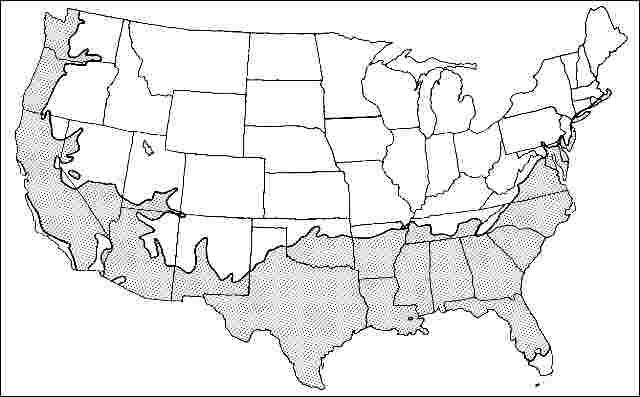
USDA hardiness zones: 7A through 10A (Figure 2)
Origin: native to North America
Invasive potential: not assessed/incomplete assessment
Credit:
Description
Height: 40 to 70 feet
Spread: 30 to 40 feet
Crown uniformity: irregular
Crown shape: columnar, pyramidal
Crown density: moderate
Growth rate: moderate
Texture: fine
Foliage
Leaf arrangement: opposite/subopposite
Leaf type: simple
Leaf margin: entire
Leaf shape: scale-like
Leaf venation: none, or difficult to see
Leaf type and persistence: evergreen
Leaf blade length: less than 2 inches
Leaf color: green
Fall color: no color change
Fall characteristic: not showy
Flower
Flower color: yellow
Flower characteristics: not showy
Fruit
Fruit shape: round
Fruit length: 0.5 to 1 inch
Fruit covering: dry or hard
Fruit color: brown
Fruit characteristics: does not attract wildlife; not showy; fruit/leaves not a litter problem
Trunk and Branches
Trunk/bark/branches: branches droop; not showy; typically one trunk; thorns
Pruning requirement: little required
Breakage: susceptible to breakage
Current year twig color: green
Current year twig thickness: thin
Wood specific gravity: unknown
Culture
Light requirement: full sun
Soil tolerances: clay; sand; loam; slightly alkaline; acidic; well-drained
Drought tolerance: moderate
Aerosol salt tolerance: high
Other
Roots: not a problem
Winter interest: no
Outstanding tree: yes
Ozone sensitivity: unknown
Verticillium wilt susceptibility: resistant
Pest resistance: sensitive to pests/diseases
Use and Management
Cypresses can be grown from seeds sown in sandy, peaty soil or from summer cuttings in a humid greenhouse under mist.
Pests
Cypresses may be infested with aphids, mealybugs, caterpillars, and scale insects. All can be controlled by washing with soap solution or with appropriate chemical spray.
Diseases
This tree is susceptible to coryneum canker fungus, for which there is no cure. Control of cankers consists chiefly in cutting out and burning affected parts. Badly infected trees may require complete removal.