


Ligustrum lucidum 'Tricolor': 'Tricolor' Glossy Privet1
Introduction
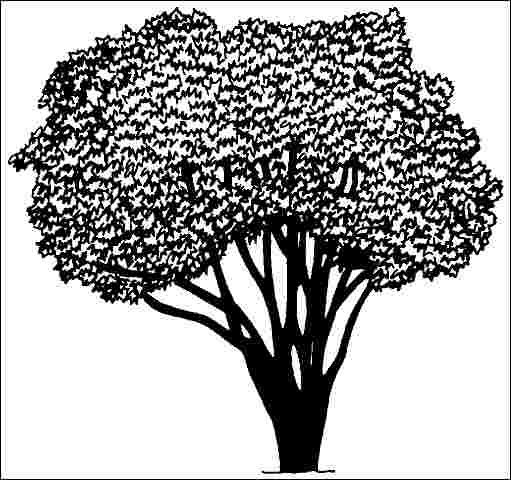
This fast-growing evergreen tree, 25 to 35 feet in height (can grow larger) with a 25 to 35-foot spread, has a dense canopy of bending branches composed of large, four to six-inch-long, glossy green leaves with white edges. Young leaves emerge pink. Terminal, 6 to 10-inch-long, eye-catching panicles of small, white, malodorous flowers are produced in late spring in the south and summer in the north. These blooms are followed in fall by large, showy clusters of small purple berries. The berries are popular with birds and the dispersed seeds germinate in the landscape and could become somewhat of a nuisance. Care must be taken in the location of this multitrunked tree since the profuse berry production can create a litter problem on hard surfaces. The fallen berries may stain car paint, walks, and patios.
General Information
Scientific name: Ligustrum lucidum
Pronunciation: lih-GUS-trum LOO-sih-dum
Common name(s): 'Tricolor' Glossy Privet, `Tricolor' Tree Ligustrum
Family: Oleaceae
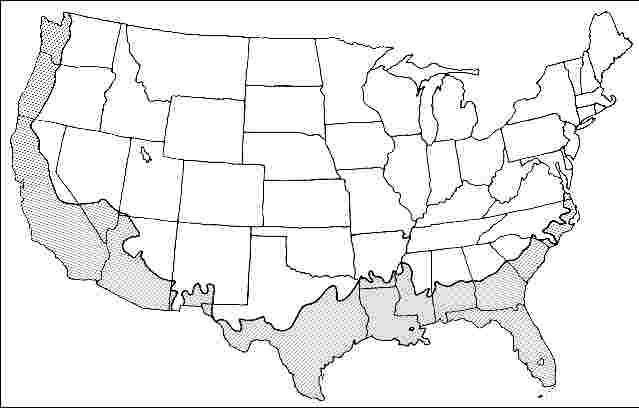
USDA hardiness zones: 8A through 11 (Figure 2)
Origin: not native to North America
Invasive potential: According to the IFAS Assessment of Non-Native Plants in Florida's Natural Areas (IFAS Invasive Plant Working Group 2008), in Florida Ligustrum lucidum should be treated with caution, may be recommended but managed to prevent escape.
Uses: Bonsai; deck or patio; street without sidewalk; screen; specimen; trained as a standard; container or planter; parking lot island < 100 sq ft; parking lot island 100–200 sq ft; parking lot island > 200 sq ft; tree lawn 3–4 feet wide; tree lawn 4–6 feet wide; tree lawn > 6 ft wide; highway median; shade
Availability: not native to North America
Description
Height: 25 to 35 feet
Spread: 25 to 35 feet
Crown uniformity: symmetrical
Crown shape: round, vase
Crown density: dense
Growth rate: moderate
Texture: medium
Foliage
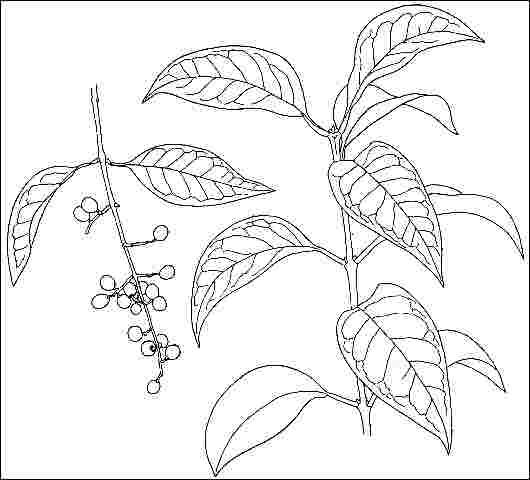
Leaf arrangement: opposite/subopposite (Figure 3)
Leaf type: simple
Leaf margin: entire
Leaf shape: ovate, lanceolate
Leaf venation: pinnate
Leaf type and persistence: evergreen, broadleaf evergreen
Leaf blade length: 2 to 4 inches, 4 to 8 inches
Leaf color: variegated
Fall color: no color change
Fall characteristic: not showy
Flower
Flower color: white/cream/gray
Flower characteristics: showy
Fruit
Fruit shape: oval, round
Fruit length: less than .5 inch
Fruit covering: fleshy
Fruit color: blue, purple
Fruit characteristics: attracts birds; showy; fruit/leaves a litter problem
Trunk and Branches
Trunk/bark/branches: branches droop; not showy; typically multi-trunked; thorns
Pruning requirement: needed for strong structure
Breakage: resistant
Current year twig color: green, gray
Current year twig thickness: medium
Wood specific gravity: unknown
Culture
Light requirement: full sun, partial sun or partial shade
Soil tolerances: sand; loam; clay; acidic; alkaline; well-drained
Drought tolerance: moderate
Aerosol salt tolerance: moderate
Other
Roots: not a problem
Winter interest: yes
Outstanding tree: no
Ozone sensitivity: unknown
Verticillium wilt susceptibility: susceptible
Pest resistance: resistant to pests/diseases
Use and Management
When growing on to a tree sized plant, be sure not to purchase those which were trained as a standard. These often have all branches originating from the same spot on the trunk, and are not well formed for longevity in the landscape. Trees trained as standards are high-maintenance plants since they should be kept in this form and size for their entire life. Most nurseries grow Tree Ligustrum with several trunks originating close to the ground. They spread out from each other as they ascend into the rounded, vase-shaped canopy. These can be planted as street trees if lower branches are periodically removed when the tree is young.
Showing quick growth while young but slowing with age, Tree Ligustrum will grow in full sun or partial shade on various soil types, and is moderately salt-tolerant. The tree seems to thrive on neglect and are used along highways (unirrigated) as a screen for headlights. Clay soil and high pH do not seem to cause any problems as long as water drains away from the roots. Plant it as a street tree along boulevards where regular mowing will kill germinating seedlings and in locations where overhead space is limited. Mature specimens will require only light pruning to maintain shape and remove dead wood.
Many other cultivars are available: `Compactum' has dense leaves of dark, waxy green; `Davison Hardy' is exceptionally hardy (to minus-10-degrees F.) and has excellent foliage, becoming available in the trade; `Gracile' has closely-spaced erect branches; `Macrophyllum' has large leaves while `Microphyllum' has small leaves; `Nigrifolium' has very dark green leaves; `Nobile' has branches which are strongly ascending and fastigiate; `Pyramidale' is narrowly conical in form; `Recurvifolium' has recurved leaf margins; `Repandum' has narrow leaves with waxy edges.
Propagation is by grafting. Plants are often grafted onto Ligustrum quihoui since Tree Ligustrum is resistant to propagation by cuttings. The abundant seedlings found under old trees can be transplanted and used as they are or as grafting stock.
Pests
Scales, white-flies, sooty-mold, and nematodes are problems but not serious.
Diseases
Root rot in wet soil.
Literature Cited
Fox, A.M., D.R. Gordon, J.A. Dusky, L. Tyson, and R.K. Stocker. 2008. IFAS Assessment of Non-Native Plants in Florida's Natural Areas: Status Assessment. Cited from the Internet (November 16, 2012), http://plants.ifas.ufl.edu/assessment/pdfs/status_assessment.pdf

