Edward F. Gilman, Dennis G. Watson, Ryan W. Klein, Andrew K. Koeser, Deborah R. Hilbert, and Drew C. McLean
2
Introduction
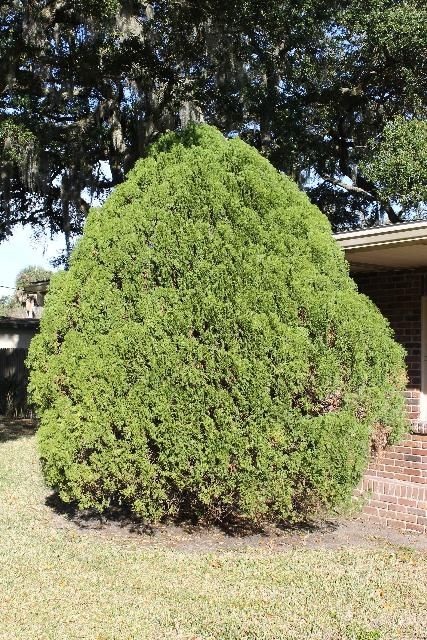
Oriental arborvitae is an easily-recognized shrub, with its large teardrop shape and flattened branchlets held vertically. Most young plants are seen as shrubs, but they can be pruned into a small tree by removing the lowest branches. This forms a distinctive vase shape and is common on older landscapes where the plant was located too close to a walk or home.
Figure 1. Full Form - Platycladus orientalis: oriental arborvitae Credit: UF/IFAS
General Information
Scientific name: Platycladus orientalis
Pronunciation: plat-ih-KLAY-dus or-ee-en-TAY-liss
Common name(s): 0rientalarborvitae, arborvitae
Family: Cupressaceae
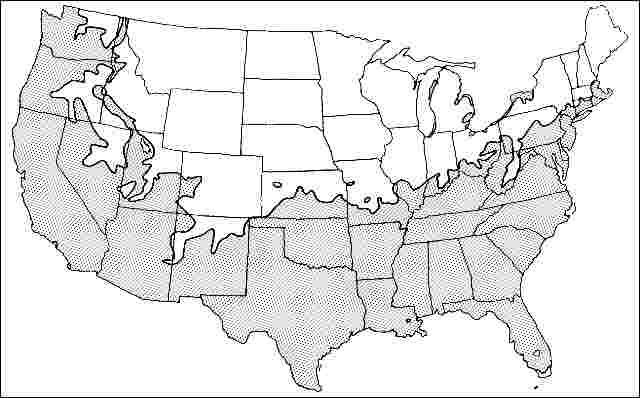
USDA hardiness zones: 6A through 10A (Figure 2)
Origin: native to China and North Korea
UF/IFAS Invasive Assessment Status: not considered a problem species at this time, may be recommended (North, Central, South)
Uses: specimen; screen; urban tolerant; highway median
Figure 2. Range
Description
Height: 15 to 20 feet
Spread: 10 to 15 feet
Crown uniformity: symmetrical
Crown shape: pyramidal, oval
Crown density: dense
Growth rate: moderate
Texture: fine
Foliage
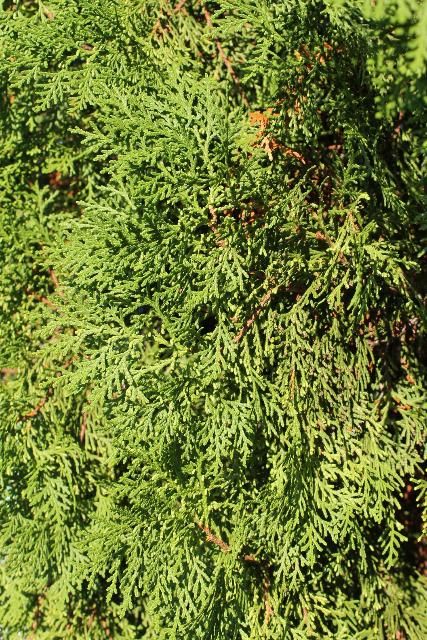
Leaf arrangement: vertical flat plane
Leaf type: simple
Leaf margin: entire
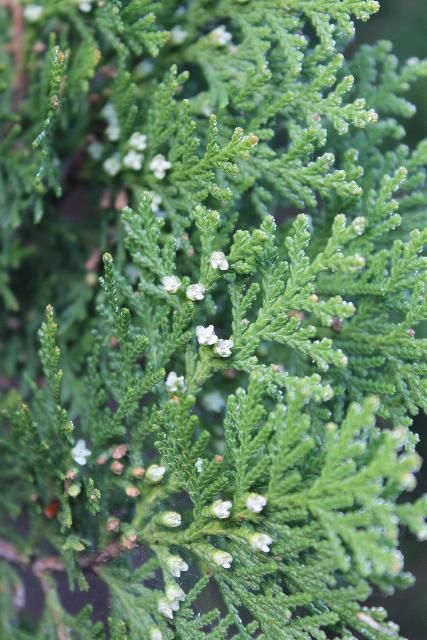
Leaf shape: scale-like, deltoid
Leaf venation: none, or difficult to see
Leaf type and persistence: evergreen
Leaf blade length: 1/16 to 1/8 inch
Leaf color: bright yellow green when young, darker green when mature
Oriental arborvitae does not tolerate pruning well since all foliage is toward the outside of the crown, but it is well-suited for use as a barrier, background, or specimen planting in a large landscape where it is properly located so pruning is not needed. Its distinctive appearance does not fit easily into natural or informal landscapes. It is often planted in cemeteries and referred to as Cemetery Plant.
Oriental arborvitae grows moderately fast in full sun or very light shade and tolerates drought well once established. Sandy or loam soil is best, clay soil is only suited on a slope where drainage is good.
Available cultivars include: `Aureus', 3 to 5 feet tall, compact, golden leaves in spring, globe-shaped; `Baker', height 7 to 9 feet, bright pale green foliage, hardy in hot, dry areas; `Berckmanii', height 4 to 6 feet, compact and globe-shaped with golden-tipped branchlets; `Bonita', cone-shaped, 3 feet tall, leaves with yellow tips; `Globosa', globe-shaped dwarf; `Juniperoides', 3 feet tall, juvenile foliage needle-like, purplish foliage in fall; `Meldensis', 3 feet tall, narrow, purplish foliage in fall.
Propagation is by cuttings.
Pests and Diseases
Pest problems include spider mites and bagworms. A fungus blight causes the interior twigs to turn brown. This blight can be controlled by fungicides in early fall and by pruning out and destroying affected areas. Locate the plant in a sunny area with good air circulation to keep the foliage as dry as possible.
Additional References
Koeser, A. K., Hasing, G., Friedman, M. H., and Irving, R. B. 2015. Trees: North & Central Florida. University of Florida Institute of Food and Agricultural Sciences.