

Reporting Clientele Contacts in Workload
Each fall, UF/IFAS faculty are asked to report on their Extension activities and accomplishments over the past year. This publication provides guidelines for UF/IFAS faculty to meet their annual Extension reporting requirements. One aspect of this reporting is the contact made with Extension clientele through direct methods, such as workshops or visits to a client's farm, or indirect methods, via printed materials or the internet. For our purposes, anyone in the community who receives educational information from UF/IFAS faculty is considered an Extension client. Students who receive this information as part of their undergraduate or graduate education, as well as faculty colleagues or other academic professionals who receive this information as part of their jobs, are not considered Extension clientele.
While faculty are required to report these same data in their Report of Accomplishments (ROA), the purpose of this fact sheet is to describe how to report Extension clientele contacts in the Workload online system. Compliance and accuracy in reporting these contacts in Workload are very important because UF/IFAS uses this information to submit an annual federal report that is required in order to receive our federal Capacity funding (e.g., Smith-Lever, Hatch, and Hatch Multistate). These data also assist in communicating with key clientele and local officials to maintain operational and salary dollars at the county level.
The clientele contact data that faculty submit in Workload serve as productivity measures, referred to as Research Delivery Units (RDU), which are used to gain additional state funds for the UF/IFAS research, teaching, and Extension missions. RDUs are based on aggregate data for all UF/IFAS faculty and do not contain individual faculty detail. Likewise, the Extension Annual Report and yearly County Economic Impacts also utilize aggregate counts of clientele contacts.
Individual-level data are available in real-time in Workload through delivered reports by district, county, department/center, and Extension priority work groups. Ad Hoc reports are available upon request. These data are provided to UF/IFAS administration and may be considered during departmental and county program reviews.
Although providing educational information to the community is most common among Extension faculty, it does occasionally occur among those who have no Extension appointment. This is why all faculty—regardless of appointment—are asked to provide their clientele contact data in Workload.
Clientele Contacts
Florida Extension, which includes both the University of Florida and Florida A&M University, defines an Extension contact as an interaction with the intention to convey educational information and classifies the following as legitimate, reportable contacts:
- individual consultations in the field or the office;
- face-to-face interactions in group meetings, workshops, field days, classrooms, and clinics;
- individual correspondence by letter, email, telephone, or other electronic methods such as texting, instant messaging, YouTube, social media sites, software applications, mobile apps, etc.;
- interactive video conferences or meetings;
- distance learning, including webinars, online training, online courses, etc.;
- diagnostic services;
- volunteer training or orientations;
- web visits.
Educational Materials
Creating educational materials and publications for a non-credit/non-academic audience is also considered a type of contact. Florida Extension defines educational material as an original work prepared or modified to communicate research-based educational information to others. A major revision may be counted as educational material, but minor revisions should not.
This category of clientele contact includes written materials (e.g., fact sheet, handout, newspaper article, book and book chapters, research report, brochure, presentation slides, newsletter, exhibit, poster, curriculum guide, etc.), as well as electronic materials (e.g., web page or site, blogs, wikis, social networking sites, curriculum created for online community education classes, CD/DVDs, audio or video podcasts, TV or radio broadcasts, YouTube videos, etc.). In Workload, do not include refereed or EDIS publications in your educational material counts—we collect these separately.
Faculty should report each original work one time. In other words, the same article should only be counted once regardless of how many times it is published or where it is published (e.g., website, SMS email, hand-delivered). While you will want to report the dissemination of the educational materials in your ROA (i.e., newsletter or SMS subscribers, radio listeners, TV audience, etc.), this information is not captured in Workload. However, if you provide the newsletter as a response to an inquiry from a client, then it is counted as a clientele contact (i.e., email or phone consultation). Moreover, electronic newsletters may be counted as a clientele contact if there is a means to track whether the recipient opened and/or read the newsletter (e.g., open rate, click-through).
Creating a new website or page, or the significant revision of one, is counted as an educational material.
Each author should report his or her own work, and the faculty member who assembles and organizes an issue should also count his or her work as an educational material. When the publication is a newsletter or contains multiple articles or a website with multiple topics or pages, it can be difficult to determine whether it is counted as a single educational material or multiple ones. When the information conveyed is lengthy, detailed, and/or there are multiple authors, then they should be broken out into their individual parts. This is a judgment call that each author/editor should make based on how much new work and information went into the articles.
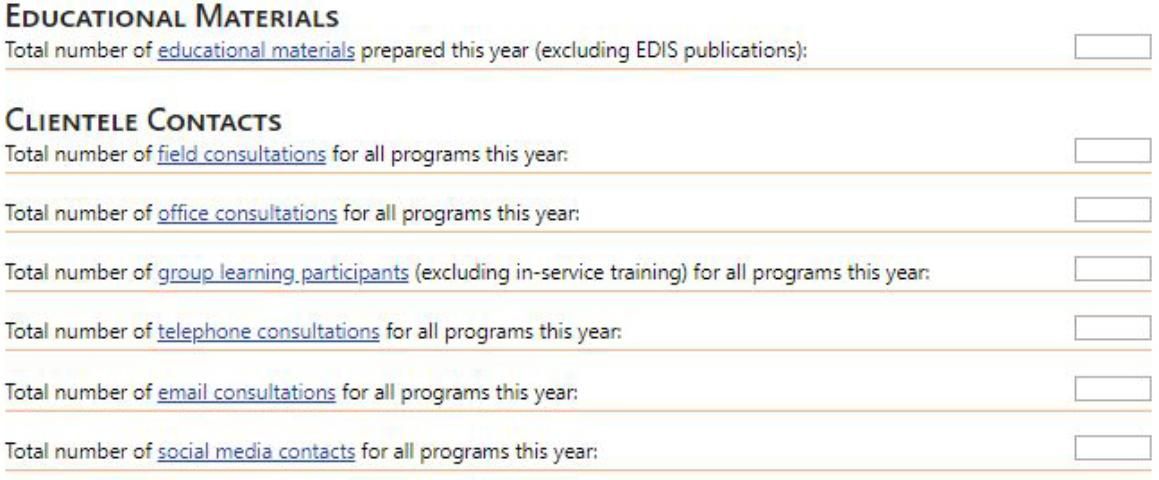
In summary, if you produced any written or visual materials for a non-student/non-academic audience or had any contact with the general public or members of the community to convey educational information about your research, teaching, or Extension program, you should enter the data in the Workload Reporting Categories section shown below, regardless of whether you have an Extension appointment (see Figure 1). Note that group learning participants is the same as extension teaching events in the ROA for county faculty.
Credit: UF/IFAS Program Development and Evaluation Center
Web Visits
Web visits are counted as an Extension contact but are not found in Workload (as of 2015). To avoid duplicated counts (i.e., many faculty counting the same shared website), the UF/IFAS Program Development and Evaluation Center (PDEC) collects this information annually from several UF/IFAS websites using Google Analytics. Sites include Solutions for Your Life, EDIS publications, IFAS News, and IFAS Blogs—all designed for an external audience to obtain educational information. A web visit begins when a person enters the website and ends when they leave the site, or the session closes automatically after a specified period of inactivity (typically 30 minutes).
Social Media
Social media, web posts, and messages that can be tracked and counted are considered social media contacts if the information contained is educational. For Workload, we count Facebook post views, likes, comments, shares, and clicks; for X (formerly known as Twitter), favorites or retweets; for YouTube, views, comments, shares, and favorites added; for Instagram, use total engagement (likes, comments, saves). We do not count Facebook "friends" or X and Instagram "followers" or YouTube "subscribers" as a clientele contact for the same reason we do not count newsletter subscribers or a TV/radio audience: they are a form of mass communication, whereby the potential audience is known but not the actual number of users.
With regard to blogs and wikis, the content you produce is considered educational material. The exchange of information on a particular issue or problem with an individual using the comments section is counted as a social media contact. If you have created a Facebook post that is an extensive piece (or a series of substantive posts on a specific topic), then you may want to count it as an educational material. If you provide educational information on another person's blog or wiki, that can be counted as a social media contact or as an educational material, depending on the amount of information and work that goes into the response. You will need to make that decision.
Instructions on how to count Facebook, Twitter, YouTube, and blog activity are available online in the Workload FAQ. Guidance on other social media sites and tools will be added as needed.
Faculty who have created apps or program materials available to Extension clientele should include the number of downloads, purchases, or users in social media contacts. For YouTube and similar outlets, count the number of downloads of your video.
Group Attendance
Group learning participants is a specific type of clientele contact and refers to the number of Extension clientele present in a group setting. The following activities are to be included in this category in Workload:
- Advisory Council meetings
- 4-H in the Classroom
- 4-H Clubs and Special Interest Groups
- Day Camps/Residential Camps
- Clinics
- County Events
- Demonstration/Field Trials
- District Events
- Field consultations where multiple persons are in attendance
- Field Days
- Group Teaching Events
- State/National Events
- Video Conferences or Webinars
- Distance or Online Learning
Faculty have the most difficulty counting group contacts because Extension programs often involve clientele coming to several classes or workshops taught by multiple faculty members. We have created a set of examples that address a wide variety of situations; this is the best reference for deciding how to count clientele contacts for group events and other types of contact. If you find these examples do not address your particular situation, please let PDEC know so we can update this site.
In-Service Training (IST) is a special case of group attendance where agents train program assistants or specialists train agents. Report this group attendance in your ROA but do not include it in Workload.
Faculty are responsible for providing an electronic or paper sign-in sheet for all Extension clientele participating in group settings. The sign-in form should be collected from each participant separately and contain the name and date of the event, with space provided for the client to enter their name, address, race, ethnicity, and gender. For programs with online registration, faculty will typically already have this information and then track only those who actually attended. A sign-in log that is shared with all participants should only include name, address, or email. It is understandable that some group participants will not provide all the information you ask of them. There is no requirement for participants to provide this information.
Events that do not have a way to capture who the participants are through some type of registration or other record of participation, should count participants as Social Media Contacts rather than as Group Learning Participants.
Race and Ethnicity
Federal civil rights rules require that Extension faculty and paraprofessionals record clientele contacts using specific race, ethnicity, and gender categories. All civil rights data are collected and maintained by the individual faculty member and not reported in Workload. State and county faculty must maintain clientele contacts data by race, ethnicity, and gender for civil rights compliance reports (and federal audit purposes) each year. For more information about civil rights requirements and resources, visit the Extension Administration Civil Rights website.
The recommended procedure for maintaining accurate clientele contacts is to keep a monthly log of telephone calls, office visits, visits to clientele, letters/emails, group participants, and social media contacts close to your telephone for easy access. Doug Mayo of UF/IFAS Extension Jackson County created an Extension contact log to keep track of his clientele contacts by race/ethnicity. We have an adapted version of this log, available at http://pdec.ifas.ufl.edu/Workload/Clientele_Contacts_Log.xlsx.
You can enter contact information into Workload as often as you would like, but you must keep track of the totals yourself. The system does not calculate a cumulative total each time you enter data.
In 2021, we piloted two new real-time reporting modules for entering clientele contacts and capturing client demographics. See the Workload Modules FAQ for more information.
Clientele Contacts Made by Others
A faculty member is responsible for reporting clientele contacts for program assistants, support personnel, and volunteers that he or she supervises. If you have other individuals who are not UF faculty working with clientele on behalf of your program(s), you must include their contacts, volunteers, and educational materials in your Workload figures.
Extension Roadmap
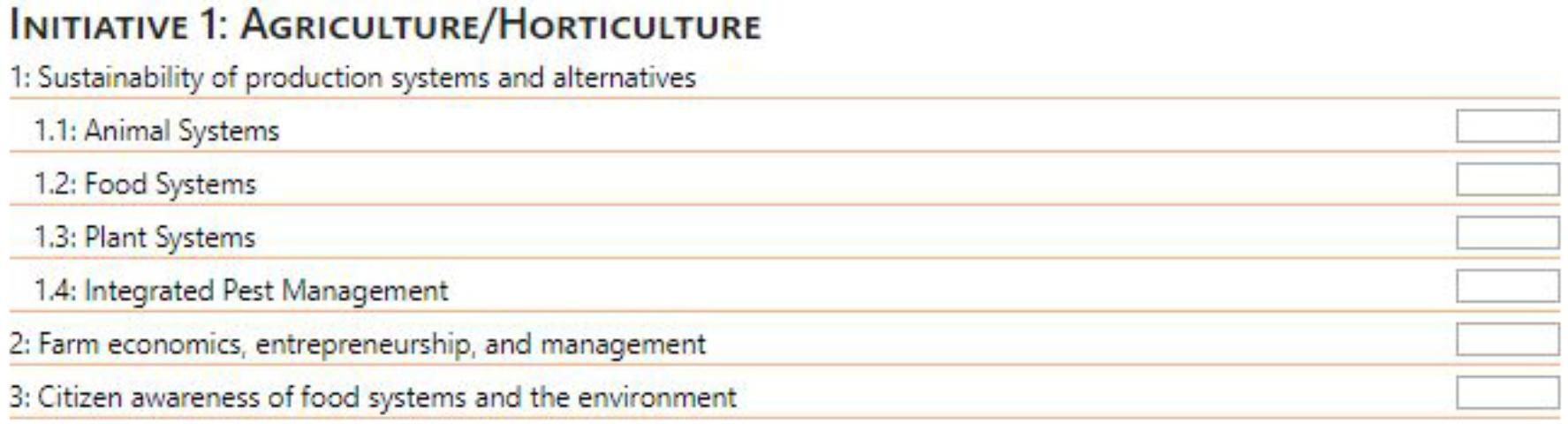
Federal reporting requires UF/IFAS to report clientele contacts by programmatic areas. To do this, faculty who have an Extension appointment report in Workload their Extension effort in one or more of the priority work groups, which are grouped into seven statewide initiatives. These initiatives represent the current Extension strategic plan, called the Extension Roadmap, and the organizational structure for all Extension activities. (see Figure 2).
Credit: UF/IFAS Program Development and Evaluation Center
Because we do not collect clientele contacts at the programmatic level in Workload, for reporting purposes, the percentage effort in each focus area is then multiplied by each Workload reporting category (i.e., office consultations, group learning participants, educational materials, email consultations, etc.). For example, if a faculty member reports 100 total phone calls and has entered a 30% effort in the Plant Systems priority work group, this will be counted as 30 phone calls for Plant Systems programs. This gives an approximate number of clientele contacts and publications per priority work group and initiative, which is sufficient for our federal reporting requirements.
Faculty should estimate the time spent on Extension programming (including planning and evaluation) related to a particular priority work group when filling in programming percentages in Workload. In short, this is a rough breakdown of where you spend all of your Extension programming effort. The total should add up to 100%.
An Extension program you offer may cut across many priority work groups. For example, if you are teaching water conservation to urban 4-H'ers, you will have spent time in both the Urban Water Quality and Conservation and Youth Development priority work groups. How much of your time is in each is usually best answered by asking yourself, "What is the main objective of this program—teaching children life skills or teaching about water conservation?" In other words, if your main emphasis is teaching children, then a larger proportion of your programming effort and outcomes and impacts should be reported under 4-H. You may indicate some effort in the Urban Water priority work group, but you are not obligated to report outcomes and impacts.
Most faculty will select one to three priority work groups to capture their Extension work. This simplifies your reporting because the priority work groups you select drive what you will see in the Workload section covering outcomes and impacts. Focus on the priority work groups for which you have the most programming and evaluation work.
Guidelines for Counting Clientele Contacts
Below are some general guidelines on how and when to count clientele contacts. We highly recommend that you review the specific, situation-based examples available online at http://pdec.ifas.ufl.edu/Workload/examples.shtml prior to reporting contacts. These instructions serve as a guide—use your best judgment for your own situation or discuss with your county or district Extension director, department chair, or center director.
- Research-based, educational information must be provided to the client. A Facebook post that announces a 4-H event is not a clientele contact.
- Your students and faculty, from any institution, are not clients unless they come to you as a homeowner/citizen.
- Out-of-state attendees or citizens, as well as community organizations and agency representatives, are considered Extension clientele.
- Faculty should count the clientele contacts made by their staff and volunteers.
- Each faculty member counts their own contacts in a jointly held program, workshop, etc.
- Field or office consultations are generally one-to-one meetings; a group event involves multiple participants and is typically more formal and organized (i.e., having an agenda, speakers, handouts, etc.).
- A series of emails, texts, phone calls, comments, etc., on a single topic count as one clientele contact.
- Diagnostic services should be counted as an office or field consultation if you are providing educational information in addition to factual data.
- Events that do not have a way to capture who the participants are through some type of registration or another record of participation, one should count participants as Social Media Contacts rather than as Group Learning Participants
- The creation of a written, audio, or visual work should be counted as educational material if it is an original work or a significant revision of existing work.
For more information about how and what to report in Workload, please review the Frequently Asked Questions (FAQ) and other resources on the login page, in the left-hand menu, or contact PDEC at 352-294-1997.
References and Further Information
Byron, L. H., D. D. Craig, and G. D. Israel. 2021. Counting and Reporting Educational Materials and Educational Contacts. Available at: https://pdec.ifas.ufl.edu/workload/WorkloadFactSheet.pdf
Mayo, D. E. 2000. Contact Calculator 1.0. Marianna, FL: UF/IFAS Extension Jackson County.
Terry, B. D., and G. D. Israel. 2006. Extension Contacts: Definitions and Examples. AEC377. Gainesville: University of Florida Institute of Food and Agricultural Sciences.
Norman, M., and G. D. Israel. 2001. Extension Contacts: Definitions and Examples. AEC362. Gainesville: University of Florida Institute of Food and Agricultural Sciences.
Taylor, C. L., and G. D. Israel. 1994. Guidelines to Reporting Extension Clientele Contacts. PE50. Gainesville: University of Florida Institute of Food and Agricultural Sciences.
US Department of Agriculture. 2011. Collection of Race, Ethnicity, and Gender Data for Civil Rights Compliance and Other Purposes in Regard to Participation in the Programs Administered by FSA, NRCS, RMA, RBS, RHS and RUS. Washington, DC: Available at: https://www.usda.gov/directives/dr-4370-001
US Department of Agriculture, National Institute of Food and Agriculture. Office of Equal Opportunity and Civil Rights FAQs. Accessed on July 27, 2023: https://www.nifa.usda.gov/civil-rights/office-equal-opportunity-civil-rights-faqs