
Weed Management in Rice
Rice is an important crop in the Everglades Agricultural Area (EAA) and surrounding region of south Florida. It is cultivated during the fallow renovation period in the sugarcane cropping system. Up to two harvests of rice can be obtained in the subtropical climate of south Florida depending on planting date and the level of weed and/or insect infestation in the first crop. Therefore, successful weed control is essential for economical rice production in Florida. Weeds reduce rice yields by competing for moisture, nutrients, and light during the growing season. Factors such as weed species composition, weed density, duration of weed-rice competition, rice cultivar, seeding density, water management, and fertility level influence the degree of rice yield loss from weed competition. The influence of rice cultivars on weed competition is often overlooked. Short-statured or dwarf cultivars, early-maturing cultivars, and erect cultivars are usually less competitive with weeds compared to tall, late-maturing, and drooping cultivars. Weed infestations can also interfere with combine operation at harvest and significantly increase harvesting and drying costs. Weed seed contamination of rice grain lowers grain quality and may lower the cash value of the crop. In addition, weeds harbor pathogens and insect pests and increase the soil weed seedbank, which becomes a source of re-infestation in subsequent crops. As with any biological system, an effective weed management program for rice must consider many factors that vary from crop to crop and year to year. The most important of these factors include planting date, climatic conditions, seedbed preparation, seed quality, stand establishment, and water management.
In Florida, rice is drill-seeded into dry seedbeds. The dominant weed species are fall panicum (Panicum dichotomiflorum), bearded sprangletop (Leptochloa fascicularis), goosegrass (Eleusine indica), yellow nutsedge (Cyperus esculentus), purple nutsedge (C. rotundus), and spreading dayflower (Commelina diffusa). Other weed species include amazon sprangletop (L. panicoides), common purslane (Portulaca oleracea), spiny amaranth (Amaranthus spinosus), alligatorweed (Alternanthera philoxeroides), rice flatsedge (Cyperus iria), primrose willow (Ludwigia sp.), and redstem (Ammania sp.). Recently, barnyardgrass (Echinochloa crus-galli) has been reported in some rice fields in Florida. It is likely that barnyardgrass was introduced in contaminated seed because it is a species not commonly associated with sugarcane, the main crop in the region. Weed infestations in rice fields occur as mixed weed populations with no monoculture of single species. Correct weed identification at the seedling stage is therefore an important step in determining management strategies.
Field Sanitation and Tillage
The first step in an effective weed management program is to ensure a solid, uniform stand of rice. Plant only high quality, uncontaminated, certified rice seed. The Florida state regulations for rice seed certification specify that a maximum of 0.05% weed seed is allowed in certified rice seed. There is zero tolerance for "objectionable" or "noxious" weed seeds, as listed in the General Seed Certification Standards. These include red rice (Oryza sativa), purple nutsedge, and Texas panicum (P. texanum).
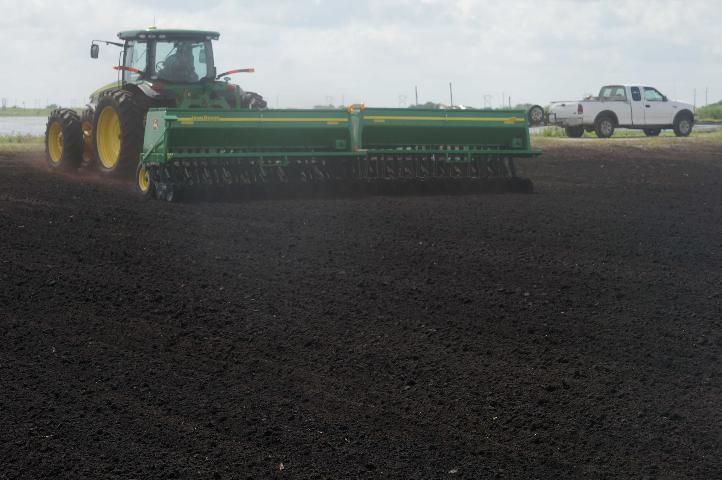
Plant rice in a well-prepared seedbed that receives a final cultivation as close to planting as possible (Figure 1). Cultivation immediately before planting destroys existing weeds and allows the rice to compete with later emerging weeds. On lighter muck soils, rolling the field before drill seeding allows for more precise planting depth and greater uniformity of emergence. Planting in a dry seedbed may require that the field be "flushed" immediately after planting to help ensure uniform rice germination and emergence. The duration of a flush will vary depending on the size of the field, the soil type, and how level the field is. The goal is to get the water on and off the planted field in approximately 48 hours. A poor stand of rice encourages infestation by weeds, which can become established in areas of open water where the rice population is sparse. In a solid stand of rice, weeds are usually not as competitive for essential sunlight and do not become very problematic.
Credit: Calvin Odero, UF/IFAS
Water Management
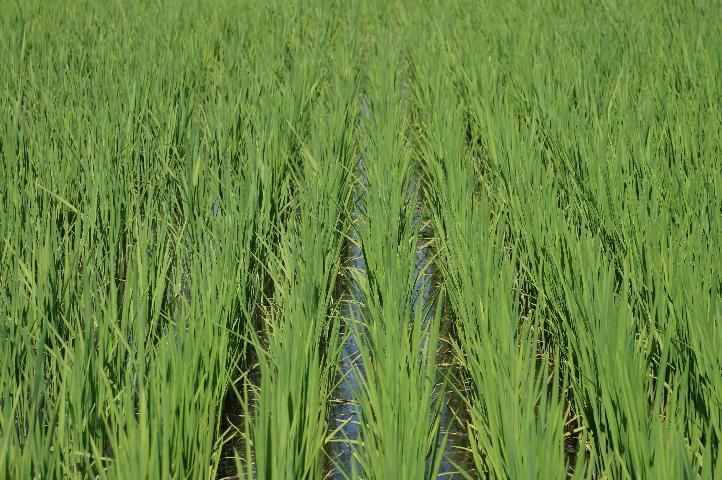
Apply the permanent flood as soon as possible in order to suppress weed seed germination. Weed seeds require oxygen to germinate, and flooding limits oxygen available for germination (Figure 2). The timing of the flood will depend on the growth rate of the rice crop, which is largely controlled by the planting date. The degree to which the field is level also plays an important role in flood timing. Take care not to flood over and drown the rice in the lower area of the field. Typically, a permanent flood is applied 3–6 weeks after planting.
Credit: Calvin Odero, UF/IFAS
The most concentrated weed-control effort should be targeted for the time span between rice emergence and the application of the permanent flood. Two sets of tools can be used in an effective weed control program in rice: water management and chemical control. Chemical control (Table 1) will be effective only if the herbicides are used in conjunction with a carefully controlled water management plan.
Water management for weed control is effective in Florida because most of the weed species in our rice crops are only semi-aquatic weeds, and their growth can be impeded and ultimately controlled by standing water. In order to control rice weeds solely by water management, the grower is walking a fine line between killing the weeds and killing the rice. A high level of management skill and intensity is required. The theory behind water management for weed control is that rice can tolerate submergence better than many weed species. Therefore, the grower must know what weed species are potential problems and whether or not these weeds are easily controlled by submergence. Drill-seeded rice can also be killed by submergence if permanent flooding is initiated too soon.
Anoxic or drowned rice will appear pale and flaccid and will not stand up after the flood has been taken off. The water depth should be kept as shallow as possible while still keeping all of the weeds totally submerged. The maximum allowable submergence time for rice depends on the water temperature because of the direct effect of temperature on plant respiration rate. The higher the water temperature, the shorter the maximum survivable duration of submergence. Typically, on most light- to medium-textured muck soils, rice can tolerate submergence for approximately 48 hours. On heavier mucks and high-mineral muck soils, rice will only tolerate shorter periods of flooding. After draining, the rice is allowed to recover for a week to 10 days, and then the flood cycle is repeated once or twice before the permanent flood is applied.
Herbicides
In the EAA, only a few commercial herbicides are widely used for postemergence chemical weed control in rice (Table 1). Preemergence herbicides are not commonly used in the Florida rice production system. Other herbicides are labeled for use in Florida rice production, but their use patterns are generally not appropriate to the Florida production system except under special conditions. As with any agricultural chemical, consult the product label and make sure you understand the recommendations before you use the product.
The underlying strategy behind using herbicides for weed control in rice is to kill or stunt the growth of weedy plants while allowing the rice plants to grow and achieve a competitive height advantage. Maintaining an effective height differential between the rice and weeds will allow the flood water to control weed growth by keeping them submerged while the rice plants grow above the water surface after the permanent flood is applied. If you can achieve a good height differential between the weeds and the rice near the time of permanent flood, you might not need herbicide, particularly at very low weed thresholds. Herbicide users must read the label and follow all instructions and precautions carefully.
Stam M4, 80, and Others
Of the herbicides available for weed control in Florida rice, Stam M4 (4 pounds active ingredient per gallon formulation of propanil) has been the most commonly used. Early applications of 2 to 3 pints per acre to small weeds and rice in the 1- to 2-leaf stage are most effective. At this timing, the herbicide is less phytotoxic to the rice seedlings, and the smaller weeds are more sensitive. Stam should be applied in no less than 10 gallons of water carrier per acre to obtain good spray coverage of weed foliage.
Because Stam is a contact herbicide and supplies no residual control, a second application of 1 to 1.5 pints per acre before permanent flood may be necessary. Second applications should be made to rice in the 5- to 6-leaf growth stage and followed by the permanent flood within 24 to 48 hours. Avoid applications at the 3- to 4-leaf stage because during this growth stage, rice plants are extremely sensitive to the herbicide and are less able to recover from phytotoxic stress.
If weed pressure is light, a single early-season application of Stam may be all that is necessary in order to ensure an adequate height differential between the rice and the weeds so that the permanent flood will effectively control weed growth. If you missed the opportunity to spray early, a single late-season "salvage" application can be helpful. Since late-season Stam applications must be at the lower rate, it is essential that the permanent flood be established within 24 to 48 hours after herbicide application in order to achieve satisfactory control of large weeds. Stam activity increases at daily maximum temperatures above 75°F and decreases as temperatures decline below 75°F. Poor weed control will occur at low temperatures (below 65°F) and rice injury can occur at very high temperatures. Do not apply more than 6 pounds active ingredient per acre of Stam in a single season.
Clincher
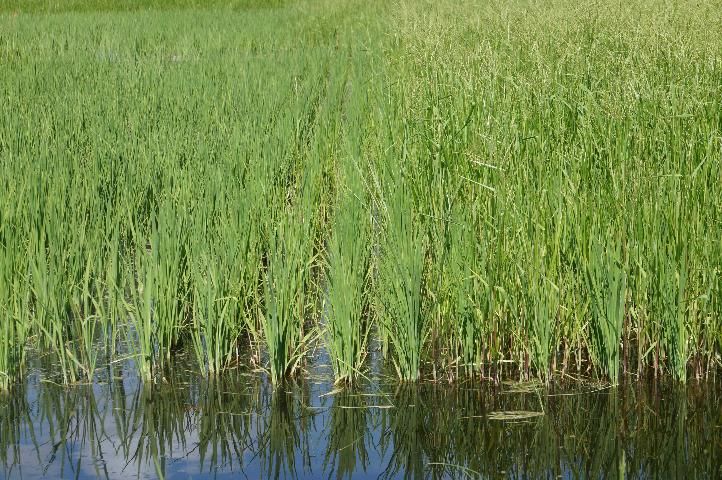
Many rice growers in Florida use Clincher (2.38 pounds active ingredient per gallon formulation of cyhalofop) instead of Stam for grass control because of phytotoxicity associated with Stam particularly at high temperatures. Clincher controls a wide spectrum of annual grasses, such as barnyardgrass, fall panicum, and junglerice and can be applied from 1-leaf rice to 60 days before harvest with no phytotoxic effect on rice (Figure 3). This herbicide can be tank mixed with sedge herbicides to broaden the weed control spectrum in rice; however, tank mixes with broadleaf weed herbicides can result in reduced grass control. Reduced grass control may also occur if herbicide is applied under dry conditions or on grass species at advanced stages of growth. Use a buffering agent if the spray solution pH is >8 to lower the pH to <8. Apply Clincher in no less than 10 gallons of water carrier per acre to obtain good spray coverage. In flooded fields, it is recommended that grass weeds be at least 70% exposed for good efficacy. If fields are drained at application, they should be reflooded within 24 to 48 hours to prevent germination of new weeds. The use rates range from 13.5 to 15 fluid ounces per acre. The maximum single application rate of Clincher is 15 fluid ounces and not more than 25 fluid ounces should be applied per year in both the first and ratoon crops. Addition of crop oil concentrate or methylated seed oil at a minimum of 1 quart per acre must be used for all applications of Clincher.
Credit: Calvin Odero, UF/IFAS
Sandea (Permit and Others)
Sandea (75% active ingredient of halosulfuron-methyl by weight) provides good control of yellow and purple nutsedge. The nutsedge species are among the most common weeds found in Florida rice. Sandea can be applied from planting until field flooding, and can be tank-mixed with Clincher or Stam for control of grassy weeds. Some propanil formulation labels indicate that any tank mixture is done at the user's risk due to the possibility of reduced control or increased injury; consult the propanil label for specific information before tank mixing with Sandea. Sandea can be mixed with Clincher, Aim, Basagran, Londax, or Grasp for additional broadleaf weed control. The use rates range from 0.67 to 1.33 ounces per acre, with total application not to exceed 1.33 ounces of product per acre per 12-month period. Sandea should not be applied within 48 days of harvest. For best results, add 0.25 to 0.5% v/v nonionic surfactant or 1.0% v/v crop oil concentrate.
Londax
Londax (60% active ingredient of bensulfuron-methyl by weight) is primarily used for yellow nutsedge control in rice. It can be applied preflood and postflood as a tank mix with propanil-containing herbicides for control of sedges and broadleaf weeds. Permanent flood should be initiated within 7 days of application for best weed control results. Failure to maintain permanent flooding following application may result in poor performance due to regrowth of treated plants or re-infestation of newly germinated seedlings. The use rate ranges from 1.0 to 1.67 ounces per acre with a maximum of 1.67 ounces in a single growing season. Londax (0.75 to 1.0 ounce per acre) can also be tank mixed with Sandea (0.125 to 0.25 ounce per acre) for improved control of broadleaf weeds and sedges. For best results, add 0.25% v/v nonionic surfactant or 1.0% v/v crop oil concentrate. Londax has a 60-day preharvest interval and should be applied in no less than 10 gallons of water carrier per acre to obtain good spray coverage.
Aim
Aim (2 pounds active ingredient per gallon formulation of carfentrazone-ethyl) is a contact herbicide primarily used for broadleaf weed control in rice. It can be tank mixed with other rice herbicides such as Stam to broaden the weed control spectrum. For postemergence preflood applications, apply Aim at 1.25 to 3.2 fluid ounces per acre to weeds up to 4 inches tall for optimum results. For best results, add 0.25% v/v nonionic surfactant. Apply Aim before flooding, when rice is at the 2-leaf stage. Some phytotoxicity (speckling) may occur on rice after application of Aim. Flooding must be maintained for at least 23 days following treatment with Aim. Aim can also be used as a harvest aid (1.25 to 1.47 fluid ounces per acre) no earlier than soft dough (i.e. when starch in the grain is beginning to become firm but is still soft) up to 3 days before harvest.
Basagran
Basagran (4 pounds active ingredient per gallon formulation of bentazon) is a contact herbicide used for control of certain broadleaf weeds and sedges in rice. It is applied at 1.5 to 2.0 pints per acre when broadleaf weeds are small. Not more than 4 pints per acre per season of Basagran should be applied whether on a single crop or two. Basagran can be tank mixed with Londax or Stam to broaden the weed control spectrum, but do not use a crop oil concentrate with the Stam tank mix because it could injure the rice.
Sharpen
Sharpen (2.85 pounds active ingredient per gallon formulation of saflufenacil) is a contact herbicide for broadleaf weed control in rice. It can be used at 1.0 fluid ounce per acre with crop oil concentrate at 1% v/v when rice is at the 2-leaf stage up to stem elongation. Tank mix of Sharpen with Clincher may reduce the level of grass control. Take care when using Sharpen because it can cause injury on sensitive rice varieties.
Other herbicides available for use in rice but not currently used by many EAA growers include Grasp (penoxsulam), Grasp Xtra (premix of penoxsulam and triclopyr), and RebelEX (premix of cyhalofop and penoxsulam). Grasp is a low-use-rate herbicide for control of barnyardgrass and many broadleaf and annual sedges. Grasp Xtra and RebelEX deliver broad-spectrum control, targeting grasses and broadleaf and annual sedges. Consult the labels for these herbicides to ensure there is no rotational restriction on the crop that would follow rice.