
Protect with Plywood1
This publication is part 3 of 6 in the Education + Action = Wind Damage Mitigation series. For the rest of the series, visit https://edis.ifas.ufl.edu/topic_series_wind_damage_mitigation.
Proper storm protection requires time and money. But if you do not have the time to hire a commercial contractor or you need to keep costs low, properly installed plywood shutters can provide reasonable protection for your house.
Because of the temporary nature of plywood shutters, the panel weight, and the installation labor required, we recommend using them as a last resort. See the second publication in this series, Install Window Shutters (https://edis.ifas.ufl.edu/ae411), to review other options.
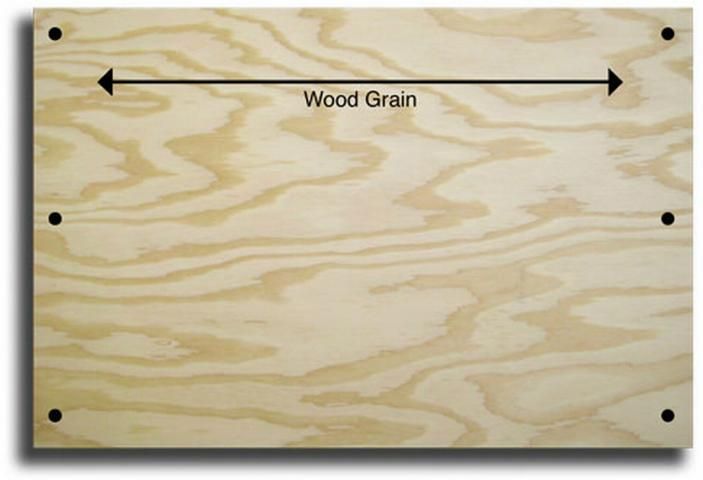
Credit: Institute for Business & Home Safety
Are all plywood shutters the same?
No. There are many ways to install plywood shutters. However, we suggest you use one of two main methods. We recommend using barrel bolt plywood shutters for concrete block homes with windows inset two or more inches from the exterior wall. Overlapping plywood shutters are best for windows inset less than two inches.
Barrel Bolt Plywood Shutters
Needed Materials
Minimum 7/16-inch-thick plywood (3/4-inch is recommended.)
3- or 4-inch barrel bolts
Drill
Circular saw
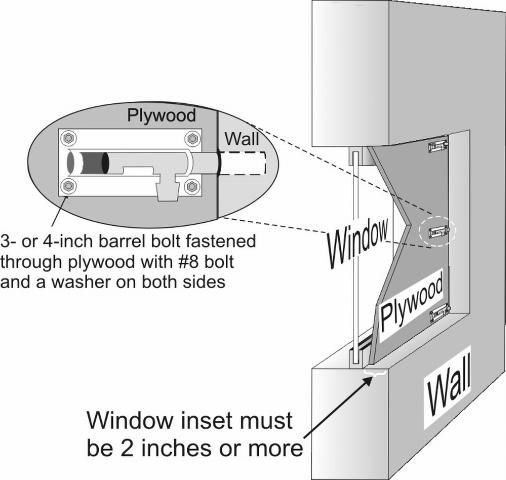
Credit: Barbara Haldeman, UF/IFAS PREC
Basic Installation Directions
Cut the plywood to fit snugly in each window indentation. Connect multiple sheets with 2 × 4s or sturdy hinges for large openings. Screw barrel bolts to each plywood shutter, using one bolt for every 12 inches of vertical plywood. Mark the locations for bolt holes in the wall. Label each panel with "Top" and "Bottom" and the window it fits. Drill the holes. Plug the holes when not in use.
Overlapping Plywood Shutters
Needed Materials
Minimum 7/16-inch-thick plywood (3/4-inch is recommended)
Nails (less secure) or screws/bolts (more secure) at least 2 inches long
Lead or stainless-steel sleeve wall anchors (do not use plastic)
Hammer (for nails) and/or drill (for screws)
Wood shims (if necessary)
Circular saw
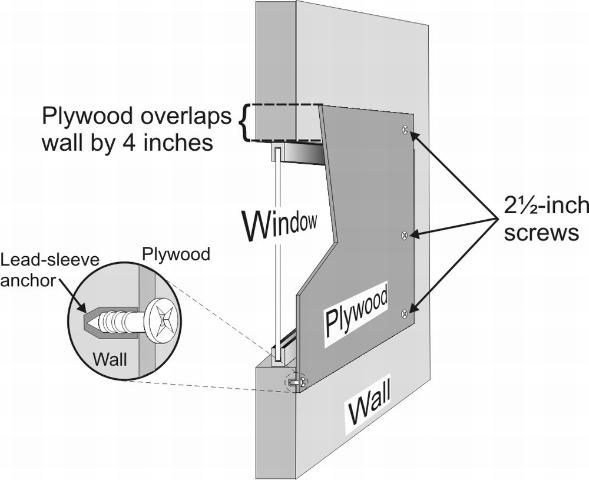
Credit: Barbara Haldeman, UF/IFAS PREC
Basic Installation Directions
Cut the plywood to overlap each window opening by 4 inches or more. Connect multiple sheets with 2 × 4s or sturdy hinges for large openings. Drill matching holes through the plywood and the wall. Label each panel with "Top" and "Bottom" and the window it fits. Hammer sleeve anchors into wall holes. Screw (or bolt) the plywood into the anchors. Plug the holes when not in use.
Issues to Consider
Avoid Oriented Strand Board
It takes 30% thicker oriented strand board (OSB) to equal the impact strength of plywood. We recommend using plywood.
Plan Ahead
Plywood is cheap, convenient, and available at most hardware stores. However, buy your plywood before a storm approaches. Your local hardware store may run out if you wait until the last minute.
Store Properly
Plywood requires proper storage to prevent wood damage. Florida's hot, humid climate can warp or degrade plywood, making the shutter unusable. It is best to waterproof your plywood shutters with a sealant or paint, and store them in a cool, dry place. Keep the shutter hardware (the bolts and screws) in a labeled container with the shutters. Storing plywood flat may also help prevent warping. Never store wet plywood.
Watch Out for Termites
Choose a storage location that keeps the plywood shutters off the ground. This helps reduce the potential for termite damage.
Label the Shutters
Most homes have a variety of window types and sizes. Clearly mark each of your plywood shutters so you know which window it fits and which side is up. You may consider making a drawing of your house and marking each window on it with a special number to match your shutter labels.
For more detailed, Florida-specific guidelines on a variety of plywood shutter designs, visit the APA (Engineered Wood Association) website (https://www.apawood.org/hurricane-shutter-designs).
Other Resources
APA—The Engineered Wood Association: Publications. Use "hurricane shutters" as a search term, or type "T460" into the search box on the page to download a free copy of the association's 2013 publication, Hurricane Shutter Design Considerations for Florida. (Registration may be required; there is no cost to register.) https://www.apawood.org/hurricane-shutter-designs
National Oceanographic and Atmospheric Administration (NOAA), Atlantic Oceanographic and Meteorological Laboratory (AOML) Hurricane Research Division: Flyers. Instructions for building plywood hurricane shutters: https://www.aoml.noaa.gov/hrd/flyers/BuildingWoodenShutters.pdf