

Tank-Mix Options for Control of Tropical Soda Apple and Dogfennel
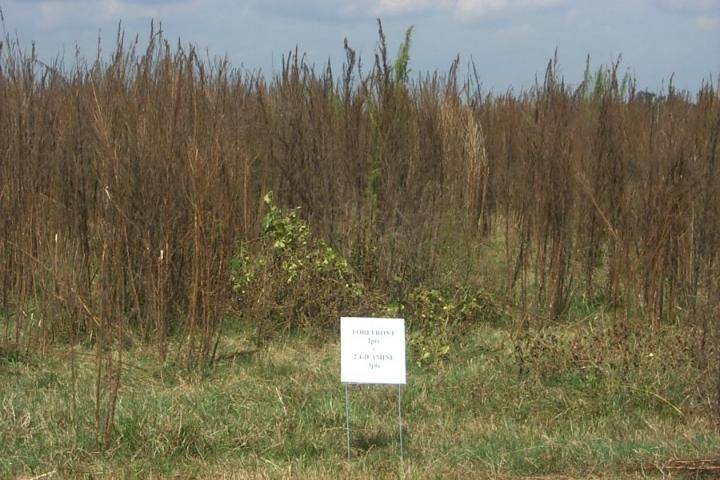
Tropical soda apple (TSA) continues to be a problem in Florida pastures, but other weeds are often present in significant numbers. Dogfennel is the most widely encountered weed in Florida pastures, and it is commonly found growing along with TSA (Figure 1). Although Milestone (aminopyralid) is highly effective on TSA, it provides little or no dogfennel control. Likewise, GrazonNext HL (a mixture of 2,4-D and aminopyralid) is more effective than Milestone, but still fails to control large dogfennel plants. Similarly, DuraCor (florpyrauxifen and aminopyralid), a relatively new introduction to the herbicide market, also fails to control dogfennel. To illustrate, UF/IFAS research has shown that GrazonNext HL applied at 1.5 pints/acre was excellent on TSA, but highly inconsistent (30%–95% control) when dogfennel was 30 inches or greater in height. Increasing the rate to 2.0 pints/acre improved the consistency of control for 30 inch-tall dogfennel but failed to control plants that were 40 inches tall or greater. Since TSA and dogfennel of all sizes are common throughout Florida, GrazonNext HL or DuraCor tank-mixed with another herbicide will be required to effectively control both species.
Credit: Brent Sellers, UF/IFAS
Many combinations were tested to determine what herbicides could be tank-mixed with GrazonNext HL to provide adequate control of both dogfennel and TSA. The ultimate goal was to maximize weed control without adding more than $8-10/acre to 1.5 pints/acre of GrazonNext; the total cost of the final tank-mix should not exceed $20/A. The most promising combinations were 8 fl oz/acre of Pasturegard HL, 2 pints/acre of 2,4-D + dicamba (WeedMaster, others), or 3 pints/acre of 2,4-D amine. Each of the herbicides, when mixed with 1.5 pints/acre of GrazonNext HL, provided at least 88% control of 40-inch dogfennel 60 days after treatment (Figure 2). TSA control with these tank-mixtures was approximately 90% at 60 days after treatment.
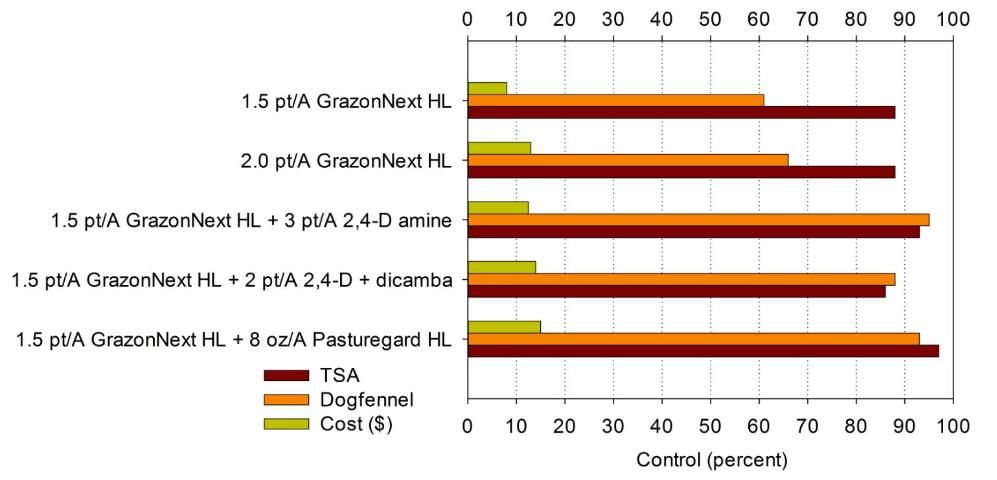
In Figure 2, the addition of $4–$7/acre increases dogfennel control from 60% with GrazonNext HL to at least 88% with GrazonNext HL and one of the three tank-mix partners. Therefore, as you scout your pastures for TSA, be sure to also look for other weeds as well. If you have pastures with both dogfennel and TSA, consider one of these tank-mix options to get the most for your money.
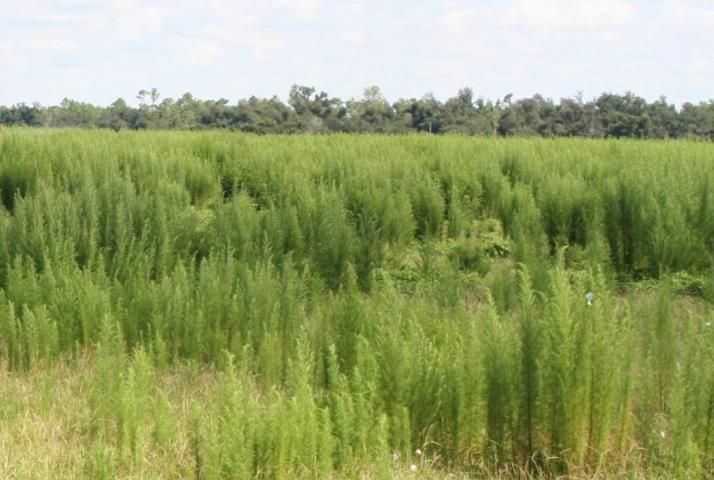
The tank-mix treatments in Figure 2 were applied on a large scale to demonstrate the success of these tank-mix treatments. All treatments performed similarly (Figure 3), but at the time of application dogfennel was at least 6 feet tall. Therefore, these tank-mix combinations can be used for both dogfennel and TSA control at any growth stage.
Even though DuraCor does not contain 2,4-D, our research has shown that these tank-mix partners also work quite well when DuraCor is applied at 16 oz/acre, but the rates will likely need to be increased for optimum control of large (>40 inches tall) dogfennel. Our research has shown that 4 pt/acre 2,4-D, 3 pt/acre 2,4-D + dicamba, or 12 oz/acre Pasturegard HL provides excellent dogfennel control. Besides the increased rates, the primary difference between the use of GrazonNext HL vs DuraCor is the type of surfactant. A typical non-ionic surfactant is used with GrazonNext HL, whereas methylated seed oil (commonly referred to as “MSO”) should be used with DuraCor for the most effective weed control.