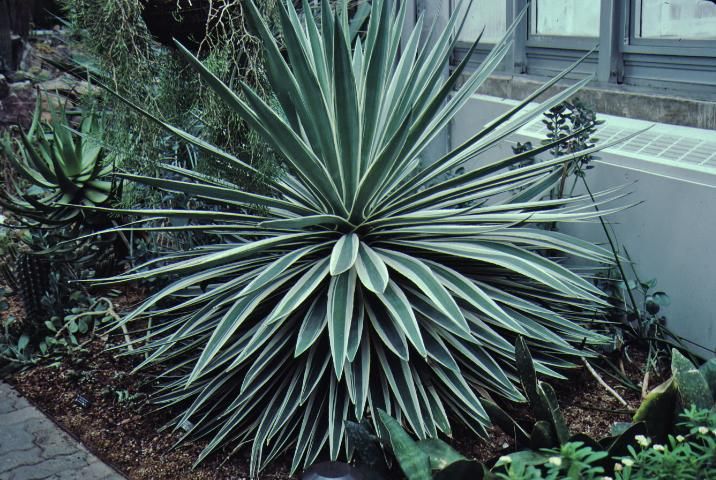
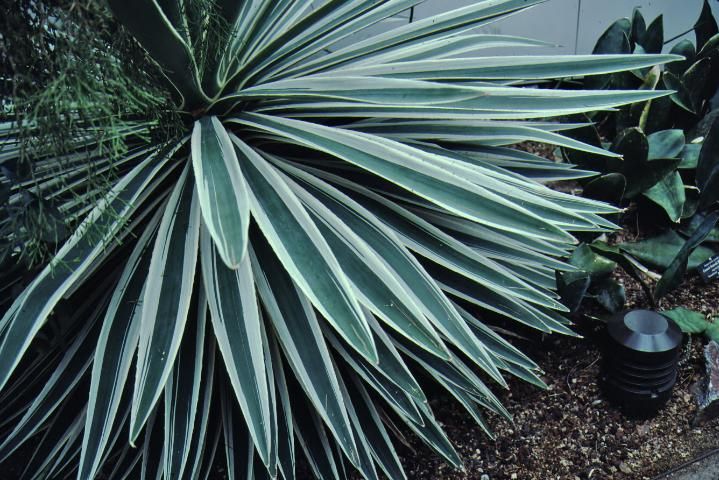
Variegated Caribbean agave is not common in cultivation, having green leaves with marginal bands of bright white. The leaves are borne from a very short trunk. Its tight rosette of stiff, sword-shaped leaves, each up to 3 feet long and 2 inches wide, makes a dramatic statement in the landscape and is much favored for use in rock gardens. The sharp spine at the tip of its toothed leaves is often removed to protect people and pets. Locate it at least 6 feet away from walks and other areas where people could contact the spiny foliage.
Figure 1. Full form—Agave angustifolia: century plant, variegated Caribbean agave. Credit: UF/IFAS
Figure 2. Leaf—Agave angustifolia: century plant, variegated Caribbean agave. Credit: Edward F. Gilman, UF/IFAS
General Information
Scientific name: Agave angustifolia
Pronunciation: uh-GAW-vee an-gus-tif-FOLE-ee-uh
Common name(s): century plant, variegated Caribbean agave
Family: Agavaceae
Plant type: shrub
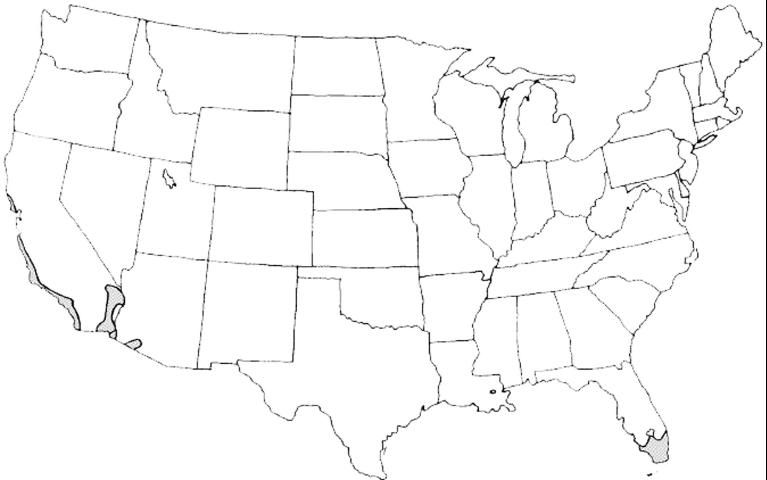
USDA hardiness zones: 10 through 11 (Figure 3)
Planting month for zone 10 and 11: year-round
Origin: native to North America, Mexico, and South America
Invasive potential: invasive and not recommended by UF/IFAS faculty (reassess in 10 years)
Uses: border; accent; mass planting
Availability: somewhat available, may have to go out of the region to find the plant
Figure 3. Shaded area represents potential planting range.
Description
Height: 3 to 4 feet
Spread: 3 to 4 feet
Plant habit: round
Plant density: open
Growth rate: slow
Texture: coarse
Foliage
Leaf arrangement: alternate
Leaf type: simple
Leaf margin: spiny
Leaf shape: linear
Leaf venation: none, or difficult to see
Leaf type and persistence: evergreen
Leaf blade length: more than 36 inches
Leaf color: blue or blue-green
Fall color: no fall color change
Fall characteristic: not showy
Flower
Flower color: white
Flower characteristic: flowers periodically throughout the year
Fruit
Fruit shape: oval
Fruit length: 1 to 3 inches
Fruit cover: dry or hard
Fruit color: brown
Fruit characteristic: persists on the plant
Trunk and Branches
Trunk/bark/branches: not particularly showy; usually with one stem/trunk
Current year stem/twig color: not applicable
Current year stem/twig thickness: not applicable
Culture
Light requirement: plant grows in part shade/part sun
Pest resistance: no serious pests are normally seen on the plant
Use and Management
Caribbean Aagave is a hardy survivor, tolerating heat, drought, and salty seaside conditions. Little if any irrigation is needed to maintain the plant once established. It grows best in full sun but can adapt to some shade. After 10 years or more (though not a century), a lofty flower spike is produced, with terminal panicles of pale yellow to white blooms. The plant can be used in residences as a free-standing specimen and is usually not planted in mass due to its unusual color and form. Due to its large size and striking habit and color, most residences only need one of these. Larger commercial landscapes have room for multiple mass plantings which can create a dramatic impact.
Propagation is by detaching the well-rooted suckers appearing at the base.
Design Considerations
The architectural form, coarse texture, and dramatic color of the variegated Caribbean agave make it perfect as a specimen plant in highly visible spaces in the landscape. Use with companion plants that are softer, with small foliage and mounding or spreading forms to contrast and highlight the tight rosette of the leaves. Pairing with plants that have more texture and small foliage will also contrast with the large, smooth, stiff leaves. To highlight the white margins in the leaves use dark green foliage or plants with small to medium flowers with cool bright colors, such as purples, blues, and corals. Another option is to build on the white theme with plants that have white flowers. Large flowers with a mass of soft petals will create more interest with contrast. Large masses of low-growing companion plants around the base or in front of the agave will create a nice setting to show off the form.
Pests and Diseases
None of major concern.
IFAS Assessment
Central, North, South
High Invasion Risk
Predicted to be invasive and not recommended by IFAS. Will be reassessed every 10 years. In particular cases, this species may be considered for use under specific management practices that have been approved by the IFAS Invasive Plant Working Group.
Critical Issue: 1. Agricultural and Horticultural Enterprises
About this Publication
This document is FPS 21, one of a series of the Environmental Horticulture Department, UF/IFAS Extension. Original publication date September 1999. Revised August 2018. Visit the EDIS website at https://edis.ifas.ufl.edu for the currently supported version of this publication.
About the Authors
Edward F. Gilman, professor, Environmental Horticulture Department; Ryan W. Klein, graduate assistant, Environmental Horticulture Department; and Gail Hansen, associate professor, Environmental Horticulture Department; UF/IFAS Extension, Gainesville, FL 32611.