


Costus igneus Spiral Flag, Fiery Costus
Introduction
The large, smooth, dark green leaves of this tropical evergreen have light purple undersides and are spirally arranged around stems, forming attractive, arching clumps arising from underground rootstocks. Plants reach to about two feet tall, with the tallest stems falling over and lying on the ground. Beautiful, 1½ diameter, orange flowers are produced in the warm months, appearing on cone-like heads at the tips of branches. They are especially showy and will stimulate compliments from visitors to your garden.
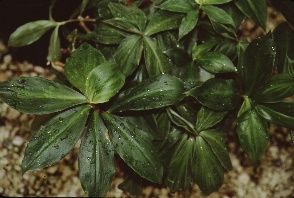
Credit: Edward F. Gilman, UF/IFAS
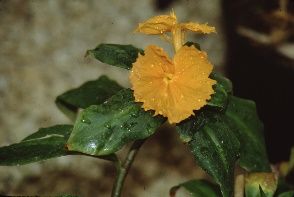
Credit: Edward F. Gilman, UF/IFAS
General Information
Scientific name: Costus igneus
Pronunciation: KOS-tus IG-nee-us
Common name(s): spiral flag, fiery costus
Family: Costaceae
Plant type: perennial
USDA hardiness zones: 9B through 11 (Figure 3)
Planting month for zone 9: year round
Planting month for zone 10 and 11: year round
Origin: not native to North America
Invasive potential: not known to be invasive
Uses: specimen; container or above-ground planter; mass planting; cascading down a wall; accent
Availability: grown in small quantities by a small number of nurseries
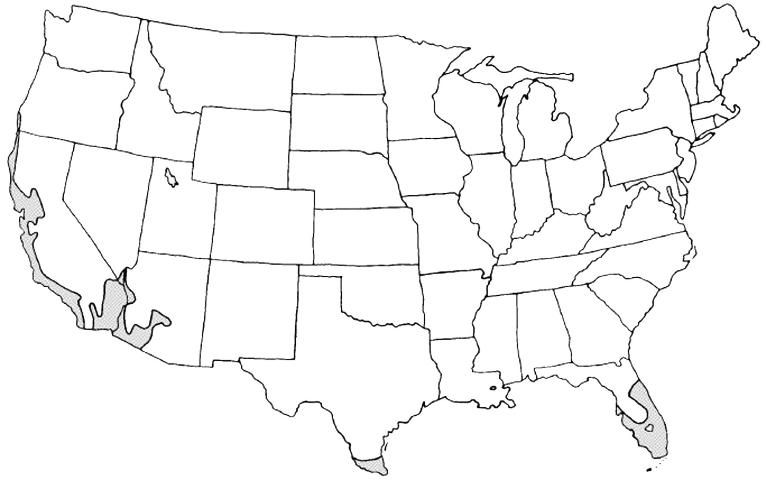
Credit: UF/IFAS
Description
Height: 2 to 4 feet
Spread: 2 to 4 feet
Plant habit: upright; spreading
Plant density: open
Growth rate: moderate
Texture: coarse
Foliage
Leaf arrangement: alternate
Leaf type: simple
Leaf margin: entire
Leaf shape: oblong
Leaf venation: parallel
Leaf type and persistence: evergreen
Leaf blade length: 4 to 8 inches
Leaf color: green
Fall color: no fall color change
Fall characteristic: not showy
Flower
Flower color: orange
Flower characteristic: summer flowering; fall flowering
Fruit
Fruit shape: unknown
Fruit length: less than 1/2 inch
Fruit cover: dry or hard
Fruit color: green
Fruit characteristic: inconspicuous and not showy
Trunk and Branches
Trunk/bark/branches: typically multi-trunked or clumping stems
Current year stem/twig color: green
Current year stem/twig thickness: very thick
Culture
Light requirement: plant grows in part shade/part sun
Soil tolerances: occasionally wet; slightly alkaline; clay; sand; acidic; loam
Drought tolerance: moderate
Soil salt tolerances: poor
Plant spacing: 18 to 24 inches
Other
Roots: usually not a problem
Winter interest: plant has winter interest due to unusual form, nice persistent fruits, showy winter trunk, or winter flowers
Outstanding plant: plant has outstanding ornamental features and could be planted more
Pest resistance: long-term health usually not affected by pests
Use and Management
Growing in either full sun or partial shade, spiral flag needs fertile soil and ample moisture and is often planted near water. It makes a nice accent plant in a shrub border, where the orange flowers will contrast the greens of the shrub border. Planted on two to three foot centers, it acts as a tall ground cover and can brighten a partially shaded location.
Propagation is by division of the clumps, cuttings, or by separating the offsets or plantlets that form below the flower heads.
Pests and Diseases
Mites and nematodes can be a problem, especially on light, sandy soil.
No diseases are of major concern.

