
Biology and Management of American Black Nightshade (Solanum americanum P. Mill.) in Tomato, Pepper, Cucurbit, and Strawberry1
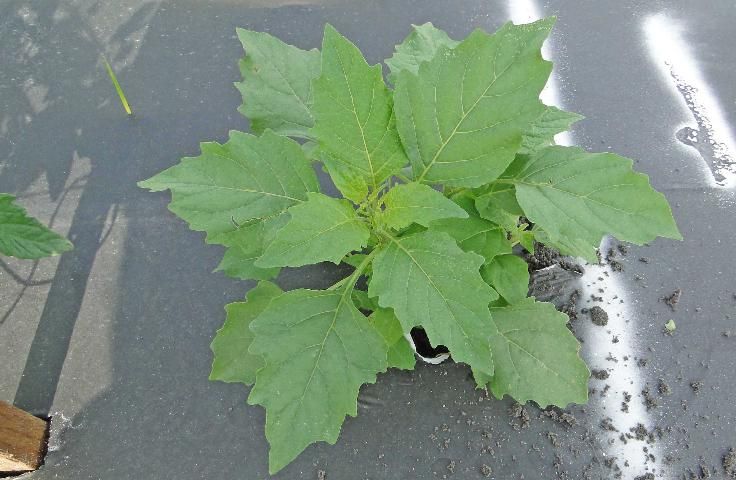
Credit: Nathan S. Boyd, UF/IFAS
Species Description
Class
Dicotyledonous plant
Family
Solanaceae
Other Common Names
American nightshade, black nightshade, common nightshade, garden nightshade, glossy nightshade, nightshade, small-flowered nightshade, Ink-berry
Life Span
Annual or short-lived perennial
Habitat
American black nightshade is commonly distributed in cultivated fields, pastures, gardens, lawns, footpaths, railroad tracks, and disturbed sites and waste areas in Florida. It is also very common in vegetable fields where it emerges in planting holes and in row middles.
Distribution
This species is widespread throughout the world and the exact native range is uncertain. It predominately occurs in tropic and sub-tropic regions and can be found throughout Florida.
Growth Habit
It is an herbaceous plant or small shrub with a predominantly upright growth habit that can reach a maximum height of 4 feet tall. Growth can be prostrate in some environments.
Seedling
Cotyledons are small and spoon-shaped with a prominent midrib on the underside of the cotyledon. They are green on both surfaces. The first leaf has a smooth to slightly wavy margin and often has a black to purple pigment on the underside of the leaf. Subsequent leaves will emerge in an alternate pattern.
Shoot
The stem is rough, erect, and highly branched, reaching up to 4 feet tall (Figure 2). Leaves are ovate (egg shaped) or lanceolate (shaped like a lance) with smooth, wavy, or slightly toothed or scalloped margins (Bryson and DeFelice 2009). Leaves have a petiole, are alternately arranged, and can be slightly to moderately pubescent (hairy) on the bottom (Figure 2).
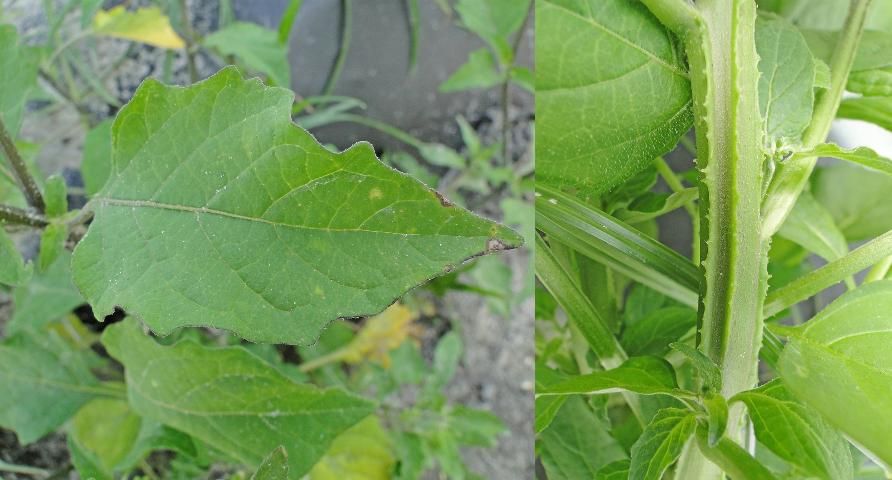
Credit: Nathan S. Boyd, UF/IFAS
Roots
This species has a fibrous root system with a slender taproot.
Inflorescence
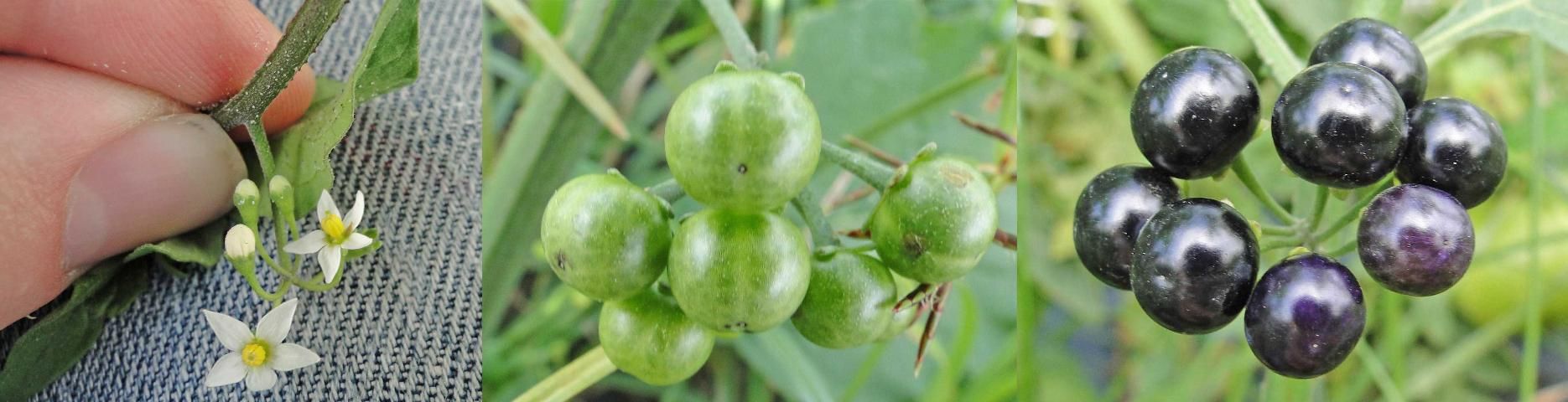
Flowers occur in an umbellate cluster (flower stalks of nearly equal length spring from a common center) of 4–12 flowers. The flower cluster emerges from the axils where the leaves join the stem. Flowers are bell shaped with five white, fused petals with five bright yellow anthers forming a cone around the pistil in the center of the flower (Figure 3).
Credit: Nathan S. Boyd, UF/IFAS
Fruit and Seeds
The fruits are berries that start out glossy green with white flecks and turn shiny black at maturity (Figure 3). The berries are borne in an umbel which consists of clusters of berries originating from one or nearly one point. There are approximately 50–110 seeds per berry. Immature berries and foliage are toxic to livestock.
Similar Species
This species is frequently confused with Eastern black nightshade and considered the same species by some authors. However, Eastern black nightshade (S. ptycanthum Dun.) may be more common in the midwestern United States whereas S. americanum appears to be more concentrated in the southern states.
Plant Biology
American black nightshade is cosmopolitan in distribution and its native origin is uncertain. It is a prolific seed producer with up to 110 seeds produced per berry (Bryson and DeFelice 2009). Nightshade begins germinating in May and can continue to germinate throughout the growing season in Florida. It competes with vegetable crops, lowers crop yield and quality, and in some cases can interfere with the harvest. It is a concern in pastures or hay crops because all vegetative parts of the plant can poison livestock.
Management
American black nightshade is typically controlled with fumigation in plasticulture production systems. It can become a serious issue when it emerges in the planting holes which occurs under sub-optimum fumigation conditions. It can also be a problem in row middles where preemergent herbicides are the most effective management option. Note that plants should be removed from the field after the final crop harvest using herbicides or cultivation because survivors will replenish the seed bank and create a problem in the field in future years.
Physical and Cultural Control
If nightshade emerges in the planting hole, hand weeding is the only option for many vegetable crops. The use of cover crops during fallow periods can inhibit seed germination, weed growth, and seed production.
Chemical Control
It is one of the few weeds in vegetable crops with documented resistance to paraquat. This is a significant issue because paraquat is one of the most commonly used products in vegetable row middles. Paraquat resistance is the primary reason preemergent herbicides are recommended for control of this weed as postemergent options are limited. Please read and follow all label instructions prior to application of herbicides.
Preemergence
Tomato and Pepper
Oxyfluorfen (Goal 2XL® or Goaltender®) applications under the plastic mulch provide good control of black nightshade. Flumioxazin (Chateau® SW) provides good to excellent control when applied in the row middle.
Cucurbits
On bare-ground plantings and in row middles, the combination of ethalfluralin and clomazone (Strategy®) provides fair to good control of nightshade. Flumioxazin is also registered in some cucurbits and provides good control of black nightshade.
Strawberry
Oxyfluorfen or flumioxazin provide good to excellent control when used under plastic mulch. Flumioxazin provides good to excellent control of nightshade in row middles.
Postemergence
There are no over-the-top or directed products for control of American black nightshade in pepper, tomato, and cucurbits.
Tomato and Pepper
Paraquat (Gramoxone Inteon®) can be applied in the row middles and will control non-resistant biotypes. Carfentrazone (Aim® EC or EW) provides good control of small seedlings but not larger plants. Lactofen (Cobra®) will provide excellent control of black nightshade if the plants are less than 6 inches tall.
Cucurbits
Paraquat (Gramoxone Inteon®) can be applied in the row middles and will control non-resistant biotypes. Carfentrazone (Aim® EC or EW) provides good control of small seedlings but not larger plants.
Strawberry
Clopyralid (Stinger) can be applied over the top of strawberries and will control American black nightshade. Paraquat (Gramoxone Inteon®) can be applied in the row middles and will control non-resistant biotypes. Carfentrazone (Aim® EC or EW) can also be applied to row middles and provides good control of small seedlings but not larger plants. Glyphosate (Roundup®-type products) can be used in the row middles to provide excellent control of nightshade. Always use a hooded applicator when applying glyphosate and take all necessary measures to prevent drift. Glyphosate can be translocated to the growing points via runners that have grown into the row middle and are exposed to glyphosate.
General Comments
American black nightshade is very common in vegetable and small fruit fields and is best controlled with preemergence herbicides under the plastic mulch or in row middles and with post-emergent herbicides during crop destruction to limit seed production.
References
Bryson, C. T. and M. S. DeFelice (eds). 2009. Weeds of the South. Athens, GA: University of Georgia Press.
MacRae, A. W. 2010. American black nightshade biology and control in fruiting vegetables, cucurbits, and small fruits. HS1176. Gainesville: University of Florida Institute of Food and Agricultural Sciences. https://edis.ifas.ufl.edu/hs1176