


Artichoke, Globe—Cynara scolymus L.1
The globe artichoke is also known as French artichoke and green artichoke. It should not be confused with the Jerusalem artichoke.
Description
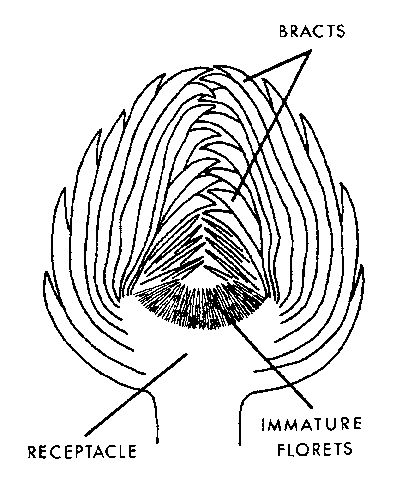
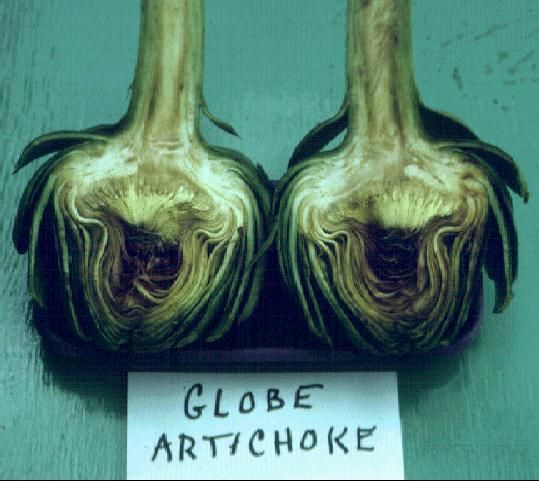
Globe artichokes are perennial, frost sensitive, thistle-like plants with edible flower buds. The silvery green plants are 4 to 5 feet tall and spread outward 5 to 6 feet. The flower buds arise on the terminal portion of the main stem and on lateral stems. Each unopened flower bud resembles a deep green pine cone 3 to 4 inches in diameter, round, but slightly elongated. Several pointed, leathery, green bracts fold around a purple-blue flower. The base of each bract is the fleshy edible portion, along with the fleshy center of the artichoke on which the flower and bracts are borne. Buds that are left on the plant open to 6-inch purple-blue flowers. These are dried and used in floral arrangements. See Figure 1 for a cross-sectional diagram of an artichoke.
Credit: James M. Stephens
Culture
Almost all the nation's globe artichokes are grown in a narrow coastal area of California because of the favorable climate. Artichokes do best in a frost-free area with cool, foggy summers. They do not overwinter in areas with deep ground freezes and are not well adapted to Florida's climate because hot weather opens buds quickly, destroying tenderness of edible parts. Brief periods of exposure to temperatures past below freezing cause no apparent damage.
Credit: James M. Stephens
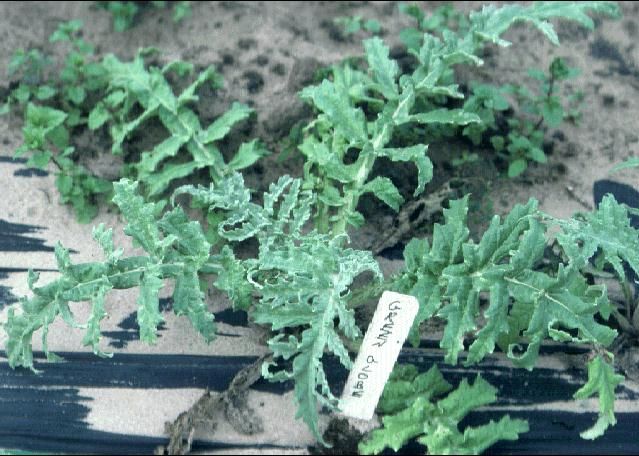
However, gardeners trying to produce them in Florida should use a variety called 'Green Globe'. Seeds may be planted, but since artichoke does not grow true to type from seed, portions of old artichoke rootstalk or root shoots are planted. Early in the spring, set the stumps, or root parts, 6 to 8 inches deep, 6 feet apart, in rows 8 feet wide. Fertilize, irrigate, and cultivate just as you would other vegetables in your garden. In other areas of the United States, attempts have been made to get artichokes to behave as annuals by planting vernalized seeds. Factors limiting production in Florida are low productivity, bacterial root rot, and an excessively long production period.
Credit: James M. Stephens
Harvesting
An artichoke is ready for harvest when it has reached maximum size, but before the bracts open. Cut the top one first, then the secondary ones as they mature. Store at low temperatures (near 32°F) and high humidity (95% RH). In addition to minerals and vitamins, artichokes contain about 3% protein and 0.2% fat.