
Asparagus—Asgaragus officinalis L.1
Asparagus, known in colloquial terms as sparagrass, sparrowgrass, and, among larger growers of the crop, as grass, is not well adapted to Florida. It is an important commercial and garden crop throughout many parts of the United States. Four states, California, New Jersey, Washington, and Massachusetts, grow over 90% of the asparagus shipped to fresh markets in the United States.
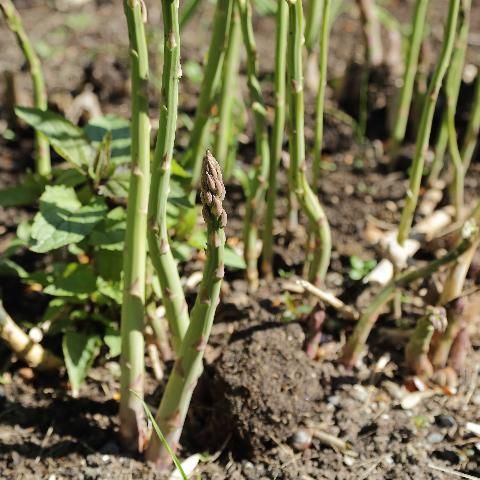
Credit: C T Johansson, CC BY-SA 3.0
Description
Asparagus plants are perennials. The underground portion consists of stems, or rhizomes, and roots. The edible aerial stems (spears) grow upward from them. Young crowns consisting of roots and rhizomes are grown from seed and planted in beds. Under the best conditions (not in Florida) the beds can remain productive for 30 years or more. The tender, succulent aerial spears are cut in the spring for 2 or 3 months, then the greenery (fern) is allowed to grow to nourish the underground part for the following year's crop. Asparagus has both male and female plants. The female plants have the little red seed-bearing fruits, which turn black on maturity. In central Florida, berries show up in July. Plants of both sexes produce spears of edible quality.
Asparagus varieties are of two types, based on the color of the spears. The more important group produces dark green sprouts when grown in sunlight and includes 'Mary Washington', 'Martha Washington', 'Reading Giant', and 'Palmetto'. The less important group, which includes such varieties as 'Conover's Colossal' and 'Mammoth White', produces light green or whitish spears. 'Jersey Giant', an all-male hybrid, produces very large spears.
Culture
Good asparagus spear production is dependent upon a dormant period. Dormancy is usually brought about by cold weather or drought, and since Florida has neither, growth is more or less continuous, resulting in weak, spindly spears. Asparagus beds in north and central Florida often yield good quality spears for 4 to 5 years before regressing.
Gardeners trying asparagus, as many have with varied success, should set out 1- or 2-year old crowns or plant seeds in the spring. Sow seeds ¾ to 1 inch deep and about 4 inches apart in 6-inch-deep furrows spaced 5 feet apart. Fill the furrow as you cultivate, until a level bed is obtained. Seeds take about 2 to 6 weeks to germinate. If crowns are used, set them 6 to 8 inches deep and 12 inches apart. Fertilize at planting, using manure if available. Many Florida gardeners dig pits and fill with an abundant amount of organic compost on which to grow the asparagus. Established asparagus generally tolerates salty soils better than most other vegetables.
North Florida Trial—1986
Eleven varieties were seeded into flats in January, then seedlings transplanted in May spaced 12 inches apart in ½ inch rows.
During a 3 to 5 week period in the late fall, 9-inch spears were cut. Mary Washington yielded only 212 lbs/acre, while a California hybrid was best at 1300 lbs/acre.