

Bean, Hyacinth—Dolichos lablab L., or Lablab purpureus (L.) Sweet1
The hyacinth bean is also called lablab, bonavist, Chinese flowering, Egyptian, Pharao, shink, val, wild field, and Indian bean. It is not cultivated much in Florida or in the rest of the United States, but where it is grown in Florida, it is mainly for ornamental purposes. In some areas of the United States, it has been used as a forage crop.
Description
Hyacinth bean is widely grown in southern Asia and Africa where the ripe seeds and the green pods are used for food. The plant is similar to the Southern pea, but the vines are longer and tougher. When the plant is supported, it often has a vine 20 to 25 feet long. Leaves are broad, oval, and pointed.
Credit: Blue Goose, Inc.
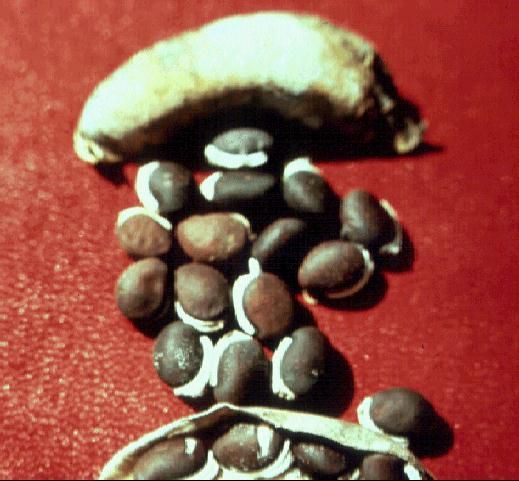
The green or purple pods are small, 2 to 3 inches long, flat, smooth, and slightly sickle shaped. Pods resemble a lima bean pod with corrugation on the edge. Each pod contains 4 to 6 seeds that may be red, brown, or white. A distinctive mark is the long white seed scar. The 4 to 6 inch long sweet scented flowers vary in color, being white, pink, or purple. A field type that is erect and bushy has inedible pods.
Culture and Use
When attempting to grow the bean, use cultural techniques similar to those for the pole bean. The ripe seeds are less nutritious than the Southern pea and they produce a somewhat disagreeable odor upon cooking. Dried seeds are a wholesome food.
At Gainesville
At one times near Fifield Hall, University of Florida, the prolific purple lablab bean vines grew on the garden fence. Seeded in 1990, they continued to flourish as a perennial crop, coming back in the spring of each year from its winter kill. The yield of pods during the late spring and into fall was very great. Each purple pod was well filled with plump green, large lima bean-size seeds.