


Bean, Scarlet Runner—Phaseolus coccineus L.1
Other names for the scarlet runner bean are scarlet conqueror, fire bean, mammoth, red giant, scarlet emperor, and white Dutch runner.
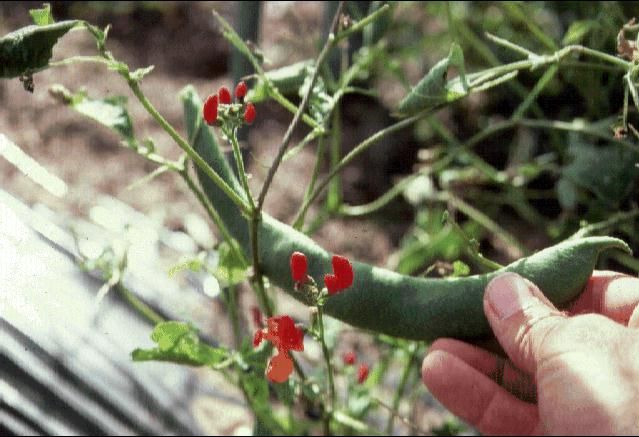
Credit: James M. Stephens
This bean belongs to a group of flowering beans that are of comparatively little importance in the United States. Like others in the runner group, scarlet runner is planted mostly as an ornamental because of its rapid growth and abundance of large, brightly colored flowers. The scarlet runner in Florida has been reported to climb up ground-based television antennas, as well as other structures such as fences. Fair production has been observed in Florida gardens.
Description
The large vigorously climbing plant reaches 12 to 15 feet. Its leaves are dark green, with an underside of veins tinged with purple. Bean-like flowers are scarlet and very large (1 inch wide). There are about 20 flowers on each flower stalk. Dark green pods possess fair quality, but are somewhat brittle and stringy, with firm, coarse flesh. Their size ranges from medium long to very long. Mature pods are broad and stout. Very large lima bean shaped seeds have a scar that is large, white, flattened, and somewhat incurved. Seed color varies from shining black to violet-black mottled with deep red (oxblood to carmine).
Another variety similar to scarlet runner is butterfly. It has white and orange bicolored flowers. Seeds are grayish olive, mottled with salmon. A russet brown eye ring surrounds the seed scar.
Use
Both the pods and the green shelled beans are edible in the fresh stage and are sometimes substituted for lima beans. The root is often eaten by Central America Indians. The long vine makes an attractive, colorful trellis plant in an edible landscape.