- Topics: Garlic | MINOR VEGETABLES | Stephens, James M

James M. Stephens2
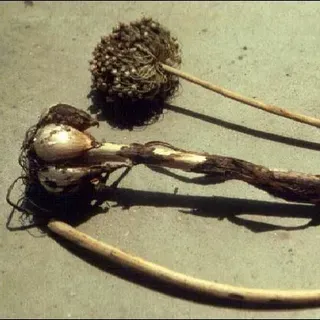
Elephant or greatheaded garlic is closely related to leek (Porrum group). This form of garlic produces very large bulbs that may weigh a pound or more. These huge bulbs consist of enlarged cloves, usually six per bulb. The cloves are milder than those of regular garlic, so that some people eat them raw.
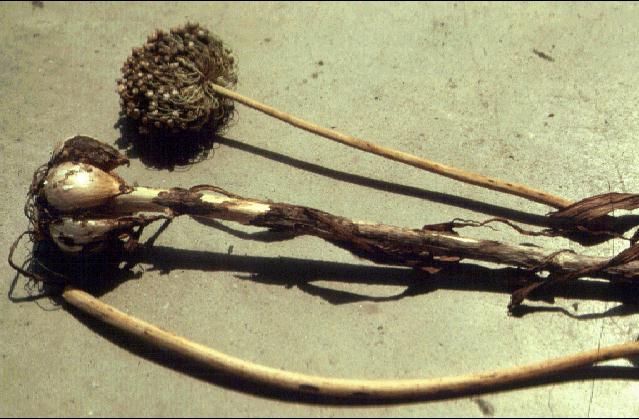
The plant is quite large, but otherwise resembles the ordinary garlic. It flowers rapidly, forming a round composite flower head at the top of a long (12-18 inches) seed stalk called a scape. This scape is solid and becomes rather woody very quickly. Leaves are flat and thin.
Elephant garlic is a vigorous plant in Florida gardens, as well as most other areas of the country. Space cloves 12 inches apart at planting and grow the same as onions. Starts are available through seed company catalogs.
This document is HS598, one of a series of the Horticultural Sciences Department, Florida Cooperative Extension Service, Institute of Food and Agricultural Sciences, University of Florida. Original publication date May 1994. Revised March 2009. Reviewed February 2012. Visit the EDIS website at http://edis.ifas.ufl.edu.
James M. Stephens, Professor, Horticultural Sciences Department, Cooperative Extension Service, Institute of Food and Agricultural Sciences, University of Florida, Gainesville FL 32611.
The Institute of Food and Agricultural Sciences (IFAS) is an Equal
Opportunity Institution authorized to provide research, educational
information and other services only to individuals and institutions
that function with non-discrimination with respect to race, creed,
color, religion, age, disability, sex, sexual orientation, marital
status, national origin, political opinions or affiliations.
For more information on obtaining other extension publications,
contact your county Cooperative Extension service.
U.S. Department of Agriculture, Cooperative Extension Service,
University of Florida, IFAS, Florida A. & M. University Cooperative
Extension Program, and Boards of County Commissioners Cooperating. Nick T. Place,
Dean.