


Gourd, Okeechobee—Cucurbita okeechobeensis Bailey1
Florida has many unique distinctions, one of which is that it is the home of the Okeechobee gourd. However, this native gourd may not be here for long, as reports indicate its existence is threatened by cold weather and habitat disturbance.
The gourd plant is an annual climbing vine growing abundantly in heavy tangled woods along the southeastern shore of Lake Okeechobee. It uses its tendrils to climb into low-growing trees.
Description
The gourd plant has grape-like foliage. Each leaf contains five to seven shallow lobes. The gourd fruits hang conspicuously from trees long after the annual vine is dead. The flowers are cream-colored or nearly white and have a 3-inch long corolla, with very small sharp lobes on the calyx. The gourds (fruits) are nearly globular, long stemmed, 3 to 3½ inches in diameter. They are hard shelled and durable, light green with faint longitudinal lines of lighter color, and sometimes have rather definite marks of yellowish green. Fruits contain many flattened seeds with raised margins.
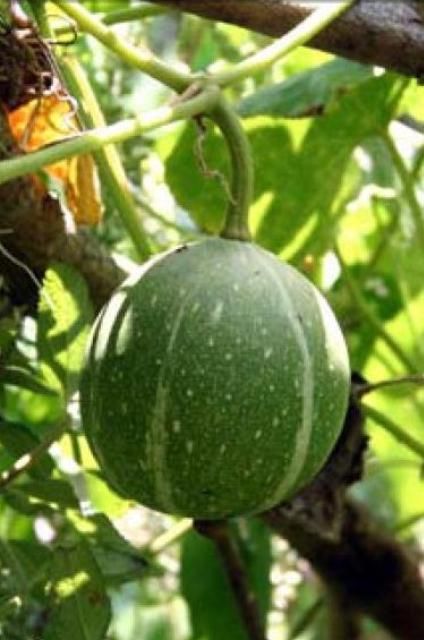
Credit: Marc Minno
Culture and Use
According to the Florida Division of Plant Industry, at one time the gourd was a common sight in the hammocks around the southern shore of Lake Okeechobee and was not known elsewhere. Today the gourd is found only occasionally in small areas that have not been too closely cultivated. Since there has been no mention of the edibility of this gourd, it should not be eaten.