

- Topics: Horticultural Sciences | Kohlrabi | MINOR VEGETABLES | Stephens, James M

James M. Stephens2
Kohlrabi is grown in gardens throughout the United States for the turnip-like enlargement of the stem just above ground level. Cabbage-like leaves on long stems arise from the top and sides of the round, root-like stem. The enlargement is tender and succulent, if rapidly grown and harvested, but becomes tough and fibrous with age.
Before kohlrabi is eaten, the peel is removed, and the interior is diced and boiled. The swollen stem also may be eaten raw, and leaves are edible.
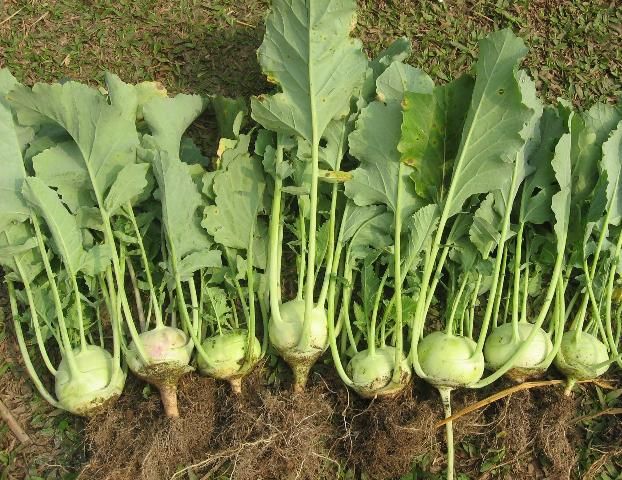
Propagation and time of planting are similar to cabbage, but plant spacing is about 4 inches. Kohlrabi matures in about 60 days when started from seeds, and 40 days started from transplants. While green varieties are most common, red varieties are popular in many gardens.
This document is HS619, one of a series of the Horticultural Sciences Department, Florida Cooperative Extension Service, Institute of Food and Agricultural Sciences, University of Florida. Original publication date May 1994. Revised March 2009. Reviewed February 2012. Visit the EDIS website at http://edis.ifas.ufl.edu.
James M. Stephens, professor, Horticultural Sciences Department, Cooperative Extension Service, Institute of Food and Agricultural Sciences, University of Florida, Gainesville FL 32611.
The Institute of Food and Agricultural Sciences (IFAS) is an Equal
Opportunity Institution authorized to provide research, educational
information and other services only to individuals and institutions
that function with non-discrimination with respect to race, creed,
color, religion, age, disability, sex, sexual orientation, marital
status, national origin, political opinions or affiliations.
For more information on obtaining other extension publications,
contact your county Cooperative Extension service.
U.S. Department of Agriculture, Cooperative Extension Service,
University of Florida, IFAS, Florida A. & M. University Cooperative
Extension Program, and Boards of County Commissioners Cooperating. Nick T. Place,
Dean.
