University of FloridaSolutions for Your Life

Download PDF
Publication #HS652

Radicchio — Cichorium intybus L.1

James M. Stephens2

Radicchio is a European gourmet salad vegetable that has recently been introduced to the United States. It is a red, broadleaf, heading form of chicory. The burgundy red-colored leaves with white midribs are folded in such a manner as to resemble a small head of cabbage. Leaf texture is close to that of French endive, which is the most popular of the heading chicories.

Owing to similarity of names, radicchio frequently is confused with `Radichetta,' a narrow-leaf, nonheading variety of common chicory that also has red pigmentation. However, the two are quite different.
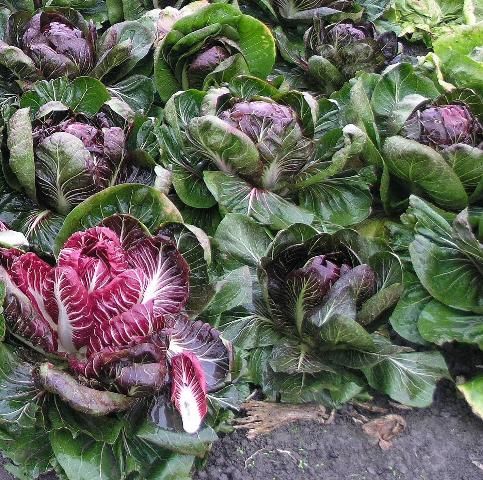
Figure 1. 

CULTURE

Two varieties of radicchio currently offered in seed company catalogs are 'Giulo' and 'Augusto.' 'Giulo' is suggested for most of the country as a spring and early summer vegetable, and for planting in the fall through winter in Florida. 'Augusto' is suggested for planting in late August for fall production. Both varieties were planted in West Central Florida with fair results. About 80% of the plants produced marketable heads in 3-4 months of growing time. Bolting, tip-burn, and frequent failure to produce heads are major problems.

Cultural considerations for radicchio are discussed under "Chicory."

Footnotes

1.

This document is HS652, one of a series of the Horticultural Sciences Department, Florida Cooperative Extension Service, Institute of Food and Agricultural Sciences, University of Florida. Original publication date May 1994. Revised March 2009. Reviewed February 2012. Visit the EDIS website at http://edis.ifas.ufl.edu.

2.

James M. Stephens, professor, Horticultural Sciences Department, Cooperative Extension Service, Institute of Food and Agricultural Sciences, University of Florida, Gainesville FL 32611.


The Institute of Food and Agricultural Sciences (IFAS) is an Equal Opportunity Institution authorized to provide research, educational information and other services only to individuals and institutions that function with non-discrimination with respect to race, creed, color, religion, age, disability, sex, sexual orientation, marital status, national origin, political opinions or affiliations. For more information on obtaining other extension publications, contact your county Cooperative Extension service.

U.S. Department of Agriculture, Cooperative Extension Service, University of Florida, IFAS, Florida A. & M. University Cooperative Extension Program, and Boards of County Commissioners Cooperating. Nick T. Place, Dean.