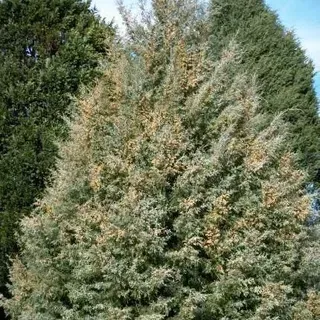
Hesperocyparis glabra 'Carolina Sapphire': Smooth Barked Arizona Cypress
Introduction
The species is a native of the American southwest and is densely clothed in blue/grey leaves and becomes a narrow pyramid, perhaps reaching 50 to 70 feet tall. Exceptionally tolerant of hot, dry conditions, smooth barked Arizona cypress is ideal for use as a screen, hedge, or windbreak. The outer red/brown bark breaks off every year, revealing the fresh, new, bright red, smooth inner bark. Foliage of 'Carolina Sapphire' is one of the brightest blues you will ever see. Jump out of the way after planting this cultivar since it springs out of the ground, with young trees growing about 6 feet each year with irrigation.
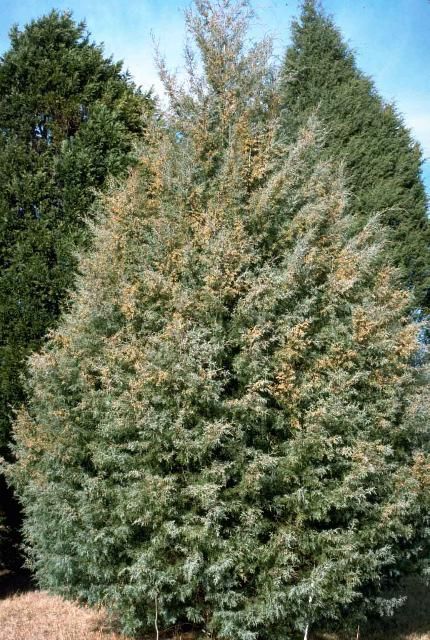
Credit: Ed Gilman, UF/IFAS
General Information
Scientific name: Hesperocyparis glabra
Pronunciation: hes-per-oh-SY-pair-iss GLAY-bruh
Common name(s): Smooth barked Arizona cypress
Family: Cupressaceae
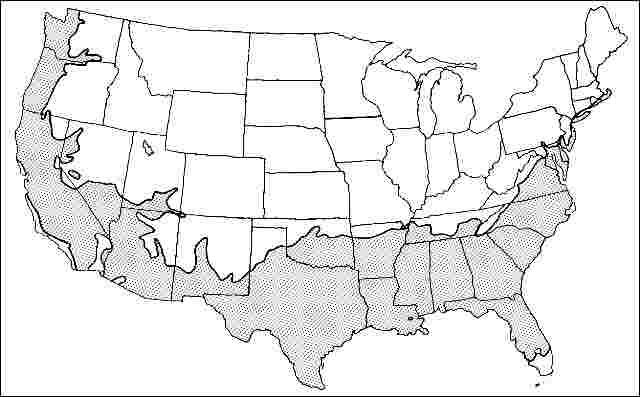
USDA hardiness zones: 7A through 9B (Figure 2)
Origin: native to North America
Invasive potential: not assessed/incomplete assessment
Uses: screen; hedge; specimen; bonsai
Credit:
Description
Height: 50 to 70 feet
Spread: 10 to 15 feet
Crown uniformity: symmetrical
Crown shape: pyramidal, oval
Crown density: dense
Growth rate: fast
Texture: fine
Foliage
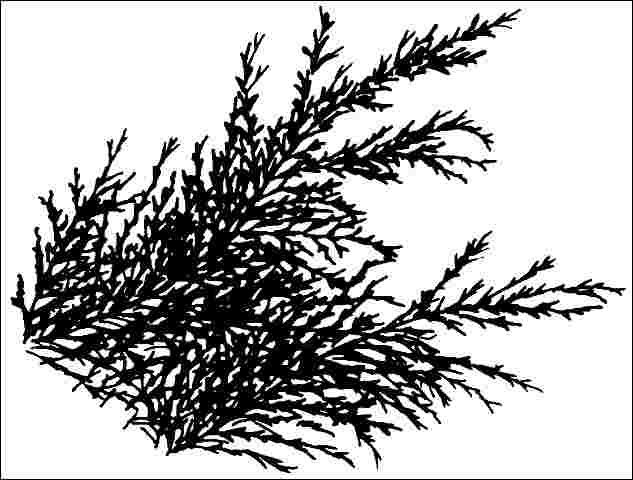
Leaf arrangement: opposite/subopposite (Figure 3)
Leaf type: simple
Leaf margin: entire
Leaf shape: scale-like
Leaf venation: none, or difficult to see
Leaf type and persistence: evergreen
Leaf blade length: less than 2 inches
Leaf color: blue or blue-green
Fall color: no color change
Fall characteristic: not showy
Credit:
Flower
Flower color: unknown
Flower characteristics: not showy
Fruit
Fruit shape: round
Fruit length: less than 0.5 inch
Fruit covering: dry or hard
Fruit color: brown
Fruit characteristics: does not attract wildlife; not showy; fruit/leaves not a litter problem
Trunk and Branches
Trunk/bark/branches: branches don't droop; showy; typically one trunk; thorns
Pruning requirement: little required
Breakage: susceptible to breakage
Current year twig color: green
Current year twig thickness: thin
Wood specific gravity: unknown
Culture
Light requirement: full sun
Soil tolerances: clay; sand; loam; alkaline; acidic; well-drained
Drought tolerance: high
Aerosol salt tolerance: unknown
Other
Roots: not a problem
Winter interest: no
Outstanding tree: no
Ozone sensitivity: unknown
Verticillium wilt susceptibility: resistant
Pest resistance: sensitive to pests/diseases
Use and Management
Smooth barked Arizona cypress should be grown in full sun on well-drained, acid, or alkaline soil. If grown with too much moisture or on a poorly drained clay, a shallow root system will develop making the tree susceptible to wind damage. The species was once widely grown in the southeastern United States but may perform best in the drier parts of the southwest, including west Texas and Oklahoma.
Propagation is by cuttings.
Pests
No pests are of major concern.
Diseases
A stem canker has devastated large numbers of smooth barked Arizona cypress in various parts of the country.