This large, upright, evergreen shrub or small tree has glossy, leathery leaves and clusters of fragrant, yellow/white flowers from late summer into winter, followed by bright red, two-inch-long, poisonous fruit borne in pairs. The fruit is poisonous. It will make a nice tree for a patio area providing shade with the lower branches removed, or a visual screen of coarse, dense foliage without growing too tall. It is suited for planting beneath power lines due to maximum height of 20 to 25 feet.
Invasive potential: According to the IFAS Assessment of Non-Native Plants in Florida's Natural Areas (IFAS Invasive Plant Working Group 2008),
Ochrosia elliptica should be treated with caution in the south zone in Florida, may be recommended but managed to prevent escape. It is not considered a problem species and may be recommended in the north and central zone in Florida (counties listed by zone at: http://plants.ifas.ufl.edu/assessment/pdfs/assess_counties.pdf)
Uses: deck or patio; screen; container or planter; specimen; espalier; highway median
Availability: somewhat available, may have to go out of the region to find the tree
Description
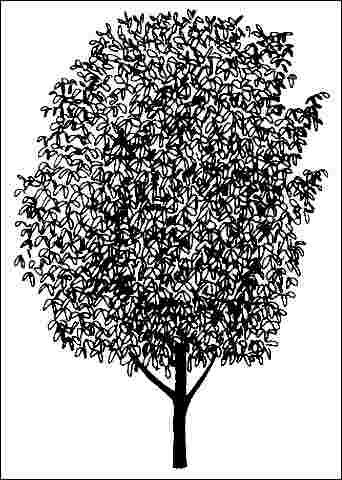
Height: 20 to 25 feet
Spread: 15 to 25 feet
Crown uniformity: symmetrical
Crown shape: upright/erect, oval
Crown density: dense
Growth rate: moderate
Texture: coarse
Foliage
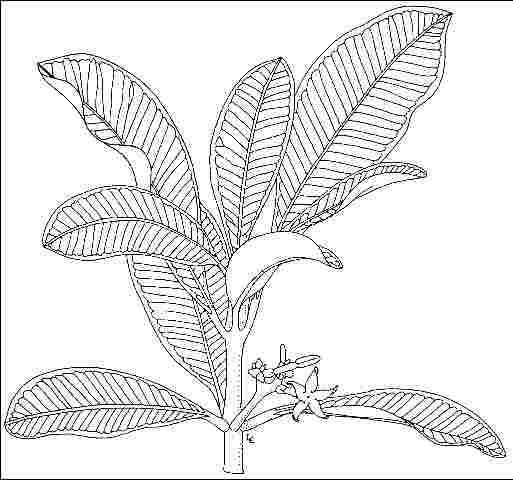
Leaf arrangement: opposite/subopposite (Figure 3)
Leaf type: simple
Leaf margin: entire, undulate
Leaf shape: obovate, oblong, elliptic (oval)
Leaf venation: brachidodrome, pinnate
Leaf type and persistence: evergreen, broadleaf evergreen
Leaf blade length: 4 to 8 inches
Leaf color: green
Fall color: no color change
Fall characteristic: not showy
Figure 3. Foliage
Flower
Flower color: yellow
Flower characteristics: showy
Fruit
Fruit shape: oval
Fruit length: 1 to 3 inches
Fruit covering: fleshy
Fruit color: red
Fruit characteristics: does not attract wildlife; showy; fruit/leaves not a litter problem
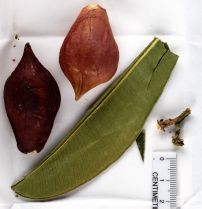
Figure 4. Fruit. Credit: Collected by William Marquardt, 11 January 2001. Courtesy of University of Florida Herbarium. FLAS 204969
Trunk and Branches
Trunk/bark/branches: branches don't droop; not showy; can be trained to one trunk; thorns
Pruning requirement: needed for strong structure
Breakage: resistant
Current year twig color: green
Current year twig thickness: thick
Wood specific gravity: unknown
Culture
Light requirement: full sun, partial sun or partial shade
Salt-tolerant Ochrosia grows well close to the ocean in full sun or partial shade on a wide range of soils, including alkaline, and responds well to fertilizing. It is very drought-tolerant but responds well to irrigation and fertilizer. Its dark green, dense foliage makes it ideal for tall screens or at the rear of a shrub border.
Propagation is by scarified seed or cuttings.
Pests
Pest problems include scale and occasionally mites. These can be locally troublesome.
Diseases
No diseases are of major concern.
Literature Cited
Fox, A.M., D.R. Gordon, J.A. Dusky, L. Tyson, and R.K. Stocker. 2008. IFAS Assessment of Non-Native Plants in Florida's Natural Areas: Status Assessment. Cited from the Internet (November 16, 2012), http://plants.ifas.ufl.edu/assessment/pdfs/status_assessment.pdf
IFAS Assessment
South
Caution
Caution - manage to prevent escape. May be recommended by IFAS. Will be reassessed in two years.