Edward F. Gilman, Dennis G. Watson, Ryan W. Klein, Andrew K. Koeser, Deborah R. Hilbert, and Drew C. McLean 2
Introduction
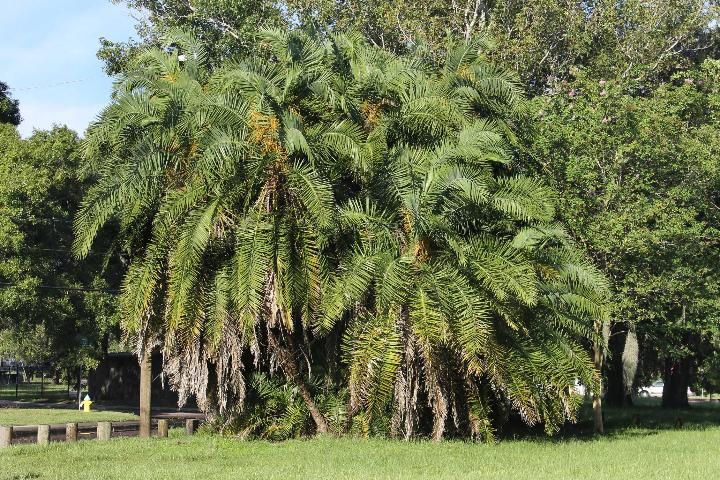
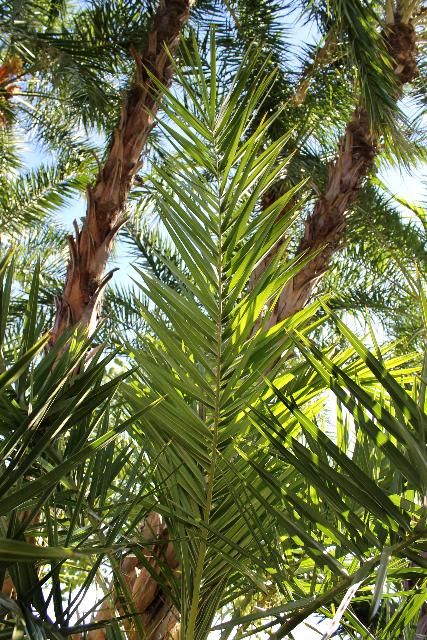
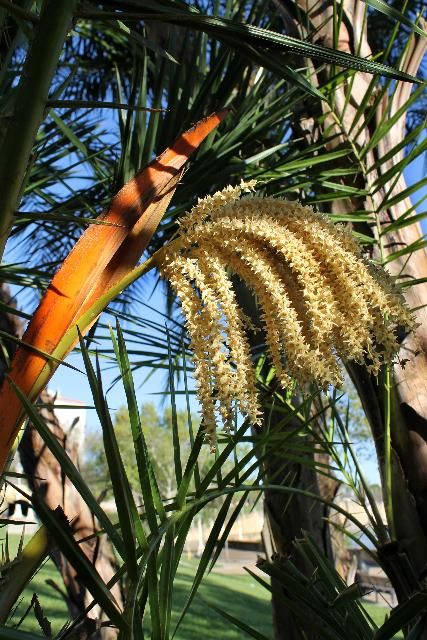
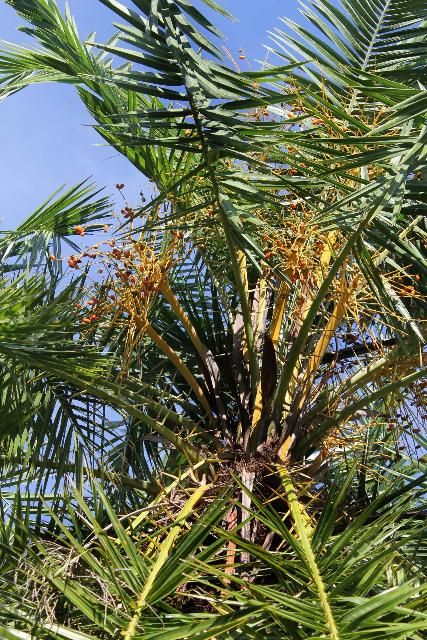
This striking palm creates an interesting silhouette with its multiple, gracefully curved, often reclining, slender brown trunks, and dense crowns of stiff but feathery leaf fronds. Old frond bases are medium brown and remain on the trunk forming a showy trunk which is attractive all year long. A mature specimen of Senegal date palm can reach 35 feet in height with a 12 to 20-foot-spread and creates a striking tree which casts a light shade. The palm is elegant when lit from below at night. It is best used as an accent for large landscapes and parks. The somewhat showy flower stalks, often lost within the thick foliage, are followed by one-inch-long, reddish-brown dates which are incredibly showy. These can be very attractive, particularly when viewed from a balcony above the tree.
Figure 1. Full Form - Phoenix reclinata: senegal date palm Credit: UF/IFAS
General Information
Scientific name: Phoenix reclinata
Pronunciation: FEE-nicks reck-lih-NAY-tuh
Common name(s): senegal date palm
Family: Arecaceae or Palmae
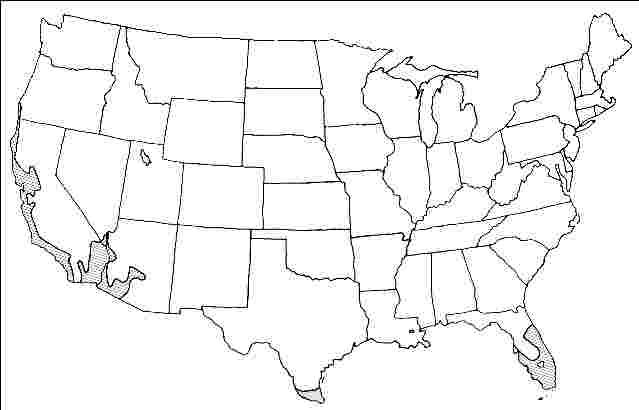
USDA hardiness zones: 9B through 11 (Figure 2)
Origin: native to Africa and Madagascar
UF/IFAS Invasive Assessment Status: invasive and not recommended (South); not considered a problem species at this time, may be recommended (North, Central)
Uses: specimen; container or planter
Figure 2. Range
Description
Height: 25 to 35 feet
Spread: 12 to 20 feet
Crown uniformity: irregular
Crown shape: palm, upright/erect
Crown density: open
Growth rate: moderate
Texture: medium
Foliage
Leaf arrangement: alternate
Leaf type: odd-pinnately compound
Leaf margin: entire
Leaf shape: linear
Leaf venation: parallel
Leaf type and persistence: evergreen
Leaf blade length: 12 to 15 feet; leaflets are 1 feet
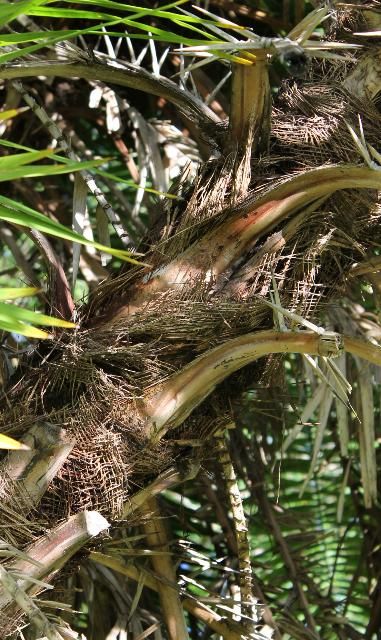
The multiple trunks lose older fronds as the palm grows, clearing lower trunks of all foliage. This characteristic makes Senegal Date Palm a wonderful tree for accenting in a bed of groundcover or a grouping of low shrubs. Trunks which bend to the horizontal as the palm ages may need to be supported with a brace or cable to hold them up.
Growing easily in full sun or partial shade, Senegal Date Palm will thrive on any well-drained soil. Plants should receive adequate moisture during periods of drought. This palm is too large for all but the largest residential landscapes. They are very costly to purchase due to the slow growth rate. Large specimens command a high price.
Propagation is by seed or division of the many suckers which appear at the base of old clumps.
Pests
A variety of scales infest this palm.
Diseases
Some diseases of this tree are lethal yellowing disease, leaf spot.
Stressed and damaged trees often are infected with the Ganoderma fungus. A conk is formed at the base of the tree which appears as a varnished shelf or mushroom. Remove the conk and the tree to help control the spread of the disease to other plants. Prevent injury to the trunk and roots, and plant in well-drained soil. Be sure sprinklers do not irrigate the trunk so it remains wet. A wet trunk and wet soil encourage this disease. There is no control for butt rot, only prevention.
Lethal bronzing (formerly Texas Phoenix Palm Decline) has been found to affect this palm tree species.
References
Koeser, A. K., Hasing, G., Friedman, M. H., and Irving, R. B. 2015. Trees: North & Central Florida. University of Florida Institute of Food and Agricultural Sciences.
Koeser, A.K., Friedman, M.H., Hasing, G., Finley, H., Schelb, J. 2017. Trees: South Florida and the Keys. University of Florida Institute of Food and Agricultural Sciences.
IFAS Assessment
South
Invasive
Invasive and not recommended by IFAS. Will be reassessed every 10 years. Specified and limited uses may be considered by the IFAS Invasive Plants Working Group