


Torreya nucifera: Japanese Torreya1
Introduction
Japanese torreya is a very slow-growing evergreen which will eventually reach 40 feet tall in the home landscape and is capable of reaching 75 feet in the wild. With a pyramidal silhouette and long, graceful branches clothed with glossy, dark green leaves, Japanese torreya provides medium to deep shade beneath its canopy. The stiff, 1.25-inch leaves give off a pungent aroma when crushed. The 1.5-inch-long, green, edible fruits follow the insignificant flowers and persist on the tree, requiring two years before maturity when they ripen and split apart. The seeds are very oily.
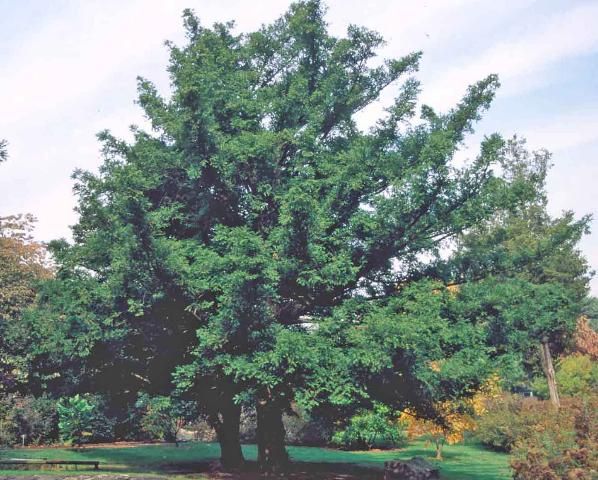
Credit: Ed Gilman, UF/IFAS
General Information
Scientific name: Torreya nucifera
Pronunciation: TOR-ee-uh noo-SIFF-er-uh
Common name(s): Japanese torreya, Japanese nutmeg
Family: Taxaceae
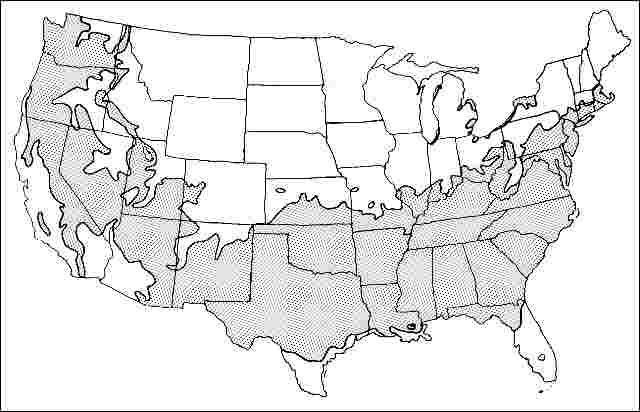
USDA hardiness zones: 6A through 8B (Fig. 2)
Origin: not native to North America
Invasive potential: little invasive potential
Uses: specimen; hedge; screen
Availability: not native to North America
Description
Height: 15 to 30 feet
Spread: 15 to 25 feet
Crown uniformity: symmetrical
Crown shape: pyramidal
Crown density: moderate
Growth rate: slow
Texture: fine
Foliage
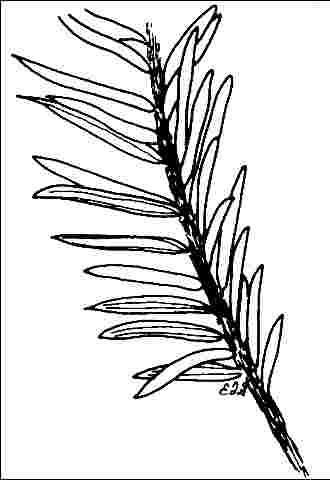
Leaf arrangement: alternate (Fig. 3)
Leaf type: simple
Leaf margin: entire
Leaf shape: linear
Leaf venation: none, or difficult to see
Leaf type and persistence: evergreen, fragrant, needled evergreen
Leaf blade length: less than 2 inches
Leaf color: green
Fall color: no color change
Fall characteristic: not showy
Flower
Flower color: unknown
Flower characteristics: not showy
Fruit
Fruit shape: round
Fruit length: .5 to 1 inch, 1 to 3 inches
Fruit covering: fleshy
Fruit color: green
Fruit characteristics: attracts birds; not showy; fruit/leaves not a litter problem
Trunk and Branches
Trunk/bark/branches: branches droop; showy; typically one trunk; thorns
Pruning requirement: little required
Breakage: resistant
Current year twig color: green
Current year twig thickness: thin
Wood specific gravity: unknown
Culture
Light requirement: partial sun or partial shade, shade tolerant
Soil tolerances: clay; sand; loam; acidic; well-drained
Drought tolerance: moderate
Aerosol salt tolerance: unknown
Other
Roots: not a problem
Winter interest: no
Outstanding tree: yes
Invasive potential: little invasive potentia
Ozone sensitivity: unknown
Verticillium wilt susceptibility: unknown
Pest resistance: resistant to pests/diseases
Use and Management
Japanese torreya should be grown in shaded areas on rich, moist soil. In the colder regions of its range it should be grown where it can be protected from harsh winter winds. It is not widely available but could be produced and planted as specimens in home and commercial landscapes.
Propagation is by seed or cuttings.
Pests and Diseases
No pests or diseases are of major concern.

