University of FloridaSolutions for Your Life

Download PDF
Publication #4H 6.5

Engaging Volunteers through ISOTURES: Selecting for Volunteer Involvement1

Bryan D. Terry, Rick Godke, Bill Heltemes, and Lori Wiggins2

Overview

Once the 4-H program has established a vision for how volunteers will be involved in the county 4-H program selecting volunteers is the next step. If a vision has not been developed, review Engaging Volunteers through ISOTURES: Identifying Opportunities for Volunteer Involvement (http://edis.ifas.ufl.edu/4h302). Program vision is as critical element in the recruitment process.

A selection and screening process is a method of strengthening the recruitment and placement of volunteers in county 4-H youth development programs. When volunteers are purposefully selected and requested to uphold high standards, there is increased credibility and value of volunteers to 4-H youth and the 4-H program. A concise policy, with risk management standards, will send the positive message to parents, volunteers, and other youth-serving organizations across the nation that 4-H has a focus on safety and protecting youth.

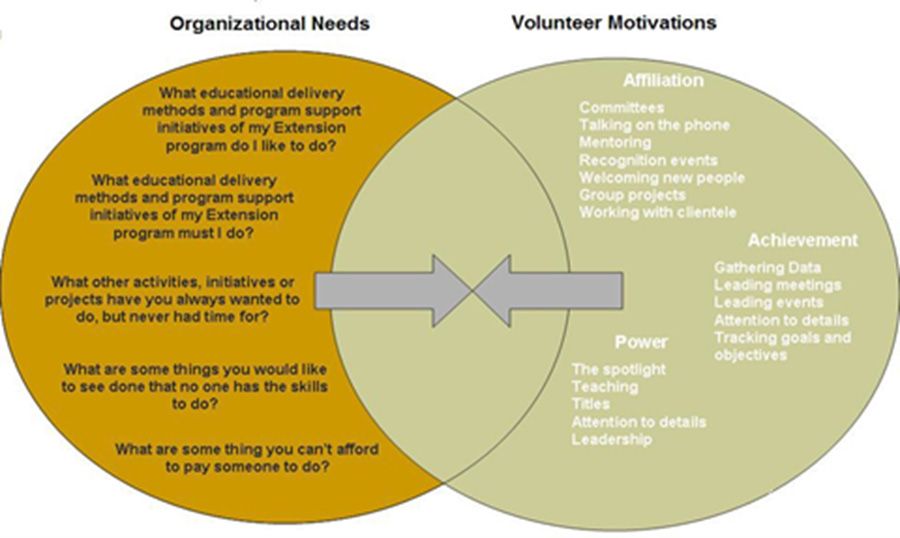
Earlier in the discussion of volunteerism, overlapping circles (Figure 1) were used to illustrate one of the roles of the 4-H agent. One circle represents the needs of the 4-H program. The other circle represents what volunteers are willing and able to do. The key to sustaining a volunteer program is the ability to match the interests, skills and abilities of a potential volunteer with an appropriate role in the 4-H. This is represented where the two circles overlap. In the volunteer life cycle, this is the Decision to Volunteer stage. The matching process is where volunteers evaluate 4-H to establish the fit between their individual needs and what 4-H has to offer.

Figure 1. 

Matching program needs and volunteer roles requires evaluation of potential volunteer interests, skills, and abilities as well as maintenance of a plan for volunteer development.


[Click thumbnail to enlarge.]

There are several basic steps for selecting volunteers for the 4-H program. Initially the process begins with identifying potential volunteers, followed by interviews, application and screening. In this section the following will be addressed:

  • Who volunteers and why

  • The essentials of effective volunteer recruitment

  • How to avoid the volunteer recruitment pitfalls—why Johnny can't recruit volunteers and what can be done about it

  • Where to start in finding volunteers

  • What should be done when a potential volunteer is identified

  • Youth protection volunteer screening

  • How to use LexisNexis

  • Documentation and volunteer files

The intent of this fact sheet is to provide the basics involved in the selection process. Should additional questions arise or if more detail is desired, contact a Regional Specialized 4-H Agent or the Volunteer State Specialist at the State 4-H office.

Who Volunteers

Consider the following facts about individuals that volunteer:

  • ~29% of U.S. population volunteered in 2005

  • 33% of all women volunteer

  • 25% of men volunteer

  • Most were educated professionals, married with children

  • Most volunteer for more than 1 organization

  • Most volunteer 50 hours annually

  • Most report more than 1 activity performed for their organization

Why is it important to know who volunteers? Demographics that describe volunteers serve as a guide to focus energy. For example, according to survey data, on average, volunteers serve more than one organization, contribute 50 hours annually, and perform more than one function. How many nonprofits and charities are in the county? These other organizations are a potential source for volunteers and current volunteers in the 4-H program may have connections to these groups.

Why Volunteer

What motivates a person to volunteer? Motivation is an important aspect in human development. Understanding motivations of potential volunteers is a necessary skill for 4-H agents working with volunteers. Ensuring that volunteer needs are being met will increase the likelihood that they will remain a volunteer for an extended period of time. According to McKee & McKee (2008), "motivation is an inside job. People do things for their reasons, not yours, so our role is to create an organizational culture that stimulates the inner motivation of each volunteer" (p. 68).

There are many theories about motivation to volunteer (Arnold and Dolenc, 2008; Clary, Snyder and Ridge, 1992; McCudden, 2000; McEwin & Jacobsen-D'Arcy, 2002; Mueller, 1975). However, most people respond to three levels of motivation.

  • Basic Level: Self-serving drive

  • Secondary Level: Relational drive

  • Highest Level: Belief drive

Basic Level: Self-serving drive

People often join 4-H because the experience meets their needs. That need may be for their children, for friendship, for belonging, to improve their employment skills, networking or for a host of other reasons. The wise recruiter looks for win/win situations. A win/win situation is where the needs of the volunteer are met by volunteering, and 4-H benefits from getting the expertise and high-energy enthusiasm.

Interns provide an example of this type of volunteer. They want experience that they can use to get a job. Most of them are also looking for a mentor and someone who can write a strong recommendation letter. Recruiting at this basic level emphasizes the personal benefits volunteers will receive.

Secondary Level: Relational drive

People also volunteer because of friendship. When a friend personally asks someone to volunteer, it is often hard to say, "No." If the friend is excited about a certain cause, he or she is the best person to do the recruiting. Relational marketing is one of the most effective marketing tools. I.I.R., or investing in relationships, is one of the strongest stimulators for our inner motivations.

Develop a team of recruiters. The advantage of having a recruiting team is that the synergy of brainstorming increases because the sphere of influence has been increased. Two people only have so many contacts; however, a recruiting team of ten people can produce hundreds of potential volunteers.

Highest Level: Belief drive

The level of belief is the strongest level of commitment. When people volunteer because of their passion for a cause—they have developed a belief in the cause. When volunteers believe in the cause of 4-H, even when volunteering will cost them a great deal of personal time, energy, or financial resources, their commitment is the strongest. This is true inner motivation that is on the level of Gandhi or Mother Teresa. People join and volunteer because they believe the cause is right. This is the highest level of motivation.

People often join an organization at level one (self-serving) or level two (because of a friend), but in time they become true believers and are passionate about the cause. This is the goal with each member of an organization. In 4-H, agents will find recruits at all three levels and can use each kind of motivation to enlist other volunteers.

Volunteer Recruitment

Why do some people really excel, why others have little or no success at the same task? Usually, there is information that is possessed that allows them to be successful. This is true for volunteer administrators that successfully recruit volunteers. Effective volunteer recruiters have information that allows them to effectively engage potential volunteers. Knowing this information will help recruit volunteers.

Essentials of Volunteer Recruitment

It is not enough to know that volunteers are needed. There are several basic essentials of effective volunteer recruitment. Successful volunteer recruiters know exactly how they want volunteers to be involved prior to recruiting volunteers! Use the information gathered from identifying opportunities for volunteer involvement. Have a vision for the 4-H program that includes volunteer involvement. Illustrate this vision with an Organizational Chart showing the relationship between volunteers and paid staff. Have a position description for each role identified on the organizational chart. This position description should outline the roles and responsibilities for the volunteer, the skills required to successfully complete the role, time commitment, and a contact person a volunteer can call on for support.

Preparation is another element. Preparation, with respect to recruiting volunteers, is the cognitive process of thinking about what will be done in the event a recruitment opportunity presents itself. Be prepared to discuss:

  • The County Extension office as an organization.

  • The 4-H program—profile including number of youth involved; benefits of 4-H to the youth in the county; profile including number of volunteers involved—be specific and be prepared to provide a narrative of individual successes.

  • The benefits of volunteering—personal gratification; personal direct benefits.

  • Specific roles that appeal to an individual's interests, skills, abilities, and time commitment.

  • Concerns that potential volunteers may have.

A process is a particular course of action, or steps, intended to achieve a result. Within any process there are usually a set of guiding principles that increase the likelihood of successfully accomplishing an objective. This process often leads to a routine. Recruiting 4-H volunteers is no different. Knowing and utilizing a "routine" will increase the likelihood that volunteers will become involved in the 4-H program.

Be committed to developing a recruitment strategy. Initiatives with commitment get done! Be confident! Optimism is infectious. 4-H has a positive image and is respected not only in Florida, but nationwide. Not everyone invited will volunteer. Do not be discouraged. The reality is that more times than not, recruitment will be successful.

Volunteer Recruitment Pitfalls

Extension agents know time is scarce. With every strategy, there are pitfalls! Knowing these pitfalls in advance will avoid wasting time.

In their book The New Breed: Understanding & Equipping the 21st Century Volunteer, Jonathan and Thomas McKee have studied hundreds of volunteer programs and make these observations and suggestions on recruitment pitfalls.

Announcements do not engage volunteers. It does not provide enough volunteers and unfortunately, often attracts the wrong people for a volunteer role. What will work is "asking" for help. Treat 'volunteer' as a noun and not a verb.

Another pitfall is to go it alone. In addition to educating, coordinating, and evaluating volunteer programs, 4-H agents have many other responsibilities. Recruiting volunteers often requires one-on-one personal relationships. Building personal relationships can be time intensive. Involve other staff and volunteers (maybe your advisory committee) by developing a recruitment task force. A task force that has a passion for 4-H, is already actively volunteering for 4-H, can clearly communicate, and is visionary.

Not everyone will initially commit to long-term involvement in 4-H. Today's volunteers are often looking for episodic volunteer opportunities to get a feel for the 4-H program. Provide episodic opportunities for volunteers and then move to short-term roles. For example, find someone to help edit the newsletter or make flyers for a special event. After a volunteer has success with this task, ask them to take on more responsibilities. Remember, success in these experiences often leads to longer term commitments.

"No" is a common response when it comes to volunteer recruitment. However, "no" does not mean "never." It might just mean "not right now." Listen carefully to their reasons for not volunteering today. Today's reason may not be forever and they may be open to future opportunities.

Steps to Success

Avoid the 'car salesman' approach volunteer recruitment. "What do I have to do to sell this car today?" No matter the answer, car salesman has a response to overcome the rejection. It was not effective for selling cars and it will not work recruiting volunteers for 4-H.

Jonathan and Thomas McKee make another good analogy. Treat recruiting volunteers like "dating."

On the first volunteer recruitment 'date,' do not be aggressive. The goal is to become familiar with the potential volunteer and for the potential volunteer to become familiar with 4-H. Many have experienced a bad first date? One that goes something like:

"Hi my name is ___fill in the name____. Would you like to go out tonight? Let's cut to the chase. I like you; you like me. Let's get married tomorrow. I will call my friend who is a pastor; by the way, how many children would you like?"

Dates similar to this usually never lead to second dates!

A more effective approach would be for them to get to know 4-H. It should include a visit to a 4-H event; an opportunity to help in a small way at an event, club, or project with youth; or even a simple lunch to share about the 4-H experience. The goal is to better understand the potential volunteer and get to a second date. After all, the goal of a first date is usually a second date!

On the second date, the goal is to ask for their help. People want to be asked and they want specifics. Based upon the first "date" talk about a specific role in 4-H that they can 'help' fill. Use the position description to discuss the roles and responsibilities for the position together with 4-H expectations of volunteers. This includes the time commitment, screening process, applications, orientation, training, etc. There is nothing worse than getting a commitment from a volunteer and then going back to them and saying "by the way" I need ________. One of the challenges here is not to overwhelm a potential volunteer. On the second date, ask for their help, provide a position description, and discuss their role. The goal would be to get another "date." This is kind of an art that everyone must perfect. Know when to say "when."

On the next date seek a commitment for the position that was discussed. It seems as though this process takes a long time, however the extra effort will pay dividends in the long term. That is, the right volunteer for the right role.

Two Strategies for Finding Volunteers

In talking with 4-H agents about expanding the involvement of volunteers in the 4-H program, the question always asked is "where do I find them?" There are several strategies that can be utilized, but for the purposes of expediency, we present here two alternatives. They are Spheres of Influence and Circle of Resources.

Spheres of Influence

Spheres of Influence is a concept that involves evaluating and diagnosing who the county Extension office "touches" in the course of a year. It works through the simple theory that those people who are already connected to Extension or 4-H are the best targets for a volunteer recruitment effort. Starting with current volunteers, work outwards, using concentric circles to identify potential groups. These groups may include current volunteers, friends and relatives of volunteers, Extension clientele, friends and relatives of Extension clients, former 4-Her's, staff, donors, people in the neighborhood, and retirees.

Circle of Resources

Circle of Resources is a concept that starts by identifying resources that are in the closest proximity to the Extension office. Picture the Extension office as the center of a bull's eye, with concentric circles around it. Walk outside with pen and a clipboard (and a companion too!) and walk around the block and write down every store, business, parking lot, church, apartment, school, etc. Repeat this going two blocks, three block, etc. The idea is to identify "neighbors" that have not been recognized that might serve as volunteers. Ask these questions:

  • Are there business people who could volunteer for 4-H on their way to or from work or even lunchtime?

  • Might any of these neighbors have an interest in a community service project?

  • What professional skills might be tapped at neighboring businesses or schools?

  • Is there access to other resources other than volunteers?

  • Do any of the neighbors share youth development as a goal or initiative?

Neighbors are an easier group to approach because after all they are neighbors and neighbors like to help! This is an excellent strategy to use for locating 4-H clubs in under represented areas.

The Concentric Circles and the Circle of Resources models are available on the Faculty and Staff Resources page of the Florida 4-H website at http://florida4h.org/.

Procedures for Post-Recruitment

General Policies

An important consideration after finding a potential volunteer is reducing risk first and foremost to youth, but also to volunteers, faculty, staff, and UF/IFAS. There are a number of policies, procedures and regulations that have been established to protect youth, volunteers, and the organization.

The University of Florida provides the following definition (6Cl-3.0031 (1b):

A volunteer is any person who, of his or her own free will, provides services to the University with no monetary compensation, on a continuous, occasional, or one-time basis.

Volunteers must be at least 14 years old. All volunteers, including youth volunteers, must complete a volunteer application. For youth this application must be signed by their parent or guardian (6Cl-3.0031 (3a)). The adult and youth applications are available on the Faculty and Staff Resources page of the Florida 4-H website at http://florida4h.org/.

At a minimum, the following steps should be conducted with a potential volunteer:

  • Volunteer submits application.

  • Volunteer signs Adult Agreement.

  • Extension obtains copy of applicant's driver's license

  • Extension conducts background check (Levels I, II and III).

  • Extension checks three references.

  • Extension conducts interview with applicant.

Youth Protection and Volunteer Screening

To protect youth involved in our Extension programs, the University of Florida has established a volunteer screening policy. UF\IFAS policy applies this policy to any volunteer working with youth three or more times annually or those chaperoning youth to overnight activities and events. University regulation 6Cl-3.0031 (3a) states:

Each person wishing to become a volunteer shall furnish to the appropriate department/operational unit such personal and professional information as may be necessary for the determination of his or her suitability as a volunteer. The department/operational unit seeking volunteer services shall be responsible for the screening and selection of volunteers.

This policy is designed for protecting:

  1. Youth participants by implementing risk management practices.

  2. Volunteers by establishing and communicating policies that reduce risk in specific situations.

  3. University of Florida, Cooperative Extension Service faculty and staff by establishing consistent guidelines for structure and behavior.

Who Must be Screened

All volunteers who want to work directly with youth (who are not their own children) on an ongoing basis or on an overnight event are required to be screened. This would include, but is not be limited to:

  • All current volunteers in the program

  • All adults who supervise youth who are not family members

  • All prospective club volunteers

  • Parents' helpers in clubs

  • Youth volunteers (age 14–18)

  • Camp counselors (all ages)

  • Day camp volunteers

  • Resource leaders to club or county programs

  • Transportation volunteers

  • Master Volunteers in project areas, event management, or chaperoning

  • Chaperones for out-of-county trips or other field trips

  • Adults in homes that host youth involved in interstate and/or international exchange programs

  • Professionals who work with Extension program youth outside of their regular job

Who is Exempt from Volunteer Screening

Although volunteer screening is encouraged for all volunteers, there are individuals involved with Extension youth development programs that are exempt from the screening process. This includes:

  • Adults who conduct Extension programs with their own children, ONLY

  • Classroom teachers who are working with youth as part of their classroom responsibility and have been previously screened through the school system

  • Event judges—one or two times per year

  • Donors and contributors

  • Adult assistants who work in public groups with youth one time a year during a weekend

  • After-school paid staff, if school has previously conducted a screening process

  • Professionals who volunteer as part of their regular job, IF their employer has previously conducted a screening process

  • Advisory committee members or Foundation Board members, who do not supervise, travel, or work directly with youth

Level 1 Volunteer Screening

For each volunteer:

  • Application and Adult Agreement

  • Interview

  • 3 References

  • Copy of Driver's License

  • Screen via Sexual Predator Website

  • Screen via local law enforcement

Level 2 Volunteer Screening

For each volunteer:

  • Application and Adult Agreement

  • Interview

  • 3 References

  • Copy of Driver's License

  • Screen via Sexual Predator Website

  • Screen via local law enforcement

  • Screen via complete FL Department of Law Enforcement and sexual predator website (http://offender.fdle.state.fl.us/offender/homepage.do)

Level 3 Volunteer Screening

For each volunteer:

  • Application and Adult Agreement

  • Interview

  • 3 References

  • Copy of Driver's License

  • Screen via Sexual Predator Website

  • Screen via local law enforcement

  • Screen via complete FL Department of Law Enforcement and sexual predator website (http://offender.fdle.state.fl.us/offender/homepage.do)

  • Submit name and fingerprints of applicant to national screening process through LexisNexis (formerly ChoicePoint) at http://screening.choicepoint.com/

Using LexisNexis

LexisNexis is a private pre-employment background screening business with a nonprofit component for conducting volunteer background screening. Florida 4-H has negotiated an agreement for use by all Florida counties. The background check fee as of June 2009 is $6.50. In addition to 4-H volunteers, LexisNexis can also be used for other Extension volunteers.

To use LexisNexis an account will be required. Contact the Regional Specialized 4-H Agent (RSA), State Volunteer Specialist or State 4-H Program Leader for the county's password, account number and user ID. Here are step by step instructions for using LexisNexis.

Prior to using LexisNexis, an account needs to be established for payment of the fees. Many counties handle this through a purchase order agreement set up in advance with LexisNexis. Use the User ID Request Form available on the Faculty and Staff Resources page of the Florida 4-H website (http://florida4h.org/). For guidance, ask the Regional Specialized 4-H Agent (RSA) or State Volunteer Specialist for assistance.

4-H agents can request reports on one volunteer applicant at a time or a batch report for a large number of volunteers with a single file upload. Batch reports are great for initial screening of all volunteers, or to update records. Volunteers need to be rescreened every 3 years and a batch report will save time. Note, however, that batch reports costs are $25 per record—significantly higher than single report requests.

  1. System requirements: Windows 98 or higher, Windows Internet Explorer 6 or higher, or Netscape 6 or higher.

  2. Information needed before logging onto LexisNexis: applicant's completed volunteer application form, applicant's SSN and birth date. The volunteer application form will provide the volunteer's authorization. Potential volunteers must complete this form. The form can be located on the faculty page of the state 4-H website.

  3. To log on, go to http://www.volunteerselectplus.com/.

  4. Use the password, user ID, and account number provided to log on. Click on 'Forget Password?' to create a new password, when an old password is forgotten.

  5. After login, take a site tour, do a training lesson, view a previous report, and then order a new report.

  6. To conduct a background check, click on 'Order a Report Now.'

  7. Click on Florida on the map.

  8. Under INSTANT DATABASE CRIMINAL SEARCHES, click on 'LexisNexis National Criminal File (CNCF).' Choose the Plus option by clicking on the Plus button. By clicking on the report titles, a description of each of the reports and what the report covers is displayed. Report results from the CNCF are instant.

  9. At Position Type, click on the Volunteer button, then on 'Continue Search.'

  10. Fill in the information form. Requester name is name of person on account; then complete the Billing Identifier.

  11. To check the applicant's driving record click on 'Motor Vehicle Rec. under Other Reports.' Results are instant to 24 hours.

  12. When the form is complete, select 'Submit Search.' After the request has been reviewed and confirmed, click on Submit/Retrieve.

  13. Print the report to maintain a record for the files. Be sure files are kept locked to ensure confidentiality.

  14. View Reports: Once an order has been submitted, the order status and a list of report orders are available. Click the View Reports link under the Background Screens heading located at the upper left side of the screen.

  15. A report status will be either in Progress, Pending, or Completed. Completed reports will remain on the Web site for 30 days; then they will be moved to an archive file.

  16. The status for completed reports will appear as either red or green. Red means there is potentially negative criminal history on the report. Green means no criminal history was found. If an item is red flagged, refer to the fact sheet "Background Check Red Flags" located at the faculty page on the state 4-H website.

  17. Pay Online: At the upper left screen click on Retrieve Invoice. An account must be set up for online billing. For assistance call 1-866-399-6647. Directions for paying online are on the LexisNexis website.

  18. Payment via credit card is available.

Documentation and volunteer files

  1. Select a location for your files that is secure and accessible only to faculty needing access to the files. Keep the file locked at all times. Provide a key only to faculty needing access and keep a spare key at a secure location (e.g., CED's office).

  2. Determine a filing system—alphabetical by volunteer last name, alphabetical by club and last name, etc. Include in the file the volunteer application, originals of the completed reference forms, interview form or notes from interview, the LexisNexis or other background check report, the volunteer appointment form, and role description. Put the initial date the file was opened and the date of final approval/appointment on the folder.

  3. In a separate folder keep a summary of the status of all volunteers and volunteer applicants. A form on the website is available for this.

Conclusion

In summary, there are a number of basic steps for selecting volunteers for the 4-H program. The process begins with identifying potential volunteers, followed by the application and screening process.

To increase the success in recruiting volunteers understand who volunteers and why. Be prepared—know what volunteer opportunities are available in the county 4-H program. Craft and memorize a message to be prepared when an opportunity arises and be confident. Avoid the six pitfalls of volunteer recruitment. Remember that volunteer recruitment is like "dating." It is all about relationships. Use the Spheres of Influence and the Circle of Resources to target potential volunteers.

Keep in mind; the responsibilities of a 4-H agent do not end when a potential volunteer is identified. For the protection of youth, other adults, and the 4-H program, know which volunteers must be screened and how. Finally, establish a filing system to track volunteers involved in the 4-H program.

References

Arnold, M. E., & Dolenc, B. (2008). Oregon 4-H Volunteer Study: Satisfaction, Access to Technology, and Volunteer Development Needs. Corvallis, OR: 4-H Youth Development Education, Oregon State University.

Bussell, H. & Forbes, D. (2003). The Volunteer Life Cycle: a marketing model for volunteering. Voluntary Action, 5(3), pp. 61–79.

Clary, E.G., Snyder, M., & Ridge, R. (1992). Volunteers' motivations: a functional strategy for the recruitment, placement, and retention of volunteers. Nonprofit Management and Leadership, 2, 333–350.

Esmond, J. & Dunlop, P. (2002). Developing the Volunteer Motivation Inventory. Perth: Lotterywest & CLAN WA Inc.

McCudden, J. (2000). What makes a committed volunteer? Research into the factors affecting the retention of volunteers in Home-Start. Voluntary Action, 2(2).

McCurley, S. and Lynch, R. (2006). Volunteer Management (2nd ed.). Ontario: Johnstone Training and Consultation, Inc.

McEwin, M., & Jacobsen-D'Arcy, L. (2002). Developing a scale to understand and assess the underlying motivational drives of volunteers in Western Australia: Final report. Perth: Lotterywest & CLAN WA Inc.

McKee, J. & McKee, T. (2008). The New Breed: Understanding and Equipping the 21st Century Volunteer. Loveland, CO: Group.

Mueller, M. (1975). Economic Determinants of Volunteer Work by Women. Journal of Women in Culture and Society, 1, pp. 325–35.

Footnotes

1.

This document is 4-H 6.5, one of a series of the Florida 4-H Program, Florida Cooperative Extension Service, Institute of Food and Agricultural Sciences, University of Florida. First published October 2010 on http://edis.ifas.ufl.edu. Please visit the Florda 4-H website at http://florida4h.org.

2.

Bryan D. Terry, assistant professor; Department of Family, Youth and Community Sciences; Rick Godke, 4-H extension agent, Duval County Cooperative Extension; William Heltemes, 4-H specialist, Northeast Region, Florida 4-H; Lori Wiggins, 4-H extension agent, Taylor County Cooperative Extension; Institute of Food and Agricultural Sciences; University of Florida; Gainesville 32611.


The Institute of Food and Agricultural Sciences (IFAS) is an Equal Opportunity Institution authorized to provide research, educational information and other services only to individuals and institutions that function with non-discrimination with respect to race, creed, color, religion, age, disability, sex, sexual orientation, marital status, national origin, political opinions or affiliations. For more information on obtaining other extension publications, contact your county Cooperative Extension service.

U.S. Department of Agriculture, Cooperative Extension Service, University of Florida, IFAS, Florida A. & M. University Cooperative Extension Program, and Boards of County Commissioners Cooperating. Nick T. Place, Dean.