University of FloridaSolutions for Your Life

Download PDF
Publication #4H GCM 12

A Guide to the Florida 4-H Council1

J.A. Rutledge, Joy C. Jordan, Wendi Armstrong, and Tracy Tesdall2

County, District, and State Youth Councils

The 4-H Program utilizes many tools or methods to provide educational experiences for youth. A 4-H Council (or other relevant named group) at county, district, and state levels is one of these tools. A Council is an elected representative group of 4-H members who meet, discuss, plan, and assist in carrying out 4-H programs and activities in the interest of the total membership. The Council provides links between local clubs or groups and County 4-H Programs, County Programs and District 4-H Programs, and District Programs and State 4-H Programs.

Why a 4-H Council?

As in all Extension programs, the purpose of the 4-H Program is to meet the needs of local people. Through the Council's activities, the interests and concerns of young people can be voiced and incorporated into the Program's goals.

Participation in a 4-H Council provides the means for the personal growth of 4-H members through citizenship and leadership activities. Teens are looking for leadership roles and are interested in returning something to 4-H. Council participation gives 4-H'ers the opportunity to exercise their leadership knowledge and be of valuable assistance to 4-H Programs.

4-H Council Levels

In Florida 4-H, there are three levels of the council system: County, District, and State. The District level of 4-H Councils, as with many 4-H events and activities, use the thirteen 4-H Districts, rather than the five Extension Administrative Districts.
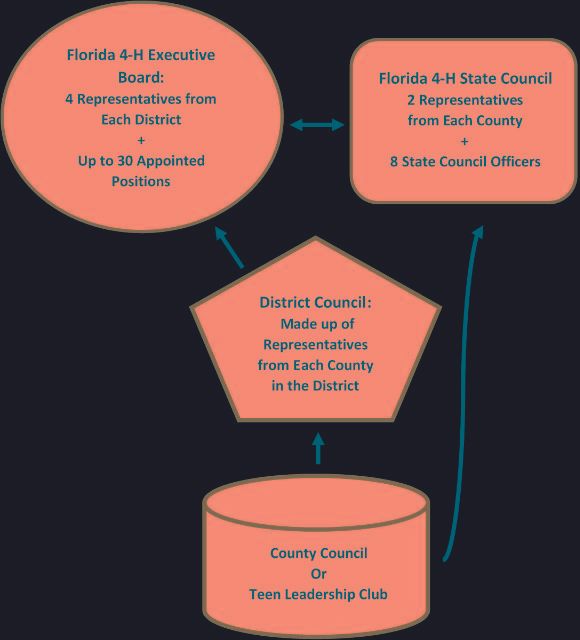
Figure 1. 

County Council

The County Council is the voice of the 4-H'ers in the county. It includes representatives from the 4-H Clubs and groups in the county.

District Council

District 4-H Councils are composed of youth representatives from each of the county councils within their geographic 4-H District.

State 4-H Council

The Florida 4-H Council is composed of two voting delegates from each county that has joined by paying dues and the eight State Officers. The Annual Meeting of the 4-H Council is held at the Florida 4-H Congress. At this time the business of the Council is conducted and new officers are elected.

Organizing a County 4-H Council

Purpose and Structure

The County Council is the voice of the all 4-H'ers in the county. It should include representatives from the 4-H Clubs and all other 4-H groups in the county. The County Council may be organized in various ways, each designed to fit the needs and interests of the local 4-H Program.

Membership

The Council is a tool to provide representative youth voice to the 4-H Program by involving representatives of all the 4-H membership in the county. Therefore, consideration should be given to representation of all age groups, delivery types, and geographic areas. Involving junior 4-H members will help generate their interest in senior programs and help increase their knowledge about 4-H on a broad scale.

The method of selecting delegates to the County Council is to be determined by the county. The most common methods designate:

  1. The President and a selected County Council delegate from each club or group; or

  2. County Council delegates selected from each club or group.

While 4-H clubs are the primary source for members, there should be some means to include youth representing other delivery methods. If your county has special-interest groups, afterschool programs, camps, or military groups, think about ways to engage these youth in being involved in council meetings. Think about when you meet and how you meet, use technology or other means to get all the youth voices into county program decisions.

Youth Leadership and Governance

Organization of the County Council should be useful, flexible, and efficient. Youth should be involved, as they are in clubs, with determining the rules for self-governance. These may take the form of County Council bylaws and, if necessary, a bigger picture Constitution. A County Council Bylaws and Constitution patterned after the state bylaws and constitution serve as the organizational base in many counties (see sample in the back of this guide). If you have a county 4-H Council, become acquainted with the current bylaws and constitution.

The following leadership roles are suggested:

  • President

  • Vice-President

  • Secretary

  • Treasurer

  • Reporter

  • Parliamentarian

  • Sergeant-at-Arms

  • Historian

  • Recreation or Social Chair

Responsibilities of the officers are discussed in the Officers' Training Handbook [4H GCO 14].

Annual Goals and Educational Programs at Council Meetings

The potential involvement of the County Council in the 4-H Program is limitless. Suggestions are provided here to encourage ideas for additional involvement. One possibility is to assist in the planning and implementation of county 4-H programs. These programs might include:

  • County events

  • National 4-H Week Observance and other marketing efforts

  • Community Service Learning, State Council Project, or the state Community Pride Program

  • Summer Camps

  • Achievement and Recognition Programs

  • 4-H Day at the Fair

County Council members can be involved in spreading the 4-H word to:

  • Civic groups and stakeholders

  • Potential 4-H members/volunteer leaders

  • Mass media, including newspaper, radio, and television.

County Representatives to District and State Council

One of the roles of the council system is to provide representative youth voices in the district and state programming levels. Therefore the county council has the opportunity to select and have representative youth participate in the District Council and the State 4-H Council.

County Representatives to the District 4-H Council

Each District 4-H Council is made up of youth representatives from each of the counties within the geographic 4-H District. Refer to a copy of the appropriate District 4-H Council Constitution for the number of representatives each county should select for participation. The new District Council delegates should be elected prior to the District Events each spring.

The delegates to the District have certain responsibilities, for example:

  • Taking notes at the district meeting.

  • Listening to all the business discussions.

  • Preparing and accurately reporting of the business and giving it to the Extension 4-H Agent and County Council members.

  • Voting according to the desires of the county's 4-H members.

County 4-H Voting Delegates to State 4-H Council

Each county selects two senior 4-H'ers to represent their county as voting delegates for the State 4-H Council. The State Council routinely meets once each year in an annual business meeting at Florida 4-H Congress. For county elected delegates to be seated on the State 4-H Council, the county must pay its annual dues at the beginning of each 4-H program year to the Florida 4-H Council. An additional fee is assessed counties paying dues after December 1.

District 4-H Council

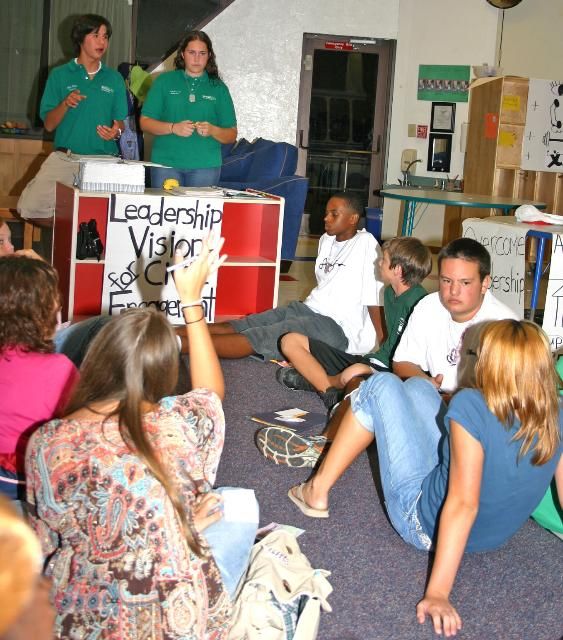
You can gain valuable leadership skills as you represent your county and participate in the District 4-H Youth Council.
Purpose

The purposes of a District 4-H Council include the following:

  • Assisting with organizing and conducting district activities and events

  • Facilitating the distribution of information from the district and state councils to the county councils

Membership

District 4-H Council is composed of two to four council delegates from each of the counties in the 4-H District. Most district councils may require that youth representatives be Intermediate or Senior 4-H members.

Leadership and Governance

The organization of the District 4-H Council is stipulated in their Constitution specific to each District. As with county councils, the organization should be useful, flexible, and efficient.
Annual Goals and Educational Programs at Council Meetings

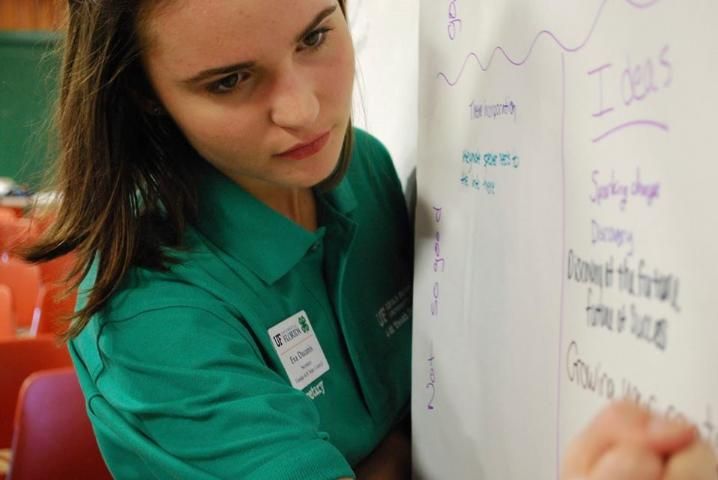
A primary role of the District Council is to voice youth issues and concerns, as well to assist in the planning and implementation of District 4-H programs. These programs might include:

  • District level events and activities

  • National 4-H Week Observance

  • Membership, media, and marketing campaigns to benefit all counties.

Role of a County Representative to District Council

You have been elected to represent your county on the District 4-H Council. This is a leadership position that carries certain responsibilities. Your duties as County Representative are the following:

  • Attending meetings of the District 4-H Council.

  • Communicating with the county regarding the activities and actions of the District 4-H Council. This might be a written meeting report for the County 4-H newsletter.

  • Soliciting the opinions of the 4-H'ers in the county for input into District-wide program decisions.

  • Assuming responsibilities as delegated and agreed upon.

  • Working with your 4-H Agents and Council Advisors to keep them informed of your district council involvement.

  • Representing the entire county, not just your club.

  • Learning about other County Councils within your 4-H District.

  • Participating in District 4-H activities.

  • Compiling county reports to submit as requested by the District President/Reporter.

Elected District Representatives to State 4-H Executive Board

From within its membership, the District Council elects four youth who serve as District Representatives to the Executive Board of the Florida 4-H Council. (Do not confuse this with the State 4-H Council delegates who represent the counties directly on the State 4-H Council at its annual business meeting.)

How the State 4-H Council Works

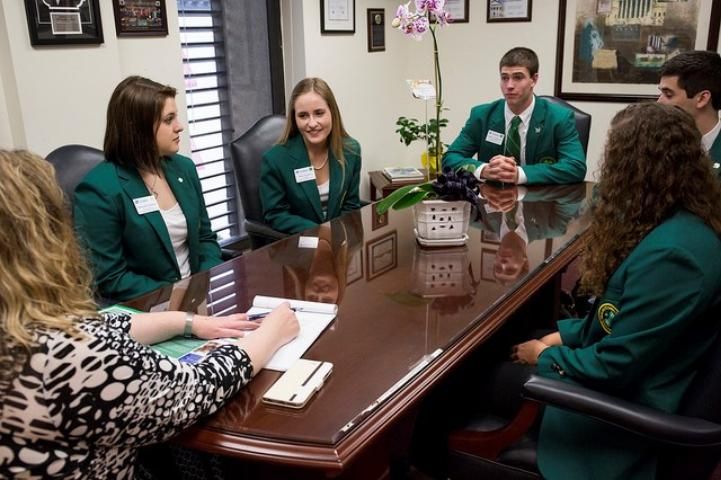
The Florida 4-H State Council is a group of 4-H members from across the state who represent their county in electing the youth leadership officers for the state. The Florida 4-H Council is composed of two voting delegates from each dues-paying county and the eight State Council Officers. The Annual Meeting of the 4-H Council is held at the Florida 4-H Congress, generally the only meeting during the 4-H year. At this time the business of the Council is conducted and new officers are elected. The State 4-H Council Officers then represent the voice of youth on various statewide advisory boards, committees and planning teams throughout the year.
State 4-H Council Constitution

One of the key outcomes of the 4-H youth development program is empowering youth to learn self-governance. This begins with youth engaged in forming local clubs, planning educational programs, contributing to their community through service and establishing their own rules and bylaws. Likewise, the Constitution of the Florida 4-H Council and Bylaws serve as the base for the organization and work of the State 4-H Council. It is established and reviewed annually by the youth membership. The State Council Constitution and Bylaws are included at the back of this document, and current copies can always be found at http://florida4h.org/youth/council.shtml.

County Dues and Membership

The State 4-H Council consists of two county youth representatives, commonly referred to as "voting delegates" from each county. Each county to "seat" two voting delegates within the annual business meeting of the Council must pay annual dues. If the county does not pay the dues, they give up the right to vote on elected officers and any changes to the State Council Bylaws and Constitution. Dues are used to help support the State Council programs, which includes the Executive Board. The Florida 4-H State Council Executive Board (EB) is a positive youth development opportunity for teen 4-H members to lead other 4-H youth members in their county, district, and state youth programs. The counties are invoiced for their annual dues in September at the beginning of each 4-H program year.

State 4-H Officers

State Council Officers consist of the President, Vice President, Secretary, Treasurer, Reporter, Parliamentarian, Sergeant-At-Arms, and Historian. The first five are elected by the State Council at its annual meeting during Florida 4-H Congress, and the last three are appointed by the five elected State Officers. All officers must meet certain criteria and submit applications to the State Council Advisor by a designated deadline each year. Criteria for running for a state office are at http://florida4h.org/youth/officer_app.shtml.

The appointed officer candidates' applications are reviewed and interviews are conducted for each of these offices immediately following the election of the five new officers. The five newly elected officers, with State Council Advisors, make the final selection of the remaining three appointed officers during Congress and the new slate of officers are presented to the youth delegation before the close of the event. The new officers assume their responsibilities at the end of the Florida 4-H Congress.

Executive Board

The Executive Board of the Florida 4-H Council is the working group of youth leaders representing the District Councils. The Executive Board is composed of Eight State Officers (five elected and three appointed) and the District Representatives, and others that may be appointed by the President. Additional representatives from each county/district may apply for a Presidential Appointee position to serve on the Executive Board. These applications are reviewed immediately after Florida 4-H Congress, and announcements are made as to those chosen to serve as Presidential Appointees on the Executive Board each year in time to register for the first Executive Board meeting. Executive Board applications for appointed members can be found at http://florida4h.org/youth/officer_app.shtml.

The Executive Board of the Florida 4-H Council has three functions:

  1. Representing 4-H with other agencies and organizations and at various 4-H events and activities

  2. Serving as a sounding board of 4-H membership

  3. Assisting with plans and implementation of 4-H Program events and activities including:

Florida 4-H Congress
Florida 4-H Legislature
L.A.W. – Leadership Adventure Weekend
Intermediate State
Florida 4-H Day at the Capitol

The Florida 4-H Council has standing committees that make recommendations for:

  • Constitutional and Resolutions

  • Ways & Means and State Fund-raising Projects

  • State Service Project

  • Communication and Council Support

The Executive Board meets three times a year. The first Executive Board meeting is held at Camp Cherry Lake and is usually the second weekend of September. The second Executive Board meeting is held at Camp Ocala and is usually the first weekend of December. The third board meeting is held at Camp Cherry Lake and is usually the third weekend of March. All three meetings are mandatory for its members.

Role of a District Representative to the State Council Executive Board

You have been elected to represent your 4-H District on the Florida 4-H Executive Board. This is a leadership position that carries certain responsibilities. Your duties as District Representative are the following:

  • Attending meetings of the Executive Board of the 4-H Council.

  • Communicating with the counties in your 4-H District regarding the activities and actions of the State 4-H Council Executive Board.

  • Soliciting the opinions of the 4-H'ers in the counties in your 4-H District.

  • Assuming responsibilities as delegated and agreed upon.

  • Working with your 4-H Agents and Council Advisors to keep them informed of your Executive Board involvement.

  • Clearing all appearances and travel as a representative of Florida 4-H through the State 4-H Office.

  • Representing the entire 4-H District, not just your county.

  • Visiting County Councils within your 4-H District.

  • Participating in District/State 4-H activities.

  • Compiling District/State Reports to submit as requested by the State President/Reporter.

  • Keeping a current list of District Council Delegates from your 4-H District.

Districts compete in Change Wars sponsored by the State Council Ways and Means committee to raise funds for Councils educational programs each year.

To learn more about this Council activity for your district, see the fact sheet at http://florida4h.org/youth/council.shtml.

The Spirit Stick Portfolio is a way for the district to report on what they have done for the 4-H Year. These portfolios are judged by the Florida 4-H State Officers at Florida 4-H Congress. Learn about what your District has done in the past to compete for this recognition during Congress.

Council Delegates and Council Success

The success of your 4-H Council depends largely on how well you fulfill your job as council delegate. Remember that it is an honor to be selected as a delegate; but like all honors, it carries certain responsibilities. Your fellow 4-H'ers expressed their faith and confidence in you when they elected you to be a council delegate. To carry out your responsibilities, you must know your duties well. It is also very important that you know the duties of the officers because you will work with them in conducting council business.

Will You Be a Good Council Delegate?

  • Good delegates are honest, sincere, friendly, and loyal. They give everyone a chance to help and let the members of the local clubs or other county 4-H groups help decide what the council will do.

  • Good delegates get things done right and on time. They are proud of their jobs and always try to do their best. They work with their 4-H Leaders to plan and carry out the council programs.

  • Delegates to the 4-H Council are representatives, not only of the local club, but also of the entire 4-H organization. Their skills and abilities, standards and ideals, grooming, speech, and even their smiles, represent the best in 4-H'ers and their club programs.

  • Council delegates represent 4-H to the people in the community, at school, and at public events like 4-H festivals, Talent Days, and fairs. This representation is one of your most important responsibilities because to other people you are a 4-H'er all of the time—not just while you are in a 4-H meeting.

  • Serving as a 4-H Council delegate gives you a real opportunity to develop leadership abilities that will be useful in any organization when you become an adult.

Responsibilities of Council Delegates

To be successful, 4-H Council delegates, committees, and members, working under the supervision of leaders, perform many duties. Some important duties are:

  • Secure new members and organize local councils.

  • Plan the program for the year.

  • Arrange for a meeting place and for the proper care of it.

  • Conduct and take part in the meetings.

  • Keep the council records and give them to the leaders as required.

  • Maintain a good spirit and interest in the council and a good relationship with all individuals and groups.

  • Help every 4-H'er find a place in the council and an opportunity to contribute.

  • Maintain contact with the county Extension Office.

  • Attend the 4-H Council training session when it is held in the county.

Qualities of Good Council Delegates:

4-H needs council delegates who will:

Serve the council best during the year and not ride on successes of the past.
Work with all 4-H'ers and give everyone an opportunity to participate.
Share leadership with many and thereby give others an opportunity to grow.
Represent the best interests of the council to others.
Be dependable.
Help plan a program that the membership can support wholeheartedly.
Work with the officers, executive committee members, and leaders.
Try their best to make the meetings worthwhile and interesting.

How do you measure by this yardstick? Ask yourself, "Do I have the following desirable qualities?"

_____ Do I know my duties and responsibilities?
_____ Am I willing to improve so I can be a better council delegate?
_____ Am I friendly to other 4-H'ers?
_____ Do I work well with them and they with me?
_____ Do I willingly accept responsibilities assigned to me?
_____ Do I do more than just what is required of me?
_____ Do I give credit to others for work they do?
_____ Am I prompt in arriving at meetings?
_____ Does my appearance inspire respect and confidence?
_____ Am I kind, tactful, and courteous?
_____ Do I say "please" and "thank you" when I should?
_____ Am I fair in my decisions?
_____ Do I ask for suggestions to improve the meeting?
_____ Do I appreciate my leaders and parents for their time, effort, and devotion to 4-H work?

Additional Resources to Support Organizing and Managing 4-H Councils

Unlock Your Leadership Potential, Cooperative Extension Services, University of Florida, Institute of Food and Agricultural Sciences

Unlock Your Leadership Potential is a 4-H Leadership Curriculum designed to help 12–18 year-old youth learn and practice leadership skills. The Florida 4-H Leadership curriculum has eight major foci: 1) What is Leadership?; 2) Understanding Self; 3) Communication; 4) Getting Along With Others; 5) Learning to Learn; 6) Making Decisions; 7) Managing; and 8) Working With Groups. This curriculum can be purchased at http://www.ifasbooks.ufl.edu.

Leadership Skills You Never Outgrow, Cooperative Extension Service, College of Agricultural, Consumer and Environmental Sciences, University of Illinois at Urbana-Champaign

This series of four project books is designed to help adolescents learn the basics of leadership. Starting with Individual Skills for Younger Members to Skills Leading Groups for older members, the books are filled with leader-led activities for a group setting. The curriculum focuses on seven main topics: 1) Understanding Self; 2) Communicating; 3) Getting Along with Others; 4) Learning to Learn; 5) Making Decisions; 6) Managing; and 7) Working With Groups. See http://www.eric.ed.gov/ERICWebPortal/detail?accno=ED355051 for more details.

Step Up to Leadership, National 4-H Cooperative Curriculum Systems, Inc.

Using this project series, you will share in the fun as you learn about the dynamic process of leadership! Mentor guides include background information, interactive activities, and real life experiences in relationship building, communication, group process, planning, and organizing. All activities offer a cross-cultural perspective. This curriculum can be purchased by following the links at the Florida 4-H Project website under leadership at http://new.4-hcurriculum.org/projects/leadership/ [May 11, 2012].

Youth-Adult Partnerships Training Manual, created in partnership by The Innovation Center for Community and Youth Development, National 4-H Council, National Network for Youth, and Youth Leadership Institute

This manual provides activities and resources that guide experienced trainers and practitioners of all ages through the process of engaging youth and adults equally to create community change.*

Creating Youth-Adult Partnerships, created in partnership by The Innovation Center for Community and Youth Development and National 4-H Council

This curriculum leads youth and adults new to group facilitation and youth-adult partnerships to build their capacity to work together in true collaboration. This step-by-step curriculum includes detailed scripts, activities, and evaluation material.*

*Both above materials can be printed from online files from the Innovation Center at http://www.theinnovationcenter.org/catalog/toolkits/resources.

The Constitution of the Florida 4-H Council

Preamble

We, the 4-H members of Florida, in order to provide additional opportunities for personal development, leadership, citizenship, and growth, and to function as a tool of the 4-H program, do hereby establish this Constitution for the 4-H Council.

ARTICLE I

Name, Scope, Emblem, and Colors

Section 1. Name and Scope

The name of this organization shall be the Florida 4-H Council, an assembly of elected and appointed representatives who meet, discuss, plan, and help expedite the 4-H Program in the interest of members.

Section 2. Emblem

The four-leaf clover with the letter "H" in each of the leaflets representing equal training of the Head, Heart, Hands, and Health and signifying Good Luck and Achievement shall be the official emblem of the Florida 4-H Council.

Section 3. Colors

The 4-H Colors are green and white. The green represents nature's most common color and is emblematic of youth, life, and growth. The white background symbolizes purity.

ARTICLE II

Objectives

To provide additional opportunities for personal development and to promote the 4-H Program throughout Florida, the objectives of this Council shall be to:

Section 1. Serve as a means of expression through responsible representation for Florida 4-H Members.
Section 2. Provide understanding and experience in applying the principles of representative government.
Section 3. Provide effective means of communication within all phases of the 4-H council program.
Section 4. Serve as a means for improving and projecting a positive image of 4-H.
Section 5. Encourage members to develop skills in communication and getting along with others.
Section 6. Serve as an example of member involvement in planning and carrying out programs.
Section 7. Provide visible leadership models for 4-H members.
Section 8. Fulfill an advisory role in planning District and State events and activities and to aid in the implementation of such programs, where applicable.

ARTICLE III

Membership

Section 1. Each County or area represented by an Extension Agent in Florida with a 4-H program shall select two voting delegates. Voting delegates shall be determined without regard to race, creed, color, religion, age, disability, sex, sexual orientation, marital status, national origin, political opinions, familial status, parental status, income, or affiliations in accordance with USDA and UF policies.

ARTICLE IV

Meetings, Quorum, and Suffrage

Section 1. There shall be at least one meeting each year of the Council which shall be held at a State 4-H event. The executive board may meet at any time with the approval of the State Advisor(s).

Section 2. Special meetings of the Council may be called by the President with the approval of the State Advisor(s).

Section 3. Two-thirds of the officially-seated delegates or alternates shall constitute a quorum for the transaction of business at any meeting of the Council provided that at least one-half of the counties with organized 4-H programs are represented.

Section 4. Each county shall be represented by two officially-seated voting delegates who may vote on each proceeding of the Council. In a voting delegate's absence, his/her county's alternate will assume the voting privileges.

Section 5. State council advisor(s) shall serve in an advisory capacity only at meetings of the State Council. State council advisor(s) shall not have voting privileges at any assemblies of the State Council and/or its officers.

ARTICLE V

Officers: Procedure of Selections

Section 1. Officer Positions

a. The elected officers of the Council shall be: a President, Vice-President, Secretary, Treasurer, and Reporter.
b. The appointed officers of the Council shall be: a Sergeant-at-Arms, Historian, and Parliamentarian.

Section 2. Elected Officers

a. The election of officers shall be by secret ballot vote of each delegate in the Council assembled.
b. To be elected to an office, a candidate must receive a majority of the votes cast.
c. The elected officers shall continue to fulfill those duties, statewide in nature, as directed in this Constitution, for one year or until such time as their successors are designated.
d. If the office of the President is permanently vacated, the Vice-President shall become the President.
e. If any elected office other than the Presidency is vacated, a committee composed of the remaining elected officers and the state council advisor(s), with the President serving as Chairperson, shall be given the option to appoint a State Executive Board Member to fill the vacated position.
f. Candidates may run for only one elected office.

Section 3. Appointed Officers

a. The appointment of officers shall be by a committee composed of the elected officers and the state council advisor(s), with the President serving as Chairperson.
b. The Appointed Officers shall continue to fulfill those duties, statewide in nature, as directed under this Constitution, for one year or until such time as their successors are designated by the President.
c. There shall be no unreasonable delay in the naming of Appointed Officers.
d. If any appointed office is vacated, a committee composed of the remaining officers with the President serving as Chairperson shall have the option to appoint a State Executive Board Member to fill that vacated position.

Section 4. Executive Officers

The executive officers shall be the elected and the appointed officers of the Council.

ARTICLE VI

Judicial Procedures

Section 1. Disciplinary actions shall be taken against any individual not adhering to the established regulations, or exhibiting inappropriate behavior while functioning as a representative of the Florida 4-H Council.

Section 2. Should a State 4-H Council member or Executive Board member exhibit inappropriate behavior while attending a state 4-H event, he/she may be referred to a disciplinary committee.

Section 3. Any decision made by this committee may be appealed to the Dean of 4-H within thirty days of notification of the committee's decision.

Section 4. Any State 4-H Council Executive Officer whose behavior while functioning as a State Council Representative causes him or her to be brought before the Disciplinary Committee, may be removed from office. This decision is left to the president and state council advisor.

ARTICLE VII

District Council and Officers

Section 1. A Council, with representatives from each county having an organized 4-H program, shall be formed in each of the 4-H Districts in Florida to assist the County 4-H Programs through their County Councils, provide organization and leadership for District activities and events, and to facilitate the distribution of material and information from the Florida 4-H Council.

Section 2. Each District shall elect or appoint four members to the State Executive Board before Congress of the preceding 4-H program year. They must serve for the following respective 4-H program year on the State Executive Board.

Section 3. Each District Council may choose an alternate to serve in the absence of any District Representatives.

Section 4. District Officers, the four representatives, shall assume office and all powers and responsibilities thereunto appertaining immediately upon the election of the State 4-H Council Officers, at which time those District Officers elected for service the previous year shall terminate their tenure of office. District Officers shall serve for one year or until their successors are designated.

Section 5. Those elected as State 4-H Executive Officers shall not be considered as representatives to the State Executive Board.

Section 6. Each District Council may require its officers to perform such duties as are found necessary and appropriate, provided that such duties do not conflict with those required by this Constitution.

ARTICLE VIII

Amendments

Section 1. A proposed amendment becomes Constitutional upon vote of two-thirds majority of the votes cast by the officially seated voting delegates.

Section 2. Before action can be taken on a proposed amendment to the Constitution, the proposed amendment must have been read at the previous Council meeting and/or distributed in writing to council delegates at least two weeks prior to the next council meeting and will have been presented to the Chairperson of the Constitution and Resolutions Committee before the proposed amendment's first reading and/or distribution.

Section 3. A proposed amendment to the Bylaws of the Constitution becomes a bylaw upon a majority of the votes cast by the officially seated voting delegates.

Section 4. Before action can be taken on a proposed amendment to the Bylaws of the Constitution, the proposed amendment must have been read at the previous Council meeting and/or distributed in writing to council delegates at least two weeks prior to the next Council meeting and will have been presented to the Chairperson of the Constitution and Resolutions Committee before the proposed amendment's first reading and/or distribution.

Revised by 2008–2009 State Constitution and Resolutions Committee

Bylaws of the Constitution of the Florida 4-H Council

ARTICLE I

Membership, Credentials, and Dues

Section 1. Membership

a. Each county delegate (2) shall be at least fourteen years of age by September 1 of the current year.
b. Each county shall elect a first and second alternate who will attend the meetings of the Council, but who may vote and participate only in the absence of their delegates.

Section 2. Dues

a. Each county or area represented by an Extension Agent in Florida with a 4-H Program shall submit to the Florida 4-H Council annual dues. Dues should be in the amount of thirty dollars to be deposited in the account, Florida 4-H Council, General of the Florida 4-H Club Foundation, Inc.
b. Dues are to be paid in the form of check or money order, made payable to the Florida 4-H Foundation, Inc., and submitted to the State 4-H office.
c. Those counties not submitting dues by January 1 will be charged a $10 late fee and dues must be paid by the Monday before Congress or they will be denied voting privileges in the Annual Meeting at Congress.

ARTICLE II

Officers: Nominee Requirements and Duties

Section 1. Nominees to fill the State Council offices shall be required to meet the following minimum requirements:

a) Shall have been an active 4-H member for at least three years, including the current 4-H year.
b) Shall be an officially seated voting delegate to the Council.
c) Shall have approval from parent or legal guardian.
d) Shall have attended at least two State Executive Board Weekends.
e) A maximum of two persons per county shall be eligible to run for a state council office.

Section 2. Duties of Officers

a. The President shall preside over all meetings of the Council; appoint all standing, advisory, and special committee chairpersons and members; make special appointments as provided in the Constitution and Bylaws, serve as an ex-officio member of all committees; and perform other duties as provided by this Constitution. The President or someone he or she appoints shall be an ex-officio member of the Florida 4-H Foundation. The President shall be responsible for the writing and presenting of the Council's annual report to the Council's advisor.
b. The Vice-President shall serve in the absence of the President, and shall perform other duties as provided by this Constitution and as required by the work of the Council.
c. The Secretary shall keep the minutes of the meetings and compile them at the end of his or her term as well as preserve the minutes of the previous year, call the roll, record all activities of the Council, attend to the correspondence of the Council, and perform other duties as provided by this Constitution and as required by the work of the Council.
d. The Treasurer shall care for the monetary matters of the council. Also, he/she will prepare and submit semi-annually, an itemized statement of disbursements and receipts from the account of Florida 4-H Council General to the state council president and state council advisor. He or she shall also perform other duties as provided by this Constitution and as required by the work of the Council.
e. The Reporter shall be responsible for the publication and distribution of the Council Newsletter at least quarterly on all Council Meetings and activities as shall be established, sending a copy to each County Reporter through appropriate means. He or she shall also perform other duties as provided by this Constitution and as by the work of the Council.
f. The Sergeant-at-Arms shall be responsible for the opening exercises at all meetings and shall also care for the 4-H effects of the Council and shall properly arrange for their display. He or she shall perform other duties as provided by this Constitution and the work of the Council.
g. The Historian shall keep a scrapbook record of all State 4-H events and of all Council meetings and activities, shall be responsible for submission of the year's scrapbook to the State Office by the first day of Congress at the end of the officer's term. He or she shall perform other duties as provided by this Constitution and the work of the Council.
h. The Parliamentarian shall advise the President on Parliamentary Procedure and shall perform other duties as provided by this Constitution and the work of the Council.

ARTICLE III

Committees

Section 1. Executive Officers, District representatives, and presidential appointees, as provided by this Constitution, shall constitute the Executive Board, which shall meet as necessary between annual meetings of the Council to plan and supervise matters of general concern.

Section 2. Each State Executive Officer (except the president) may be appointed chairperson of one Standing, Advisory, or Special Committee by the president. The vice-chairperson of Standing, Special, and Advisory Committees shall be appointed by their committee's respective chairperson.

Section 3. The president, with recommendation from the other executive officers, shall appoint up to twenty non-elected Executive Board members. These Executive Board members shall be known as presidential appointees.

Section 4. The Standing Committees of the Council shall be:

a) Constitution and Resolutions Committee
b) State Project Committee
c) Ways and Means Committee
d) Communication and Council Support
a. The Constitution and Resolutions Committee shall provide a continuing review of the Constitution and Bylaws while recommending necessary and appropriate revisions. It may also provide a means of expressing the Council's appreciation of services rendered and may also make recommendations to the Council and to other groups and individuals in general concern to the 4-H members in Florida. The Chairperson shall produce an amended copy of the Constitution to the State 4-H Office before the first Executive Board retreat of the next year. This committee will also be responsible for educating members of Florida 4-H about parliamentary procedure and constitutional structure.
b. The State Project Committee of the Florida 4-H Council is responsible for the decision and application of a state project. The project can be a contest, recognition program, or other topic which the Florida 4-H Council promotes and the counties and districts implement.
c. The Ways and Means Committee is a strategic planning committee for resource development. It shall organize short and/or long term fundraisers to benefit the Florida 4-H Council as well as assist or facilitate the Florida 4-H Council as requested.

Section 5. The Advisory Committees of the Executive Board shall be:

(1) Leadership Adventure Weekend (LAW)/Intermediate State
(2) Florida 4-H Congress
(3) Florida 4-H Legislature
(4) 4-H Day at the Capitol

Each Advisory Committee shall plan at least one leadership event every year, which corresponds to its committee name.

Section 6. The President may appoint special committees as necessary and appropriate.

Section 7. The President is ex-officio member of all committees.

Section 8. The State Council Advisor is ex officio advisor of all committees.

ARTICLE IV

Judicial Procedures

Section 1: The Review Board shall consist of:

(1) The State Staff Advisor to the Council
(2) Two present adult leaders
(3) Two Executive Board Members

Section 2: The Disciplinary Committee shall be appointed by the President and State Council Advisor.

Florida 4-H Constitution, September 2010

Annual 4-H Council Calendar

The following calendar of council activities will assist Extension 4-H Faculty in planning and integrating these roles and responsibilities into their county 4-H calendars.

August:

  • New State Officers' Orientation, Training, and Planning Meeting

September:

  • 1st Meeting of Executive Board of the Florida 4-H Council

  • Annual Dues Invoice Sent to Counties (due by December 1)

December:

  • 2nd Meeting of Executive Board of the Florida 4-H Council

March/April (or prior to District Events):

  • 3rd Meeting of Executive Board of the Florida 4-H Council

  • Election of County Delegates to 4-H District Council

April/May (usually coincides with District Events Day):

  • Election of District Representatives to State 4-H Council Executive Board

  • Report two State Council Voting Delegates to State Office

June:

  • State Council Officer Applications Due June 1

  • District Spirit Stick Portfolio Due June 1

  • Report District Executive Board Delegates to State 4-H Office

July:

  • Annual Meeting of Florida 4-H Council at State 4-H Congress

  • Election of State 4-H Council Officers

  • Presidential Appointee Applications for Executive deadline

Advisors and Supervision

The State 4-H Council is responsible to the designated State 4-H Council Advisor. The State Advisor is a state staff member, designated by the Associate Dean of 4-H. Also, two county faculty/volunteers, one male and one female, serve as co-advisors and are appointed for four years, with CED and DED approval. These advisors work in partnership with the State 4-H Council and Executive Board members to foster youth engagement and representative youth-adult partnerships throughout the Florida 4-H Youth Development Program.

The 4-H Pledge

The HEAD represents:

  1. Thinking, planning and reasoning.

  2. Gaining new and valuable knowledge.

  3. Understanding the whys.

The HEART represents:

  1. Being concerned about the welfare of others.

  2. Accepting the responsibilities of citizenship.

  3. Determining the values and attitudes by which to live.

  4. Learning how to live and work with others.

  5. Developing positive attitudes.

The HANDS represent:

  1. Learning new skills.

  2. Improving skills already known.

  3. Being useful, helpful, and skillful.

  4. Developing respect for work and pride in accomplishment.

The HEALTH represents:

  1. Practicing healthful living.

  2. Enjoying life.

  3. Using leisure time wisely.

  4. Protecting the well-being of self and others.

Footnotes

1.

This document is 4H GCM 12, one of a series of the 4-H Youth Development Department, Florida Cooperative Extension Service, Institute of Food and Agricultural Sciences, University of Florida. Original publication date August 1996. Revised January 2011. Visit the EDIS website at http://edis.ifas.ufl.edu/.

2.

J.A. Rutledge and Joy C. Jordan, Department of Family, Youth and Community Sciences; Wendi Armstrong, State Council Advisor; and, Tracy Tesdall, South RSA, State 4-H Youth Development Program; Institute of Food and Agriculture Sciences; University of Florida; Gainesville 32611.


The Institute of Food and Agricultural Sciences (IFAS) is an Equal Opportunity Institution authorized to provide research, educational information and other services only to individuals and institutions that function with non-discrimination with respect to race, creed, color, religion, age, disability, sex, sexual orientation, marital status, national origin, political opinions or affiliations. For more information on obtaining other extension publications, contact your county Cooperative Extension service.

U.S. Department of Agriculture, Cooperative Extension Service, University of Florida, IFAS, Florida A. & M. University Cooperative Extension Program, and Boards of County Commissioners Cooperating. Nick T. Place, Dean.