
Introduction
The 972 Clean Water Act, section 303(d) established federal rules for identifying waters that are polluted and not compliant with their designated uses, usually denominated as impaired water bodies. These rules, passed down to the states by the US Environmental Protection Agency (EPA), required to establish a prioritized list of impaired water bodies and to develop estimated loads that the water bodies could receive of each pollutant while meeting water quality standards.
TMDLs are defined as the maximum amount of a pollutant that a water body can receive and still meet the water quality standards. Section 303(d) requires states to submit lists of those impaired waters along with their TMDLs on a prioritized schedule.
In response to state TMDL requirements, the Florida Watershed Restoration Act (FWRA) (s. 403.067 F.S.) was passed in 1999. This act identified the methods that the Florida Department of Environmental Protection (FDEP) would use to develop and implement TMDLs. Specifically, the FWRA requires that TMDLs be established for all pollutant sources (agriculture and urband).
In addition, FWRA:
- directs the Florida Department of Agriculture and Consumer Services (FDACS) to develop Interim Measures and Best Management Practices (BMPs) to address agricultural nonpoint pollution sources,
- provides growers implementing BMPs that are adopted by rule (by FDACS) and verified by FDEP as effective with a "Presumption of Compliance" with applicable state water quality standards,
- directs FDEP to allocate pollutant loads between point, nonpoint, and background sources, and
- allows cost-share of BMPs, with funds to support the program for agriculture originating from the Florida Forever Act Amendments.
The legislature, through the Florida Right to Farm Act (s. 823.14 F.S.), provides that a local government may not adopt any ordinance, regulation, rule, or policy to prohibit, restrict, regulate, or otherwise limit an activity of a bona fide farm operation where growers are utilizing best-management practices or interim measures developed by FDACS.
Florida TMDL Development
Evaluation and development of TMDLs for Florida is a daunting task, with 52,000 miles of rivers and streams, 800 lakes, 700 springs, and 4500 square miles of estuaries. FDEP has developed a five-year rotating plan to assess each water body within the state. The water basins in each of FDEP's six districts have been divided into five groups (Table 1), and the timeline for assessments within each district will be based on the group number (FDEP, 2019).
FDEP has identified these basic steps for the TMDL program.
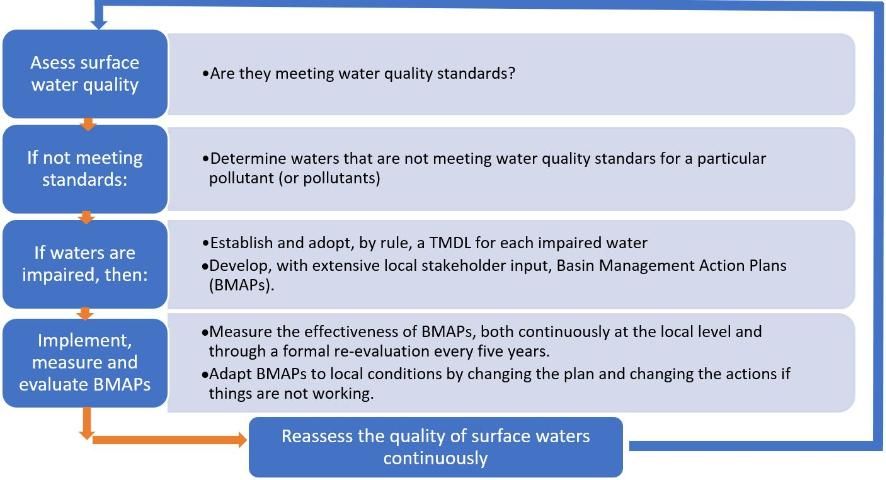
BMAPs, which are a comprehensive set of practices and strategies to manage a basin in order to reduce pollutant loads, have been developed and implemented for most of Florida basins. An interactive online map of BMAPs adopted and in progress is available electronically by FDEP (https://floridadep.gov/dear/water-quality-restoration/content/impaired-waters-tmdls-and-basin-management-action-plans).
While FDEP is responsible for Florida TMDLs, the agricultural nonpoint source pollution portion of the TMDL process is being guided by the Florida Department of Agriculture and Consumer Services (FDACS).
TMDLs and Agricultural Best Management Practices
When a water body is identified as impaired and a TMDL is established, pollutant loads are distributed among the different stakeholders (e.g., agriculture, urban, industry). Normally, each stakeholder would implement a set of management practices expected to reduce its contribution to meet its designated load. These practices are commonly referred to as Best Management Practices (BMPs) and can be defined as a practice or combination of practices determined by the coordinating agencies, based on research, field-testing, and expert review, to be the most effective and practicable on-location means, including economic and technological considerations, for improving water quality in agricultural and urban discharges.
Agricultural BMP manuals are written by FDACS with the cooperation of UF/IFAS and FDEP and adopted by rule. Selection of BMPs for agriculture is no easy task because of Florida's agriculture diversity and geographical differences. Hence, BMP manuals are commodity and region specific. Some of the areas where BMPs have been developed are: cow/calf operations, citrus, vegetable and agronomic crops, nurseries, equine operations, specialty fruit and nut crops, sod operations, agriculture wildlife, and dairy operations. Although some water bodies do not have designated TMDLs as of yet and therefore do not legally require BMPs, many agricultural producers have adopted and implemented the BMPs.
For a more complete list and additional information on specific BMP manuals, visit the FDACS Office of Agricultural Water Policy website: https://www.fdacs.gov/Divisions-Offices/Agricultural-Water-Policy.
UF/IFAS is actively involved in the BMP process, including BMP research, development, and education. Extension agents and UF/IFAS state specialists play a critical role in the adoption of BMPs by educating agricultural producers in the need to implement BMPs as well as in their proper use once implemented. For more information on the involvement of UF/IFAS in BMPs and our role in Florida's BMP program, see the UF/IFAS Best Management Practices website (http://bmp.ifas.ufl.edu/).
The primary benefit for growers implementing agricultural BMPs (even without a designated TMDL) is that if a BMP program is in place, an agricultural producer is considered to be operating under a Presumption of Compliance with water quality standards. Preventative actions have a double purpose for growers, reduction of environmental impact and increase of crop management efficiency.
BMP implementation is different if a TMDL has already been established for a particular basin. Pursuant to Section 403.067(7)(b)2(g) of Florida law, a nonpoint source discharger included in a basin management action plan shall demonstrate compliance with the pollutant reductions established pursuant to subsection (6) by either implementing the appropriate best management practices established pursuant to paragraph (c) or conducting water quality monitoring prescribed by the department or a water management district. This means that if a TMDL has been established for a basin, agricultural producers are required to either implement a BMP plan or they must conduct water quality monitoring to prove discharges meet state water quality standards.
Adopting a BMP Program
Agricultural producers interested in formally adopting a BMP program should follow several important steps. If you have questions about this process, contact your local UF/IFAS Extension office or FDACS OAWP.
- Identify the BMP manual applicable to the commodity in question. BMP manuals are available on the FDACS OAWP website https://www.fdacs.gov/Divisions-Offices/Agricultural-Water-Policy
- Contact the FDACS OAWP staff member for your county to coordinate a free assessment of the property to determine which BMPs are applicable. Contact information for the person assigned to each county is available on the FDACS OAWP website.
- Complete the BMP checklist and sign the Notice of Intent (NOI) to implement BMPs.
- Keep a copy of the checklist and signed NOI in your records.
- Implement and maintain the applicable BMPs and keep adequate records to maintain a presumption of compliance with state water quality standards.
References
DeBusk, W. F. 2001. Overview of the Total Maximum Daily Load (TMDL) Program. SL188. Gainesville: University of Florida Institute of Food and Agricultural Sciences.
FDEP (Florida Department of Environmental Protection). 2019. Total Maximum Daily Loads (TMDL) Program. Accessed at https://floridadep.gov/dear/water-quality-evaluation-tmdl/content/total-maximum-daily-loads-tmdl-program.