
Introduction
Plants provide us with food and fiber, decorate our yards and gardens, and provide habitats for wildlife. But when plants grow where they are not wanted, we call them weeds. To homeowners, weeds may be unwanted plants in lawns and gardens. To farmers, weeds are plants that interfere with raising crops or livestock. To biologists who manage natural areas, weeds are plants that interfere with the functions of natural plant communities.
Natural area weeds are often introduced plant species (a species brought to a new geographic area intentionally or unintentionally by humans) that have become established (a self-sustaining and reproducing population in a specified geographic area without the need for human intervention). When these species cause harm to humans or the environment, they are referred to as invasive species. Invasive plants are weeds that alter the functions and value of natural areas by outcompeting native species and disrupting ecosystem services. Carrotwood (Cupaniopsis anacardioides) is a good example of this.
Carrotwood has been listed by the Florida Invasive Species Council as one of Florida's most invasive plant species since 1995. It was also added to the Florida Noxious Weed List (5b-57.007 FAC) by the Florida Department of Agriculture and Consumer Services in 1999. Plants on the Florida Noxious Weed List may not be introduced, possessed, moved, or released without a permit.
Impacts
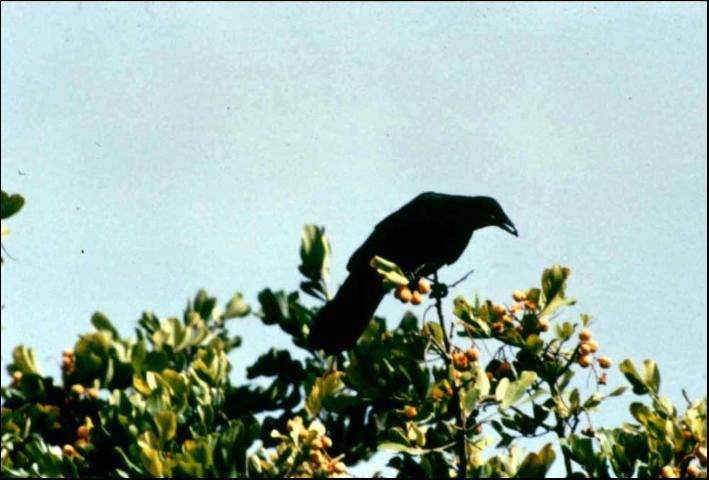
Carrotwood freely seeds from plantings (Menninger 1964). Seeds are eaten by birds and dispersed away from parent plants (Lockhart et al. 1999; Coile 1997). Habitats that have been invaded by carrotwood include spoil islands, beach dunes, marshes, tropical hammocks, pinelands, mangrove and cypress swamps, scrub habitats, and coastal strands (Lockhart et al. 1999). Consumption by fish crows (Figure 1) is particularly important because seeds are carried from inland feeding sites to coastal islands where they are deposited and germinate (Lockhart et al. 1999). Carrotwood is somewhat salt tolerant but not to the extent of mangrove species. Regardless, the threat of carrotwood to coastal plant communities is a concern. Coastal habitats are extremely important to Florida and are already heavily impacted by development and many invasive plants. Natural areas of most coastal counties in central and south Florida have been impacted by carrotwood (Langeland et al. 2008).
Credit: UF/IFAS
Distribution
Carrotwood is native to Australia, where it occurs on the north and east coasts on rocky beaches, sand dunes, hilly scrub, and riverine and monsoon forests (Reynolds 1985). The earliest record of carrotwood in Florida is 1955 from a cultivated plant in St. Lucie County, but it was not introduced commercially until 1968 (Coile 1997). By 1990, seedlings were found established in various habitats, disturbed and undisturbed, on both Florida coasts (Oliver 1990). It is found in private and commercial landscapes and naturalized in coastal counties from Brevard and Hillsborough south to Miami-Dade and Collier (Langeland and Burks 1998).
How to Recognize Carrotwood
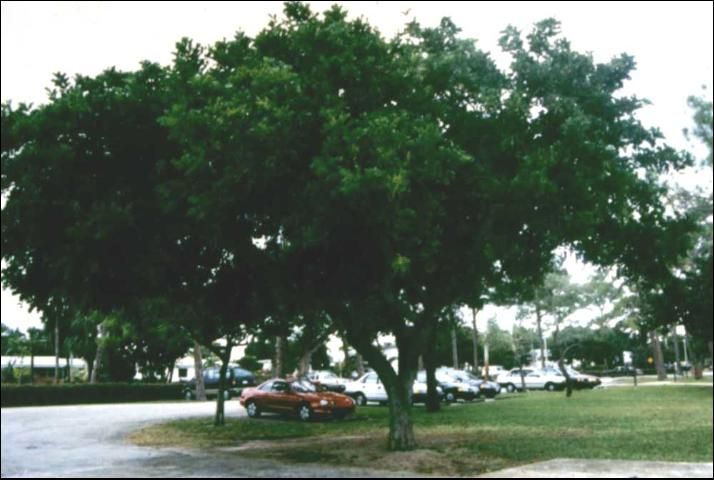
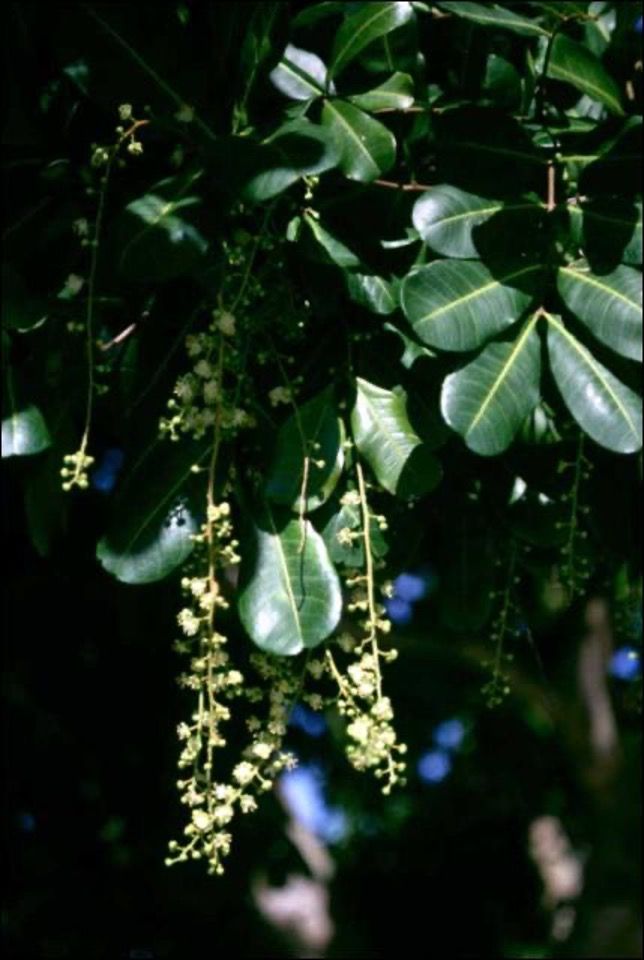
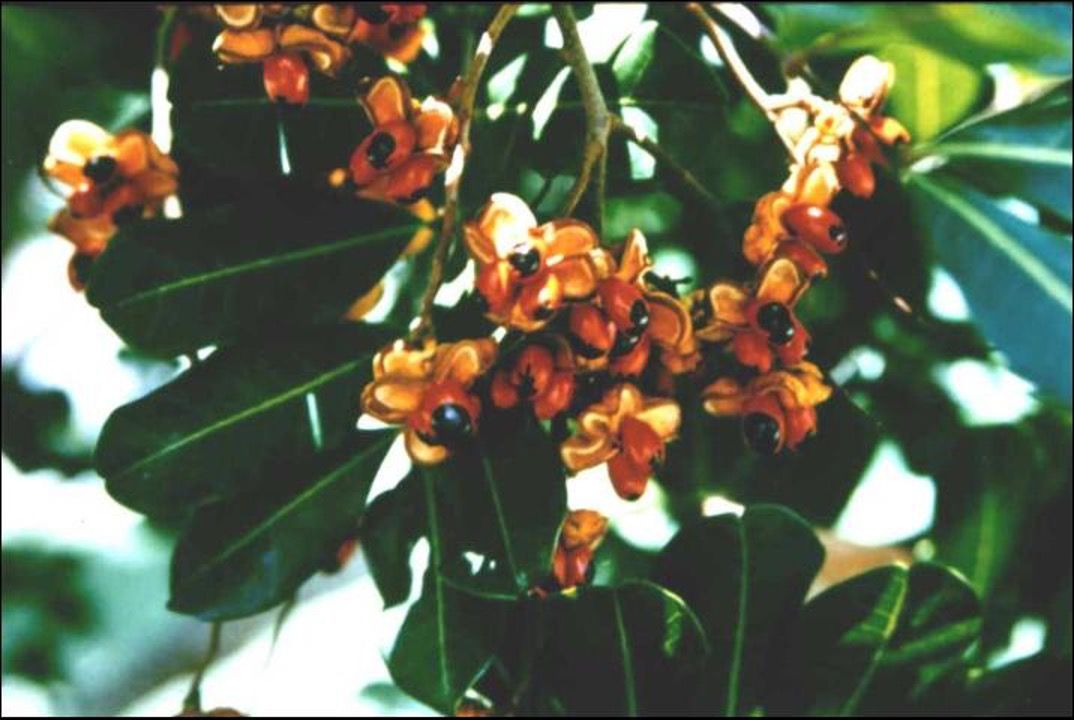
Carrotwood is an evergreen tree (Figure 2) that is usually single-trunked and grows to 35 feet tall. The outer bark is dark grey. The tree is called carrotwood because it often has an orange colored inner bark. Carrotwood leaves are compound, alternate, and usually even-pinnate (a compound leaf whose terminal leaflets are a pair) (Figure 3). Petioles (leaf stalks) are swollen at the base. Leaflets are 4–12, stalked, oblong, leathery, shiny yellowish-green, to 8 inches long and 3 inches wide, with untoothed margins, and tips rounded or slightly indented. Numerous white to greenish yellow flowers (Figure 3) occur in branched clusters up to 14 inches long in January and February. Fruits are the most striking identifying characteristic; a short-stalked woody capsule to 1 inch across with 3 distinctly ridged segments. Fruits are yellow-orange when ripe (April/May) and dry to brown before splitting open to expose three shiny oval black seeds covered by a yellow-red crust (Figure 4).
Credit: Chris Lockhart
Credit: Chris Lockhart
Credit: Chris Lockhart
Remove Carrotwood from Your Property to Protect Florida's Natural Areas
Homeowners can help mitigate the problem of carrotwood trees in Florida's natural areas by removing them from their property. Mature trees should be felled with a chain saw by the property owner or a professional tree service. The final cut should be made as close to the ground as possible and as level as possible to facilitate application of an appropriate herbicide to prevent sprouting. Stumps that are not treated with an herbicide will sprout to form multiple-trunked trees. If it is not objectionable for dead trees to be left standing, certain herbicides can be applied directly to the bark at the base of the tree (basal bark application) or as a frill or girdle application. A complete description of these techniques can be found in the publication Integrated Management of Nonnative Plants in Natural Areas of Florida (2022, https://edis.ifas.ufl.edu/wg209).
Herbicides that contain the active ingredient triclopyr amine (e.g., Brush-B-Gon, Garlon 3A Ultra) or glyphosate (many trade names) can be applied to cut stumps to prevent resprouting. The herbicide should be applied as soon as possible after felling the tree and concentrated on the thin layer of living tissue (cambium) that is just inside the bark. Herbicides with the active ingredient triclopyr ester can be used for basal bark applications. Concentrated products (e.g., Garlon 4) must be diluted according to instructions on the herbicide label with a penetrating oil manufactured for this purpose. Herbicide products are available for basal bark application that are pre-diluted with penetrating oil (e.g., Pathfinder II). It is illegal to use an herbicide in a manner inconsistent with the label's instructions; therefore, read the label carefully and follow the instructions.
If trees are cut at a time when seeds are attached, make sure that the material is disposed of in such a way the seeds will not be dispersed to new areas where they can germinate and produce new trees. Seedlings should be continually pulled by hand before they reach seed-bearing maturity. The local UF/IFAS Extension office in your county can provide information on herbicide availability and application training.
Replace with Non-invasive Species
Carrotwood trees can be replaced with non-invasive species that will provide the same functions, such as shade and wildlife attraction. Table 1 lists some landscape plants that are appropriate for replacing carrotwood trees. Fact sheets that provide additional information on landscape plants can be viewed at http://hort.ifas.ufl.edu/database/trees/trees_scientific.shtml. For information on the availability of native landscape plant species, contact the Association of Florida Native Nurseries (http://www.floridanativenurseries.org/). Your local UF/IFAS Extension office can help you identify plants appropriate to your property conditions, the ecosystems on and near your site, and your aesthetic desires.
Additional Information about Invasive Plant Species
Center for Aquatic and Invasive Plants website: http://plants.ifas.ufl.edu
Florida Invasive Plant Council website: https://floridainvasivespecies.org
Help Protect Floridas Natural Areas from Non-native Invasive Plants. K. A. Langeland. 2015. UF/IFAS Circular 1204. Gainesville: University of Florida Institute of Agricultural Sciences. https://edis.ifas.ufl.edu/ag108
Integrated Management of Nonnative Plants in Natural Areas of Florida. K. A. Langeland, J. A. Ferrell, B. Sellers, G. E. MacDonald, and R. K. Stocker. 2022. SP 242. Gainesville: University of Florida Institute of Agricultural Sciences. https://edis.ifas.ufl.edu/wg209
Literature Cited
Coile, N. C. 1997. "Risk Assessment for Carrotwood." Memorandum to Connie Riherd, Assistant Director, Division of Plant Industry.
Langeland, K. A. and K. Craddock Burks. 1998. Identification and Biology of Nonnative Plants in Florida's Natural Areas. SP 257. Gainesville: University of Florida. 193 pp.
Lockhart, C. S., D. F. Austin, W. E. Jones, and L. A. Downey. 1999. "Invasion of Carrotwood (Cupaniopsis anacardioides) in Florida Natural Areas (USA)." Natural Areas Journal 19:254–262.
Menninger, E. A. 1964. Seaside Plants of the World. New York: Hearthside Press Inc. 303 pp.
Oliver, J. D. 1992. "Carrotwood: a review of the literature." Tech. Report. Tallahassee: Florida Department of Environmental Protection, Bureau of Aquatic Plant Management. 10 pp.
Reynolds, S. T. 1985. "Sapindaceae." In: George, A. S., ed. Flora of Australia, Volume 25, Melianthaceae to Simaroubaceae. Australian Government Publishing Service, Canberra. pp. 4–163.
Table 1. Some landscape plants for replacing carrotwood trees after removal. Information is available for many of these species at http://hort.ifas.ufl.edu/database/trees/trees_scientific.shtml.