
Introduction
Florida's natural areas—a great source of pride and enjoyment to its citizens—provide recreation, protect biodiversity and fresh water supplies, buffer the harmful effects of storms, and significantly contribute to the economic well-being of the state (Jue et al. 2001). Natural areas are protected in over ten million acres (nonsubmerged) of state, federal, local and private managed conservation lands in Florida (http://fnai.org). Unfortunately, many of these natural areas can be adversely affected by invasive plant species. An estimated 25,000 plant species have been brought into Florida for use as agricultural crops or landscape plants. While only a small number of these have become invasive, those that do can adversely affect native plant communities by competing for space and resources, disrupting hydrologic and fire regimes, or hybridizing with native species. They must be managed for the protection of native communities in natural areas. Chinese tallow (Triadica sebifera (L.) Small is one of these invasive plant species.
How to Recognize Chinese Tallow
Chinese tallow is a deciduous tree with a milky sap that commonly grows to 30 ft tall. Leaves are simple, alternate, 1–2.5 inches wide, with broadly rounded bases and tapering to a slender point (Figure 1). Leaf stalks are 1–2 inches long. Small yellow flowers that are borne on spikes to 8 inches long occur in spring (Figure 2). The fruit is a 0.5 inch wide, 3-lobed capsule that turns brown at maturity to reveal 3 dull white seeds (Figure 1). The seeds, which often remain attached to the tree through the winter, resemble popcorn, suggesting the other common name of popcorn tree.
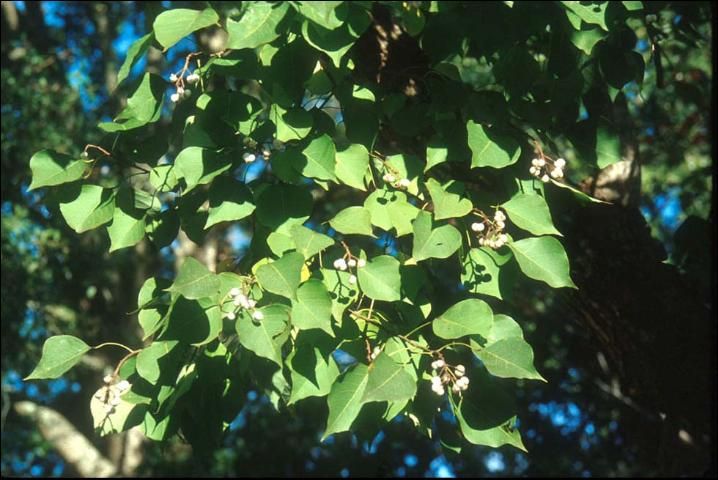
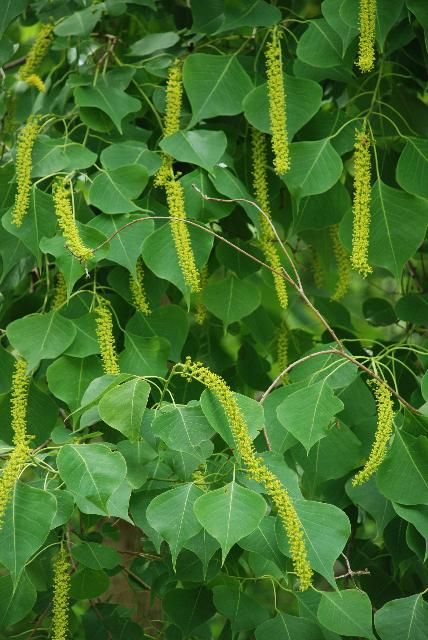
Credit: Nancy J. Loewenstein, Auburn University
Distribution
Chinese tallow was introduced to the US before 1800. In a letter from Benjamin Franklin written in 1772 to Dr. Noble Wimberly Jones of the Georgia colony, Franklin wrote: "I send also a few seeds of the Chinese Tallow Tree, which will I believe grow & thrive with you. 'Tis a most useful plant" (Bell 1966). As early as 1803, Chinese tallow was spreading into coastal forests according to the noted French botanist Andre Michaux. Since Franklin's time, Chinese tallow has been introduced repeatedly to the United States as an ornamental and potential oil crop species. It is now naturalized from North Carolina, south through Central Florida, extending west into Texas and northwest Arkansas (McCormick 2005). Within Florida, Chinese tallow has increased greatly over the last twenty years. In 1993, it was naturalized in 57% of the counties (Jubinsky and Anderson 1996) and found as far south as Dade County (Wunderlin et al. 2003). Today, it is found in almost every county in the state.
Invasiveness
Chinese tallow has been recognized as a pest plant in the Carolinas since the 1970s (Langeland and Burks 1998). It is found throughout Florida where it invades mesic flatwoods, scrubby flatwoods, alluvial floodplain forest, strand swamp, and ruderal communities. Chinese tallow has been extensively used for ornamental planting and is a common plant on landscaped property. These trees present a constant source of seed for infestation of natural areas because the seeds are transported by birds such as pileated woodpeckers, cardinals, yellow-rumped warblers, American robins, and grackles, as well as by water (Jubinsky and Anderson 1996). While the length of time needed to deplete the seedbank is unknown, indications are that seeds remain viable for many years (Jubinsky and Anderson 1996). The Florida Exotic Pest Plant Council (Now named the Florida Invasive Species Council, or FISC) included Chinese tallow on its 1993 List of Florida's Most Invasive Species and it is currently a FISC Category 1 species. Chinese tallow was added to the Florida Department of Agriculture and Consumer Services Noxious Weed List (5b-57.007 FAC) in 1998. Plants on the Florida Noxious Weed List may not be introduced, possessed, moved, or released without a permit.
Remove and Replace
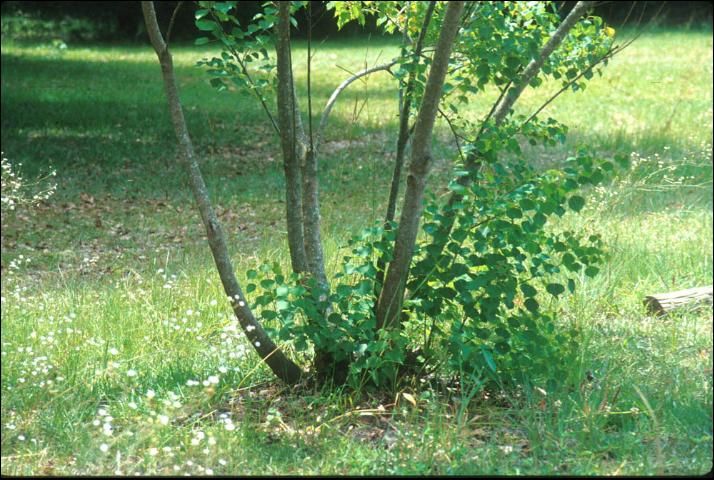
Homeowners can help mitigate the problem of Chinese tallow trees in Florida's natural areas by removing them from their property. Mature trees should be felled with a chain saw by the property owner or a professional tree service. The final cut should be made as close to the ground as possible and as level as possible to facilitate application of an herbicide to prevent sprouting. Stumps that are not treated with an herbicide will sprout to form multiple-trunked trees (Figure 3). If it is not objectionable for dead trees to be left standing, certain herbicides can be applied directly to the bark at the base of the tree (basal bark application).
Herbicides that contain the active ingredient triclopyr amine (e.g., Brush-B-Gon, Garlon 3A) can be applied to cut stumps to prevent resprouting. The herbicide should be applied as soon as possible after felling the tree and concentrated on the thin layer of living tissue (cambium) that is just inside the bark. Herbicides with the active ingredient triclopyr ester can be used for basal bark applications. Concentrated products (e.g., Garlon 4 Ultra) must be diluted, according to instructions on the herbicide label, with a penetrating oil, manufactured for this purpose. Herbicides with the active ingredients triclopyr ester can be used for basal bark applications. Herbicide products are available for basal bark application that are pre-diluted with penetrating oil (e.g., Pathfinder II). Only certain triclopyr amine products may be applied to trees that are growing in standing water. Suckers may grow from remaining roots, even if herbicide is applied to the parent tree. These suckers can be cut or treated with a foliar herbicide application. It is illegal to use a herbicide in a manner inconsistent with the label's instructions; therefore, read the label carefully and follow the instructions.
If trees are cut at a time when seeds are attached, make sure that the material is disposed of in such a way the seeds will not be dispersed to new areas where they can germinate and produce new trees. Seedlings should be pulled by hand before they reach seed-bearing maturity. A complete description of each of these control techniques can be found in the following publication: https://edis.ifas.ufl.edu/wg209.
Space in a landscape left after removal of Chinese tallow can be used to plant a new native or noninvasive tree for shade, or some other landscape purpose. Tree species recommended in Table 1 are similar in size to Chinese tallow. Blackgum, maples, dogwood, and crepe myrtles provide fall color similar to Chinese tallow. Fact sheets that provide additional information on landscape plants can be viewed at http://hort.ifas.ufl.edu/database/trees/trees_scientific.shtml. For information on the availability of native landscape plant species contact the Association of Florida Native Nurseries (877-352-2366 or http://www.afnn.org). The UF/IFAS Extension office in your county can help you identify plants appropriate to your property conditions, the ecosystems on and near your site, and your aesthetic preferences.
Literature Cited
Bell, M. 1966. Some notes and reflection upon a letter from Benjamin Franklin to Noble Wimberly Jones. October 7, 1772. Privately printed at The Ashantilly Press, Darien, Georgia. 10 pp.
Florida Natural Areas Inventory. (22 May 2012). http://fnai.org.
Jubinsky, G. and L. C. Anderson. 1996. The invasive potential of Chinese tallow-tree (Sapium sebiferum Roxb.) in the Southeast. Castanea 61:226-231.
Jue, S., C. Kindell, and J. Wojcik. 2001. Florida Conservation Lands 2001. Florida Natural Areas Inventory, Tallahassee, Florida. 165 pp.
Langeland, K. A. and K. C. Burks. 1998. Identification and Biology of Non-Native Plants in Florida's Natural Areas. University of Florida, Gainesville. 165 pp.
McCormick, C. M., Task Force Chair. 2005. Chinese Tallow Management Plan for Florida. https://bugwoodcloud.org/CDN/fleppc/publications/Tallow_Plan.pdf
Wunderlin, R. P., and B. F. Hansen. 2003. Atlas of Florida Vascular Plants (http://www.plantatlas.usf.edu/). [S. M. Landry and K. N. Campbell (application development), Florida Center for Community Design and Research.] Institute for Systematic Botany, University of South Florida, Tampa.
Zhang, K. and Y. Lin. 1994. Chinese Tallow. China Forestry Press. Beijing, China. 460 pp.