
Dogfennel (Eupatorium capillifolium) is an aggressive native perennial found throughout much of the Southeast. Dogfennel is particularly troublesome in unimproved or overgrazed pastures where it adds to the decline of forage yield and quality. Although dogfennel is generally considered to be only unsightly, research has shown that significant bahiagrass yield loss will be observed when dogfennel infestations are not removed prior to July 1. Cattle do not normally feed on dogfennel, but they may eat it when more suitable forages are lacking. However, the leaves contain low levels of the toxin tremitol, which causes dehydration when ingested by cattle. Dogfennel is currently the number one most commonly occurring pasture weed in Florida.
Biology
Dogfennel growth frequently occurs from overwintering rosettes, but seeds will also sprout and grow when soil temperatures reach 65°F. The growth will generally consist of a single, non-branching shoot that can exceed 8 feet in height. The leaves are very thin (Figure 1) and emit a strong odor when crushed. Near Gainesville, Florida, the life cycle will resemble the information found in Table 1, and these growth patterns will occur earlier in South Florida.
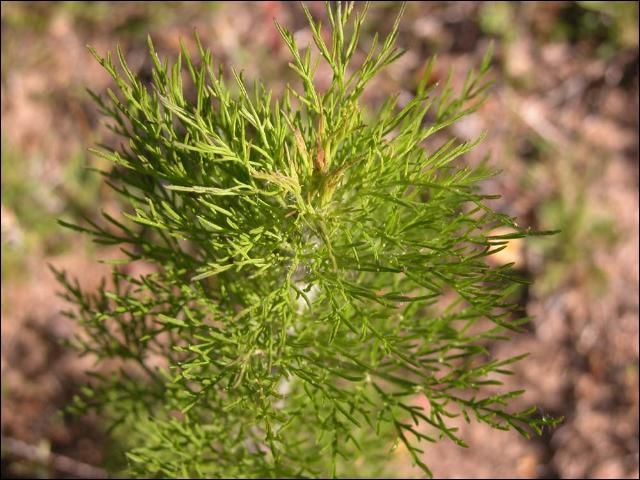
Credit: Jason Ferrell, UF/IFAS
Seeds are surrounded with hairs (similar to dandelion), allowing effective dispersal by wind. Therefore, bare areas in pastures are ideal environments for windblown seed to become established.
In addition to growth from seed, dogfennel can spread from underground rootstocks. These rootstocks arise from the main taproot and grow laterally in all directions. This process will result in the production of distinct plant colonies in only three years.
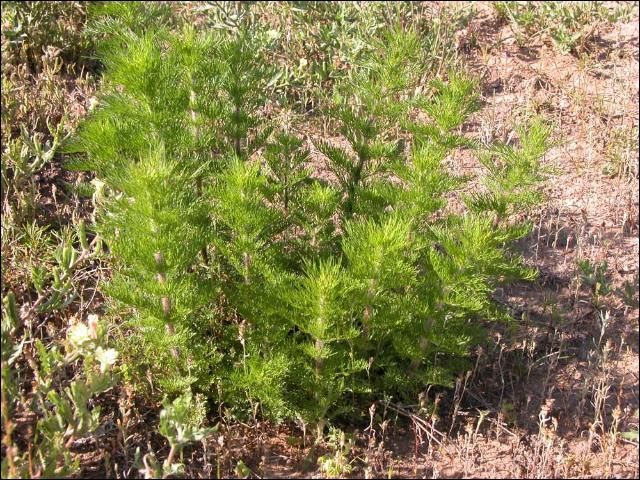
Credit: Jason Ferrell, UF/IFAS
Herbicide Timing and Selection
Although we have a fairly thorough understanding of dogfennel biology, there is no specific month when an herbicide application for dogfennel control is recommended. Rather, it is much more important to select an herbicide program based on dogfennel height (Table 2). Smaller plants are much easier to control than larger ones. In fact, dogfennel less than 20 inches in height is readily controlled with 2 qt/A 2,4-D amine or 1.5 qt/A WeedMaster (dicamba + 2,4-D amine, others). Control with these herbicides tends to decline as dogfennel plants grow above 20 inches. However, it is not uncommon to reach levels of 80%–85% control with these herbicides when plants are between 20 and 36 inches tall. Above 36 inches, the level of control is dramatically reduced and a more rigorous herbicide program is recommended.
There are several options for controlling large dogfennel (Table 2). When choosing an herbicide program, we need to consider the weed spectrum within a given pasture as well as the forage grass present. If dogfennel is the primary target weed in the pasture, Pasturegard HL at 1.5 pt/A is an extremely effective option regardless of the plant's size at the time of application. However, if other weeds such as tropical soda apple are present, we recommend applying GrazonNext HL at 1.5 pt/A in combination with 1) Pasturegard HL at 0.5 pt/A, 2) 2,4-D amine at 3 pt/A, or 3) 2,4-D + dicamba at 2 pt/A. All of these herbicide combinations can be safely applied with minimal injury to forages in Florida. The only exception is that products containing 2,4-D should not be applied to limpograss (Hemarthria) between May 1 and November 1, as severe injury may occur. For more information concerning weed management in limpograss, please refer to the EDIS publication Weed Management in Limpograss (https://edis.ifas.ufl.edu/ag344).
In addition to dogfennel height, there are environmental factors to consider. The driest time of year, especially in South Florida, is April and May when most dogfennel is relatively small. Even though small dogfennel is typically the easiest to control, herbicide effectiveness can be severely impacted by drought conditions as plants tend to "harden-off" to limit water loss. In most cases, as long as the plant is not wilting during the day, the herbicides listed in Table 2 will provide effective control. However, it is important that application rates are not reduced. We have seen 2,4-D amine and 2,4-D amine + dicamba fail to effectively control dogfennel under dry soil conditions on several occasions.
Dogfennel Infestation and Forage Production
There is no doubt that weed infestations have a detrimental impact on bahiagrass production. Until recently, however, the extent of the impact was not known. In an experiment conducted in 2007 and 2008, season-long production of bahiagrass was measured in response to the timing of dogfennel removal at increasing dogfennel densities.
The data indicate that a pasture with > 50% infestation will yield 42%–74% less bahiagrass than a dogfennel-free pasture, if dogfennel removal is performed in May. Waiting until August to remove dogfennel from pastures with > 50% infestation resulted in a more than 75% loss in bahiagrass yield. As such, we recommend that dogfennel be controlled as early as possible if more than half the pasture is infested.
Experimental pastures with < 25% dogfennel cover had relatively consistent bahiagrass yields as the growing season progressed. Even though the bahiagrass yield was lower than the plots without dogfennel, it appears that bahiagrass is somewhat tolerant of light dogfennel infestations. The same does not hold true for higher levels of dogfennel infestations. Bahiagrass yield declined as the growing season progressed in both 50% dogfennel cover plots as well as > 75% dogfennel cover plots.
From this research we concluded that when pastures are infested with < 25% dogfennel cover, herbicide applications may be delayed for almost a whole growing season, especially if dogfennel plants have become so large that more expensive herbicide mixes are needed for optimum control. Conversely, at dogfennel cover > 50%, dogfennel should be controlled as early as possible to prevent substantial yield loss and potential stand reductions.
Dogfennel is an important pest that is more destructive to bahiagrass pastures than may be realized. We believe it is important to focus on this weed and remove it as infestations increase beyond 25% groundcover. Unfortunately, providing a "one size fits all" recommendation for dogfennel control is difficult, if not impossible. Each pasture is going to require some thought with regard to herbicide selection and application timing based on both the environment and dogfennel density. We recommend you review the information in this article, along with the following EDIS articles:
-
Tank-Mix Options for Control of Tropical Soda Apple and Dogfennel (https://edis.ifas.ufl.edu/ag306)
-
Weed Management in Pastures and Rangeland (https://edis.ifas.ufl.edu/wg006).
If you need assistance with your particular situation, please contact your local UF/IFAS Extension agent.