
There are numerous Rubus (blackberry and dewberry) species in the southeastern United States, several of which occur in Florida. Blackberry is commonly found in fencerows, ditch banks, and pastures, and can be overlooked for extended periods of time. This lack of management can give rise to dense, difficult-to-control thickets. This document provides information regarding blackberry and dewberry management in pastures to Extension agents and clientele.
Blackberry and dewberry are often viewed as nuisance weeds that reduce grazing in a portion of the pasture. However, severe financial losses can occur if these growing thickets injure cattle. For example, blackberry or dewberry thorns can severely damage a bull's reproductive organs. Lesions or scratches may result in infection or complete loss of reproductive performance. Lactating beef and dairy cows can also be negatively affected. Thorns can scratch and cause infections of the udder, which may result in lower milk production.
Identification
It is difficult to distinguish between individual dewberry and blackberry species. However, the overall plant appearance and growth habit of dewberry species are quite different from blackberry species. Dewberry species have a low, vine-like growth habit and rarely reach heights greater than 2 feet (Figure 1). Blackberry species have an upright growth pattern that commonly reaches 3–6 feet in height (Figure 2). Dewberry commonly has slender thorns with red hairs on the stem (Figure 3), while blackberry has hard, tough thorns and no hairs. Additionally, dewberry seeds are much larger and tougher than blackberry seeds. For purposes of this document, identification of individual dewberry or blackberry species is not necessary because individual species of dewberry and blackberry can be managed in the same way. There are typically few differences in control of different blackberry species.
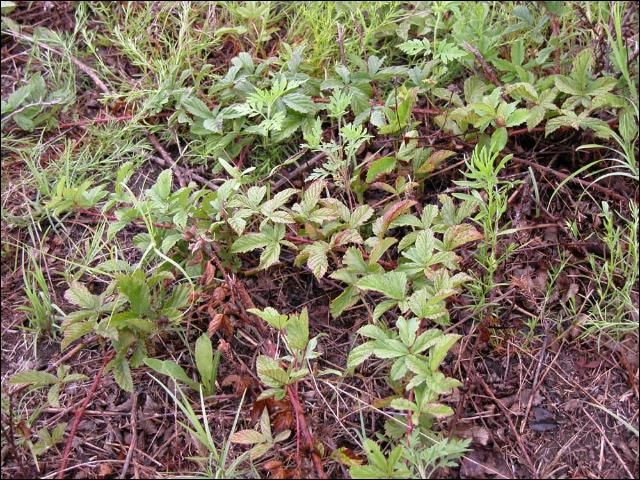
Credit: J. Ferrell, UF/IFAS
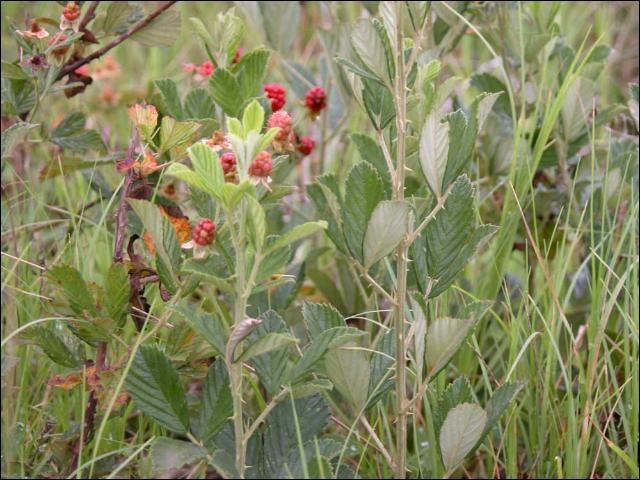
Credit: J. Ferrell, UF/IFAS
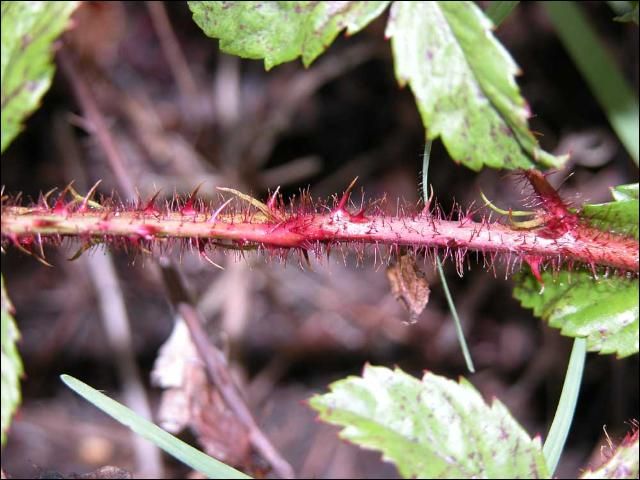
Credit: J. Ferrell, UF/IFAS
Biology
Blackberry and dewberry plants are considered perennial, thicket-forming shrubs. Each species has a large, lateral-growing root system that sprouts and produces additional plants. The rhizomatous root system is perennial, while the aboveground canes are biennial (living for two years). During the first year, the canes emerge and grow rapidly. The canes bud and produce flowers and fruit in the second year. Dewberry stems (canes) can also root where they come in contact with the soil. The canes die after fruiting.
Control
Herbicide application timing is important for effective blackberry control. Blackberry is most sensitive to herbicides when blooming in late spring and in the fall prior to frost. Applications made soon after emergence from winter dormancy or during fruiting are generally less effective. Make sure that the plants are not drought-stressed at the time of herbicide application. A fall application may be more beneficial in most of Florida.
Mowing is an effective practice if the goal is to keep blackberry at a manageable height until herbicide treatment becomes necessary. However, mowing alone is often ineffective. The large underground root structures are difficult to kill with mowing, and sprouting of cut stems is common. Additionally, blackberry propagates from both seed and rhizomes. Therefore, mowing at bloom reduces seed production, but does little to stop the spread of blackberry rhizomes.
However, mowing can be effective when combined with herbicides. Large, dense thickets often have many dead canes with no leaves or two-year-old canes with old leaves. Old leaves do not absorb herbicide sprays as effectively as new foliage and are not as susceptible to herbicide applications. Additionally, dead canes can intercept the spray and decrease herbicide contact with susceptible foliage. Mowing reduces the height of the thicket and makes herbicide application easier.
A frequent issue that arises is how to effectively integrate mowing with chemical control methods. Herbicide application and mowing should not occur during the same growing season. Applying herbicides soon after mowing often leads to ineffective or inconsistent control. The most effective strategy is mowing followed by six months of active blackberry regrowth before herbicide treatment. For example, in north Florida, if mowing takes place in October, it is often best to delay herbicide application until the following August because blackberry does not actively grow from November to February.
It may be necessary to mow the dead blackberry plants to improve grazing in the treated area. However, it is best to allow the herbicide to work for approximately six weeks before mowing and removing the dead canes. This allows the herbicide sufficient time to act before the treated plants are destroyed.
Herbicides
Currently, several herbicides list blackberry on their label (Table 1). The most effective herbicides are metsulfuron, triclopyr ester (Remedy Ultra, others), PastureGard HL, and Telar. Velpar, Weedmaster, and 2,4-D are not recommended because individual plants rarely die and thicket density will not be reduced.
PastureGard HL (triclopyr + fluroxypyr) and triclopyr ester (Remedy Ultra, others) can safely be applied to bermudagrass and bahiagrass. Triclopyr ester or PastureGard HL at 2 pt/A applied during blooming is effective, but retreatment may be required the following year to achieve 100% control. These herbicides cause rapid blackberry defoliation (relative to metsulfuron and Telar, which are more slow-acting) while controlling many other broadleaf species. Triclopyr ester will not control dewberry. PastureGard HL applied at 2 pt/A is more effective on dewberry, but only fair control (60% or 70%) should be expected. PastureGard HL and triclopyr ester can be effective when applied in the spring or fall. However, fall applications are generally more effective than spring applications.
Metsulfuron-containing products are the most consistent herbicides for control of blackberry. They can be used on bermudagrass, stargrass, and limpograss. Applications of metsulfuron made in spring or fall have proven equally effective. However, activity is slow and may take two or three months to show significant control. Metsulfuron should only be applied to blackberry in bahiagrass when injury to bahiagrass is not a concern. Tank-mixing 2,4-D at 1 pt/A with products containing metsulfuron will reduce the injury observed compared to applying metsulfuron alone.
Telar (chlorsulfuron) is closely related to metsulfuron, but can safely be applied to bermudagrass and bahiagrass. Telar at 1 oz/A is effective on blackberry, but will not likely control other common pasture weeds.
Summary
Complete blackberry and dewberry eradication is difficult. It will likely require multiple herbicide applications and/or tactics. When relying solely on herbicides to control these species, it is best to spray during blooming or in the fall prior to frost; if pollinators are a concern in your area, it may be best to delay application to the fall. If you use a mowing strategy, make sure at least six months of active regrowth occur prior to herbicide application. At least six weeks should pass after herbicide application before removing dead canes.