
Introduction
Giant reed (Arundo donax L.) (Figure 1) is a tall perennial grass native to Asia and widespread throughout the Mediterranean region. It has been cultivated for use as building material, erosion control, and windbreak throughout the Middle East and Mediterranean region for thousands of years, and is currently widespread in southern Europe, Northern Africa, the Middle East, Australia, South America, and North America. The majority of commercially produced giant reed is grown in the Mediterranean to make reeds for musical instruments.
In the 1820s, it was introduced in California for erosion control, but has since escaped and become a major invasive weed problem in California and Texas watersheds. Giant reed can be found throughout the southern United States and as far north as Maryland, but the date and location of its initial introduction in the eastern United States is unknown.
With renewed interest in bioenergy production in the United States and throughout the world, giant reed is receiving considerable attention because of its ability to quickly accumulate high amounts of biomass. In Florida, mineral soils in the southern part of the state, which are also used for sugarcane production, have been proposed for potential giant reed production. However, giant reed has been reported as having a high invasive potential in Florida based on the widespread distribution of its propagules and inherent weedy characteristics. Although giant reed has been present in parts of Florida for many years, it has not become a problem species in south Florida where it is nonnative. However, because of giant reed's growth characteristics, competitive ability, and potential risk of future invasions, it should be monitored closely if introduced as a bioenergy crop.
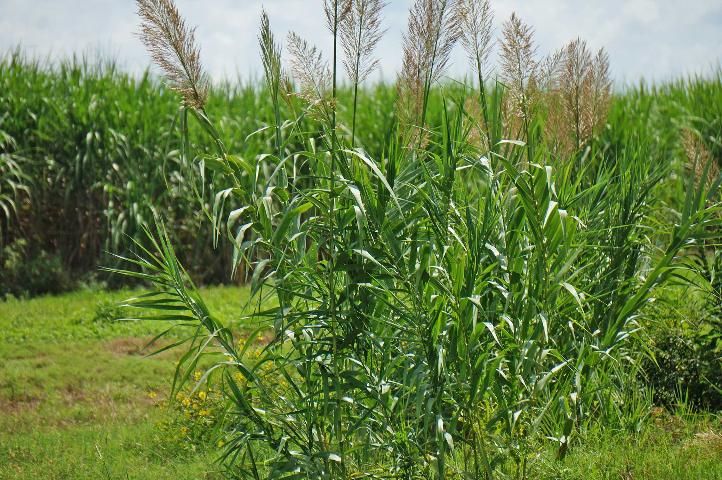
Credit: Calvin Odero, UF/IFAS
Biology and Identification
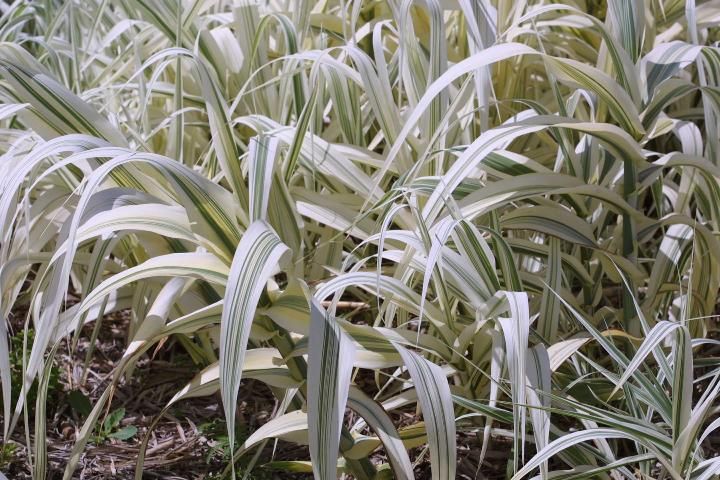
Giant reed is a large, clumping, perennial grass with hollow stems that are 1/4 to 2 inches thick (Figure 2). The stems have a cane-like (Figure 3) appearance that is similar to bamboo. Mature stands are typically 12 to 16 feet in height, but stands over 20 feet high have been reported. Leaves typically have a stiff or erect habit, are alternate, and, at maturity, are about 2 inches wide and 24 to 36 inches long. Leaves have smooth surfaces, are rounded at the base, and taper to a long point (Figure 4). The ligules are large and papery with small hairs along the margin. Leaf color is typically blue-green, but in some clones the immature leaves range from variegated to almost complete white (Figure 5). The underground portion of giant reed consists of an extensive network of rhizomes and fibrous tap roots. Rhizomes and root masses are light brown in color (Figure 6). The inflorescence is an erect feathery spike 1 to 2 feet long ranging from whitish to brown in color depending on maturity (Figure 7). Spikelets are stalked and solitary and the flowers have long silky awns. Although giant reed can produce seed under some conditions, there is no evidence that the seeds are viable. Consequently, reproduction is strictly from stalk and rhizome pieces. Giant reed can grow from rhizome fragments as small as 1 inch.
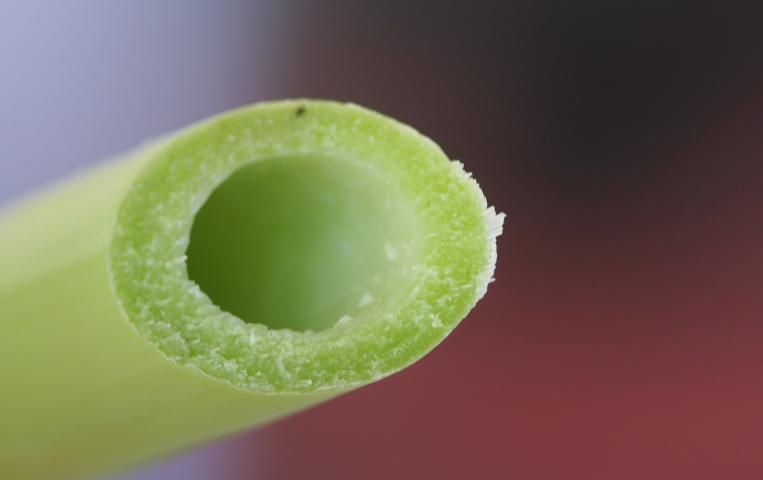
Credit: Calvin Odero, UF/IFAS
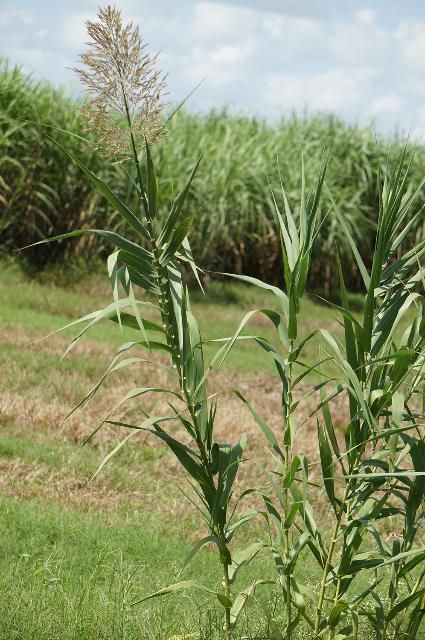
Credit: Calvin Odero, UF/IFAS
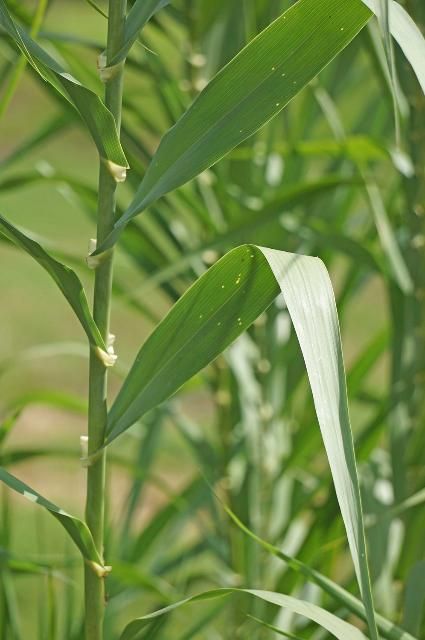
Credit: Calvin Odero, UF/IFAS
Credit: Calvin Odero, UF/IFAS
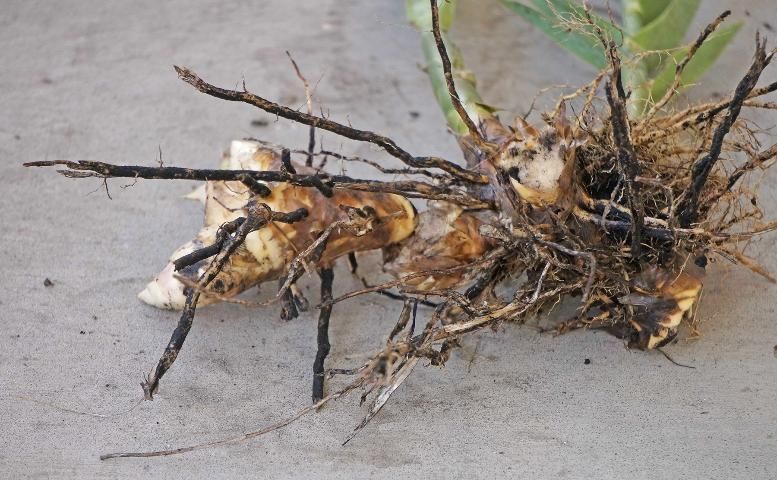
Credit: Calvin Odero, UF/IFAS
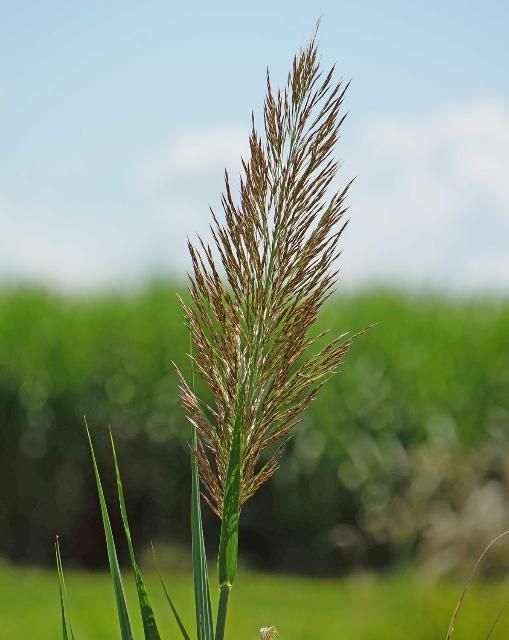
Credit: Calvin Odero, UF/IFAS
Common reed (Phragmites australis) (Figure 8) may be mistaken for giant reed but is typically smaller in stature and has a looser silvery-tan inflorescence.
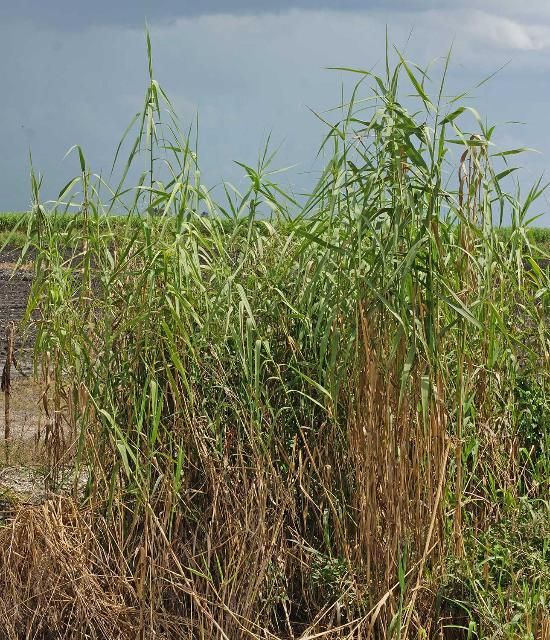
Credit: Calvin Odero, UF/IFAS
Giant reed prefers wet conditions but can be found in areas ranging from moist, well-drained soils to areas with a water table near the surface. It is also commonly found along roadsides and stream banks. Once established in wetland and riparian habitats, giant reed produces monotypic stands that displace native species. Dead and dry stands can pose a fire hazard. Giant reed also interferes with rivers and lakes by increasing sedimentation and narrowing water channels, which leads to flooding and erosion.
Management
Giant reed growth can be greatly suppressed by repeated close mowing. To prevent regrowth, mown plant material should be removed from the site. Repeated tillage can also be used to deplete root and rhizome masses, but care should be taken to avoid spreading rhizomes to uninfested areas. The key to eradicating established populations of giant reed is killing the root and rhizome mass. This requires treating the plant with a systemic herbicide at appropriate times of the year to ensure translocation to the roots and rhizomes. Glyphosate (2 to 5% solution) applied to leaves after the crop has flowered has been effective in California. Additionally, applications of imazapyr (Arsenal, and others) at 2% or imazapyr 0.5% + glyphosate at 2% may also be effective. Regardless of which herbicide is used, repeat applications will likely be necessary. Cut-stem treatments can be effective if glyphosate is applied within minutes of cutting the stem. When controlling giant reed with herbicides in aquatic areas, make sure that the product is registered for this use. In the sugarcane production region of south Florida, where giant reed has a high invasive potential, currently labeled sugarcane grass herbicides (asulam and trifloxysulfuron) will not provide complete control of potential escapes in the crop. This indicates that selective control and containment of established or aggressively spreading giant reed with currently available sugarcane grass herbicides will not be an option.
Bibliography
Bell, G. P. 1997. "Ecology and Management of Arundo donax, and approaches to riparian habitat restoration in Southern California." In Plant Invasions: Studies from North America and Europe, edited by J. H. Brock, M. Wade, P. Pysek and D. Green, 103–113. Netherlands: Backhuys Publishers.
Benton, N., G. Bell, and J. M. Swearingen. 2005. "Fact Sheet: Giant Reed." Plant Conservation Alliance's Alien Plant Working Group. Accessed September 15, 2018. https://www.invasive.org/alien/fact/pdf/ardo1.pdf.
Boose, A. B., and J. S. Holt. 1999. "Environmental effects on asexual reproduction in Arundo donax." Weed Research 39: 117–127.
Christou, M. "Giant reed in Europe." In Volume II 1st World Conference on Biomass for Energy and Industry, Proceedings of the Conference held in Sevilla, Spain, 5–9 June 2000, edited by S. Kyritsis, A. A. C. M. Beenackers, P. Helm, A. Grassi, and D. Chiaramonti, 2089–2091. London, UK: James & James (Science Publishers) Ltd, 2001.
Else, J. A. 1996. "Post flood establishment of native woody species and an exotic, Arundo donax, in a Southern Californian riparian system." MS Thesis, 73 p. San Diego, CA: San Diego State University.
Global Invasive Species Database. 2015. "Species profile Arundo donax." Global Invasive Species Database. Accessed September 15, 2018. http://www.iucngisd.org/gisd/species.php?sc=112.
Gordon, D. R., K. J. Tancig, D. A. Onderdonk and C. A. Gantz. 2011. "Assessing the invasive potential of biofuel species proposed for Florida and the United States using the Australian Weed Risk Assessment." Biomass Bioenergy 35: 74–79.
Marianil, C., R. Cabrinil, and A. Danin. 2010. "Origin, diffusion, and reproduction of the giant reed (Arundo donax L.): a promising weedy energy crop." Annals of Applied Biology 157: 191–202.
Odero, D. C. and R. A. Gilbert. 2012. "Response of giant reed (Arundo donax) to asulam and trifloxysulfuron." Weed Technology 26: 71–76.