University of FloridaSolutions for Your Life

Download PDF 
Publication #SS AGR 314

Florida Pusley Control in Pastures1

Brandon Fast, Jason Ferrell, and Brent Sellers2

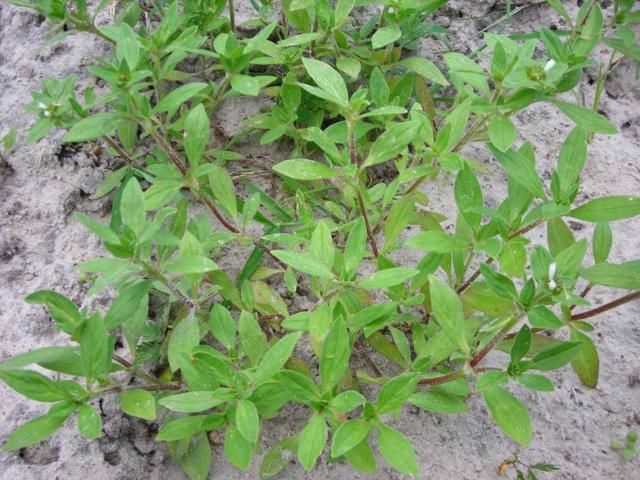
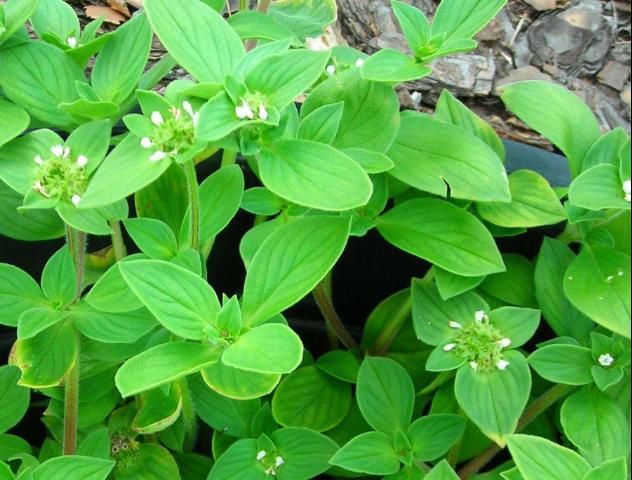
Florida pusley (Richardia scabra L.) is a common and troublesome weed found in pastures, cultivated fields, waste areas, and roadsides throughout Florida. Plants grow prostrate (creeping along the ground) and have hairy stems that grow to lengths of up to 30 inches (Figures 1 and 2). Leaves are thick and fleshy and often have a rough upper and lower surface. Small white flowers that form a cluster at the ends of stems are characteristic of this weed (Figure 3).
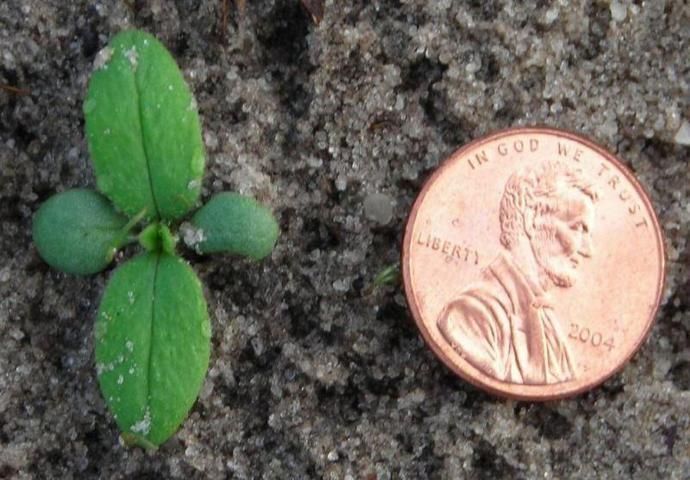
Figure 1. 

Seedling Florida pusley.

Florida pusley grows low to the ground and rarely infests fields with good grass cover. However, Florida pusley can become a prevalent weed in open areas during grass establishment or in areas where grass has died. The dense, mat-like nature of this weed makes it difficult for desirable grasses to grow in its presence.

Figure 2. 

Mature Florida pusley in vegetative stage.

After Florida pusley has become well established, it can be difficult to control with common pasture herbicides, such as 2,4-D. Several new herbicides have recently been developed for pasture use, but their efficacy on Florida pusley is not known.

Figure 3. 

Mature Florida pusley in flowering stage.

Research was conducted to determine the efficacy of several commonly used pasture herbicides on Florida pusley plants that were approximately four inches in size when herbicides were applied. Table 1 details Florida pusley control two, four, and eight weeks after treatment (WAT), as well as the approximate costs of treatments.

Forefront, Forefront used in combination with Cleanwave, and Forefront used in combination with Pasturegard provided excellent Florida pusley control (90% or greater). It should be noted, however, that Forefront is a relatively slow -acting herbicide and often requires up to four weeks for significant weed control to occur. Control provided by Pasturegard was fair (84% at eight WAT), and control provided by Cleanwave (18% at eight WAT) and Weedmaster (70% at eight WAT) was much lower.

As mentioned above, control of Florida pusley becomes more difficult as the plant matures. Therefore, if applications are to be made to plants larger than four inches, it is likely that Pasturegard and Weedmaster will not provide acceptable levels of control. For larger plants, Forefront used in combination with Cleanwave or Pasturegard will most likely be necessary.

Tables

Table 1. 

Control of Florida pusley with pasture herbicides

Herbicide1

Rate

2WAT2

4WAT

8WAT

Dollars/ac3

Florida pusley control (%)

Cleanwave

14 fl oz / ac

14

28

18

7

Weedmaster

3 pt / ac

56

75

70

11

Pasturegard

3 pt / ac

48

81

84

21

Forefront

2 pt / ac

55

90

90

14

Forefront + Cleanwave

2 pt /ac

14 fl oz / ac

73

96

99

21

Forefront + Pasturegard

2 pt / ac

1 pt / ac

90

100

100

21

1 All treatments included 0.25% v/v non-ionic surfactant.

2 Control data collected 2 weeks after treatment (WAT).

3 Approximate costs of herbicides are from EDIS Publication SSAGR16, Approximate Herbicide Pricing-2008, http://edis.ifas.ufl.edu/wg056, and do not include the costs of surfactant and application.

Footnotes

1.

This document is SS AGR 314, one of a series of the Agronomy Department, Florida Cooperative Extension Service, Institute of Food and Agricultural Sciences, University of Florida. Original publication date, November 2008. Visit the EDIS Web site at http://edis.ifas.ufl.edu.

2.

Brandon Fast, graduate student assistant; Jason Ferrell, assistant professor; and Brent Sellers, assistant professor, Agronomy Department, Range Cattle Research and Education Center, Ona, FL, Institute of Food and Agricultural Sciences, University of Florida, Gainesville, FL.


The Institute of Food and Agricultural Sciences (IFAS) is an Equal Opportunity Institution authorized to provide research, educational information and other services only to individuals and institutions that function with non-discrimination with respect to race, creed, color, religion, age, disability, sex, sexual orientation, marital status, national origin, political opinions or affiliations. For more information on obtaining other extension publications, contact your county Cooperative Extension service.

U.S. Department of Agriculture, Cooperative Extension Service, University of Florida, IFAS, Florida A. & M. University Cooperative Extension Program, and Boards of County Commissioners Cooperating. Millie Ferrer-Chancy, Interim Dean.